Advertisements
Advertisements
Question
In figure given below, the pie-charts show the contribution of each sector in the respective country’s GDP and the percentage of population engaged in various activities. Read both the pie-charts carefully and answer the following questions.
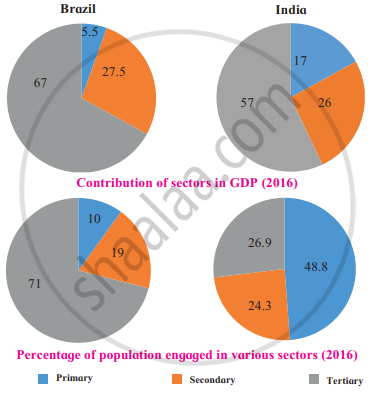
- Which country has a higher percentage of population engaged in primary activities?
- In which country is the contribution of tertiary sector greater in the GDP?
- In which country is the share of secondary activities more in the GDP?
- Can we say that Brazil is an agrarian economy like India? Give reasons.
Advertisements
Solution
- India has a higher percentage of population engaged in primary activities (48.8%).
- The contribution of tertiary sector is greater in Brazil’s GDP (67%).
- The contribution of secondary activities is more in Brazil’s GDP (27.5%).
- Brazil is not an agrarian economy like India. This is because 71% of its population is engaged in the tertiary sector and it contributes 67% in GDP.
APPEARS IN
RELATED QUESTIONS
Brazil’s economy is also of ---------------- type like that of India.
Between India and Brazil, whose per capita income is less?
B) Read the following graph and answer the questions :
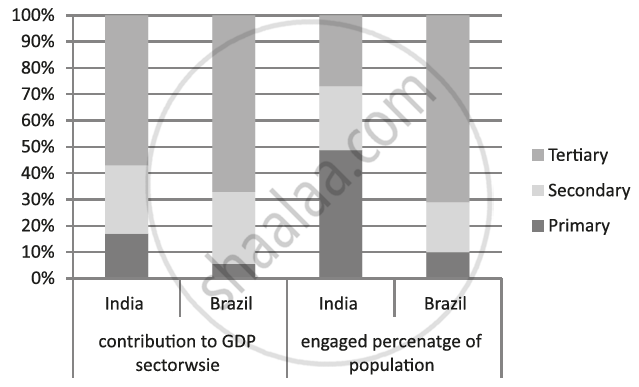
i) In which country is the contribution of tertiary sector higher ?
ii) In India, most people are engaged in which occupational sector?
iii) Which country has only 10% of the population engaged in primary sector?
iv) How much does tertiary sector contribute to the national income of India?
v) Which sector contributes the least in the Brazilian national income?
vi) What is the percentage of people engaged in the secondary sector in Brazil?
Mark the following in the outline map of Brazil supplied to you, write the names and give index

- Marajó Island
- Pico-De-Neblina
- Pantanal Wetland
- Drought Quadrilateral
- Caatinga
- Golden Lion-Tamarin
Mark the following in the outline map of Brazil supplied to you, write the names and give index:
(1) Marajo Island
(2) Pico-De-Neblina
(3) Pantanal Wetland
(4) Drought Quadrilateral
(5) Caatinga
(6) Golden Lion-Tamarin
India’s per capita income is less than Brazil due to ______.
The economy of Brazil is mainly dependent on the ______ activities there.
Give geographical reasons.
Per capita land availability is more in Brazil as compared to India.
State whether right or wrong-
Per capita income of India is less than Brazil.
India and Brazil are progressing in the fields of ______ education and industry.
