Advertisements
Advertisements
Question
The economies of India and Brazil are of the ______ type.
Options
Undeveloped
Developed
Developing
Highly developed
Advertisements
Solution
The economies of India and Brazil are of the developing type.
Explanation:
These countries are progressing in the field of technological advancement, education and industry. For being a developed country, per capita income, living standard, income inequality has to be comparable with the top-performing economies in the world.
APPEARS IN
RELATED QUESTIONS
Select the correct option and rewrite the sentence:
------------ is seen as one of the world’s major markets and contributor to economic growth of the world.
B) Read the following graph and answer the questions :
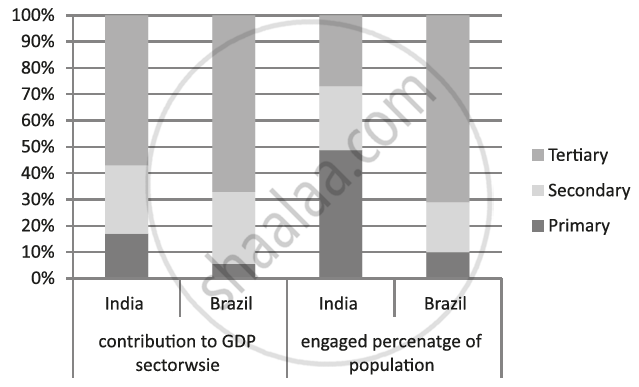
i) In which country is the contribution of tertiary sector higher ?
ii) In India, most people are engaged in which occupational sector?
iii) Which country has only 10% of the population engaged in primary sector?
iv) How much does tertiary sector contribute to the national income of India?
v) Which sector contributes the least in the Brazilian national income?
vi) What is the percentage of people engaged in the secondary sector in Brazil?
State whether the sentence is right or wrong and correct the wrong ones and rewrite the sentence
Like the Indian economy, the Brazilian economy is also of mixed type.
Mark the following in the outline map of Brazil supplied to you, write the names and give index

- Marajó Island
- Pico-De-Neblina
- Pantanal Wetland
- Drought Quadrilateral
- Caatinga
- Golden Lion-Tamarin
India’s per capita income is less than Brazil due to ______.
Read the following graph and answer the questions:
Gross National Incomes (GNI) from 1960 to 2016 (in million US $)
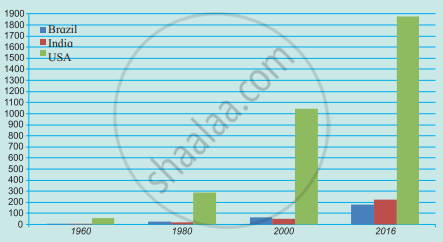
- Which country’s national income was highest in 2016 and was it how much?
- Comparing India and Brazil, which country had a higher national income in 1980?
- Comparing India and Brazil, which country had a higher income in 2016?
- Tell the difference between the GNP of Brazil and India in 2016.
- Calculate the difference between the national incomes of developed and developing countries in 2016.
Which type of occupations gives a boost to the development of a country’s economy?
State whether right or wrong-
Per capita income of India is less than Brazil.
Observe the following graph and answer the questions given below-

- Which country has a higher percent of the population engaged in primary activities?
- In which country is the contribution of tertiary sector greater in the GDP?
- In which country is the share of secondary activities more in the GDP?
- Can we say that Brazil is an agrarian economy like India? Give reasons.
- Which country has a higher percent of the population engaged in secondary activities?
- How much percent of population is engaged in tertiary activities in India?
Read the following graph and answer the questions:
India and Brazil
Contribution of sectors in national income and percentage of population engaged in the sector.

Questions:
- Name the sectors mentioned in the graph.
- Which sector contributes the highest in National income in India?
- How much percent of population is engaged in primary sector in Brazil?
- Out of given two countries, the share of primary sector to the national income is less.
- Which country's contribution of tertiary sector to the national income is less?
- In which sector 19% population of Brazil is engaged?
