Advertisements
Advertisements
Question
Which type of occupations gives a boost to the development of a country’s economy?
Advertisements
Solution
- Economic development occurs when the national income and per capita income of the country rise. The rise in Gross Domestic Product (GDP) is due to the increasing economic activities. But a boost in the national income would be with the improvement of the secondary and tertiary sector.
- The history of all the developed countries shows that their development is by the improvement of both the secondary and the tertiary sector.
- The primary sector will contribute to the development of the country only in the initial stages. Only with the transition to the secondary sectors like manufacturing and the service sector can the economy achieve growth.
- To achieve economic development, the economy would have to provide basic necessities to the people and improve their standard of living.
RELATED QUESTIONS
Brazil’s economy is also of ---------------- type like that of India.
B) Read the following graph and answer the questions :
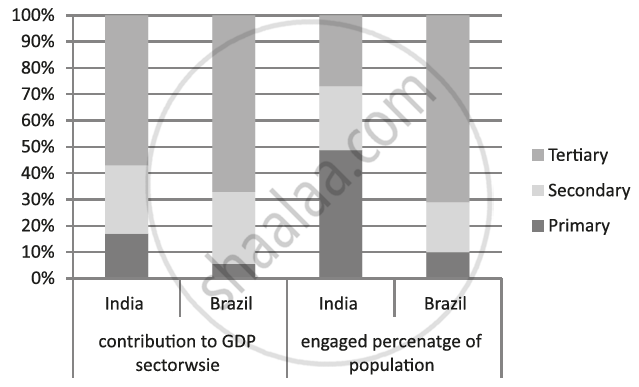
i) In which country is the contribution of tertiary sector higher ?
ii) In India, most people are engaged in which occupational sector?
iii) Which country has only 10% of the population engaged in primary sector?
iv) How much does tertiary sector contribute to the national income of India?
v) Which sector contributes the least in the Brazilian national income?
vi) What is the percentage of people engaged in the secondary sector in Brazil?
Mark the following in the outline map of Brazil supplied to you, write the names and give index

- Marajó Island
- Pico-De-Neblina
- Pantanal Wetland
- Drought Quadrilateral
- Caatinga
- Golden Lion-Tamarin
Mark the following in the outline map of Brazil supplied to you, write the names and give index:
(1) Marajo Island
(2) Pico-De-Neblina
(3) Pantanal Wetland
(4) Drought Quadrilateral
(5) Caatinga
(6) Golden Lion-Tamarin
India’s per capita income is less than Brazil due to ______.
Give geographical reasons.
Per capita land availability is more in Brazil as compared to India.
Classify the following activities in by ticking (✓) in the respective column.
| Activities | Primary | Secondary | Tertiary |
| Television Broadcasting | |||
| Bee-keeping | |||
| Coir and Rope making | |||
| Jaggery-making | |||
| Producing blades of the plough. |
|||
| Construction | |||
| Extracting Iron Ore | |||
| Automobile Production | |||
| Rice Production | |||
| Teaching | |||
| Driving buses | |||
| Providing lodging and boarding facilities |
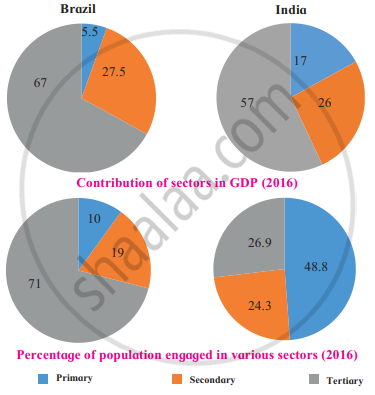
With the help of the pie chart given in the fig., tell what the contribution of secondary activities is to Brazil’s GDP?
Distinguish Between:
Occupations in India and Brazil.
India and Brazil are progressing in the fields of ______ education and industry.
