Advertisements
Advertisements
Question
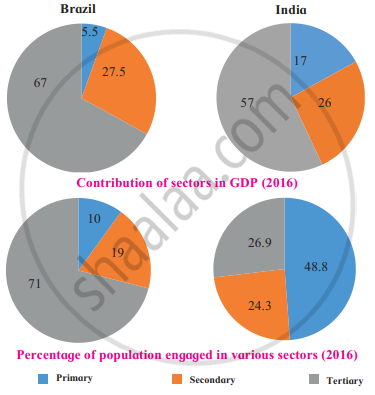
With the help of the pie chart given in the fig., tell what the contribution of secondary activities is to Brazil’s GDP?
Advertisements
Solution
National income is the money value of all the final goods and services produced within the domestic territory of the country during a particular period of time, generally within a year. A boost in the national income would be with the improvement of the secondary and tertiary sectors. The history of all the developed countries shows that their development is by the improvement of both the secondary and the tertiary sectors. The manufacturing industry in Brazil is contributing nearly 27.5% to the GDP.
RELATED QUESTIONS
Between India and Brazil, whose per capita income is less?
State whether the sentence is right or wrong and correct the wrong ones and rewrite the sentence
Like the Indian economy, the Brazilian economy is also of mixed type.
Mark the following in the outline map of Brazil supplied to you, write the names and give index

- Marajó Island
- Pico-De-Neblina
- Pantanal Wetland
- Drought Quadrilateral
- Caatinga
- Golden Lion-Tamarin
Mark the following in the outline map of Brazil supplied to you, write the names and give index:
(1) Marajo Island
(2) Pico-De-Neblina
(3) Pantanal Wetland
(4) Drought Quadrilateral
(5) Caatinga
(6) Golden Lion-Tamarin
Give geographical reasons.
Per capita land availability is more in Brazil as compared to India.
Give reasons.
There is mixed economy in Brazil and India.
Read the following graph and answer the questions:
Gross National Incomes (GNI) from 1960 to 2016 (in million US $)
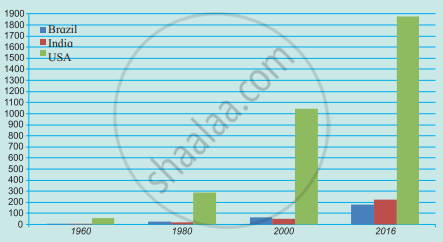
- Which country’s national income was highest in 2016 and was it how much?
- Comparing India and Brazil, which country had a higher national income in 1980?
- Comparing India and Brazil, which country had a higher income in 2016?
- Tell the difference between the GNP of Brazil and India in 2016.
- Calculate the difference between the national incomes of developed and developing countries in 2016.
Distinguish Between:
Occupations in India and Brazil.
India and Brazil are progressing in the fields of ______ education and industry.
Read the following graph and answer the questions:
India and Brazil Contribution of sectors in national income and percentage of population engaged in the sector.

- Name the sectors mentioned in the graph.
- Which sector contributes the highest in National income in India?
- How much percent of population is engaged in primary sector in Brasil?
