Advertisements
Advertisements
प्रश्न
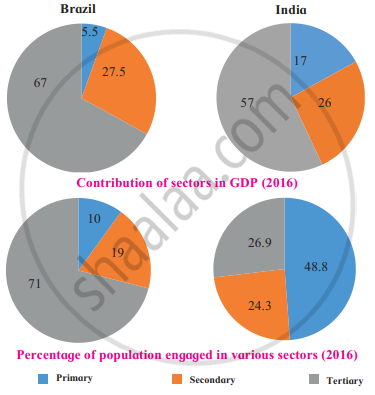
With the help of the pie chart given in the fig., tell what the contribution of secondary activities is to Brazil’s GDP?
Advertisements
उत्तर
National income is the money value of all the final goods and services produced within the domestic territory of the country during a particular period of time, generally within a year. A boost in the national income would be with the improvement of the secondary and tertiary sectors. The history of all the developed countries shows that their development is by the improvement of both the secondary and the tertiary sectors. The manufacturing industry in Brazil is contributing nearly 27.5% to the GDP.
संबंधित प्रश्न
Select the correct option and rewrite the sentence:
------------ is seen as one of the world’s major markets and contributor to economic growth of the world.
Brazil’s economy is also of ---------------- type like that of India.
B) Read the following graph and answer the questions :
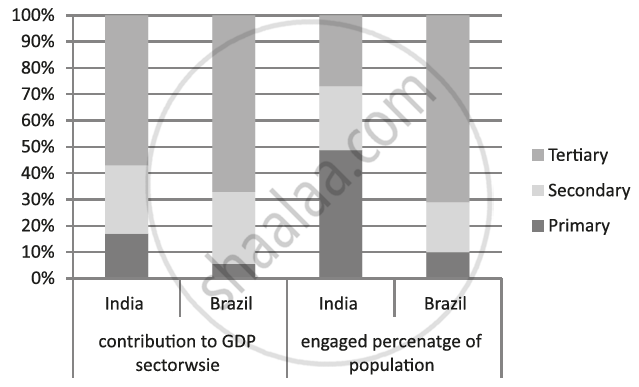
i) In which country is the contribution of tertiary sector higher ?
ii) In India, most people are engaged in which occupational sector?
iii) Which country has only 10% of the population engaged in primary sector?
iv) How much does tertiary sector contribute to the national income of India?
v) Which sector contributes the least in the Brazilian national income?
vi) What is the percentage of people engaged in the secondary sector in Brazil?
State whether the sentence is right or wrong and correct the wrong ones and rewrite the sentence
Like the Indian economy, the Brazilian economy is also of mixed type.
The economy of Brazil is mainly dependent on the ______ activities there.
The economies of India and Brazil are of the ______ type.
Give reasons.
There is mixed economy in Brazil and India.
Which type of occupations gives a boost to the development of a country’s economy?
Distinguish Between:
Occupations in India and Brazil.
Read the following graph and answer the questions:
India and Brazil Contribution of sectors in national income and percentage of population engaged in the sector.

- Name the sectors mentioned in the graph.
- Which sector contributes the highest in National income in India?
- How much percent of population is engaged in primary sector in Brasil?
