Advertisements
Advertisements
Question
In Fig. ABCD is a quadrilateral in which AB = BC. E is the point of intersection of the right bisectors of AD and CD. Prove that BE bisects ∠ABC.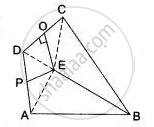
Advertisements
Solution
Given: A quadrilateral ABCD in which AB = BC. PE and QE are right bisectors or AD and CD respectively such that they meet at E.
To prove: BE bisects ∠ABC.
Construction: Join AE, DE and CE.
Proof: Since, PE is the right bisector of AD and E lies on it.
∴ AE = ED ...(i)
[∵ Points on the right bisector of a line segment are equidistant from the ends of the segment]
Also, QE is the right bisector of CD and E lies on it.
∴ ED = EC ...(ii)
From (i) and (ii), we get
AE = EC ...(iii)
Now, in Δs ABE and CBE, we have
AB = BC ...[Given]
BE = BE ...[Common]
and AE = EC ...[From (iii)]
So, by SSS criterion of congruence
ΔABE = ΔACE
⇒ ∠ABE = ∠CBE
⇒ BE bisects ∠ABC.
Hence, BE is the bisector of ∠ABC.
Hence proved.
APPEARS IN
RELATED QUESTIONS
In triangle LMN, bisectors of interior angles at L and N intersect each other at point A. Prove that:
- Point A is equidistant from all the three sides of the triangle.
- AM bisects angle LMN.
Construct a triangle ABC, with AB = 7 cm, BC = 8 cm and ∠ABC = 60°. Locate by construction the point P such that:
- P is equidistant from B and C.
- P is equidistant from AB and BC.
- Measure and record the length of PB.
Describe the locus of a runner, running around a circular track and always keeping a distance of 1.5 m from the inner edge.
Describe the locus of points inside a circle and equidistant from two fixed points on the circumference of the circle.
Describe the locus of points at distances greater than or equal to 35 mm from a given point.
In Δ ABC, the perpendicular bisector of AB and AC meet at 0. Prove that O is equidistant from the three vertices. Also, prove that if M is the mid-point of BC then OM meets BC at right angles.
In a quadrilateral ABCD, if the perpendicular bisectors of AB and AD meet at P, then prove that BP = DP.
Show that the locus of the centres of all circles passing through two given points A and B, is the perpendicular bisector of the line segment AB.
ΔPBC, ΔQBC and ΔRBC are three isosceles triangles on the same base BC. Show that P, Q and R are collinear.
Use ruler and compasses for the following question taking a scale of 10 m = 1 cm. A park in a city is bounded by straight fences AB, BC, CD and DA. Given that AB = 50 m, BC = 63 m, ∠ABC = 75°. D is a point equidistant from the fences AB and BC. If ∠BAD = 90°, construct the outline of the park ABCD. Also locate a point P on the line BD for the flag post which is equidistant from the corners of the park A and B.
