Advertisements
Advertisements
Question
In the given triangle ABC, find a point P equidistant from AB and AC; and also equidistant from B and C.

Advertisements
Solution
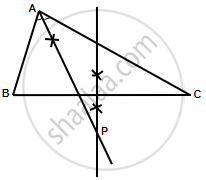
Steps of construction:
- In the given triangle, draw the angle bisector of ∠BAC.
- Draw the perpendicular bisector of BC which intersects the angle bisector at P.
P is the required point which is equidistant from AB and AC as well as from B and C.
Since P lies on angle bisector of ∠BAC,
It is equidistant from AB and AC.
Again, P lies on perpendicular bisector of BC,
Therefore, it is equidistant from B and C.
RELATED QUESTIONS
The bisectors of ∠B and ∠C of a quadrilateral ABCD intersect each other at point P. Show that P is equidistant from the opposite sides AB and CD.
Draw a line AB = 6 cm. Draw the locus of all the points which are equidistant from A and B.
Describe the locus of the moving end of the minute hand of a clock.
Describe the locus of the door handle, as the door opens.
Describe the locus of points inside a circle and equidistant from two fixed points on the circumference of the circle.
Describe the locus of points at distances less than or equal to 2.5 cm from a given point.
Describe the locus of points at distances greater than or equal to 35 mm from a given point.
Find the locus of the centre of a circle of radius r touching externally a circle of radius R.
Show that the locus of the centres of all circles passing through two given points A and B, is the perpendicular bisector of the line segment AB.
ΔPBC, ΔQBC and ΔRBC are three isosceles triangles on the same base BC. Show that P, Q and R are collinear.
