Advertisements
Advertisements
Question
Draw an angle ABC = 75°. Draw the locus of all the points equidistant from AB and BC.
Advertisements
Solution

Steps of construction:
- Draw a ray BC.
- Construct a ray RA making an angle of 75° with BC. Therefore, ABC = ABC = 75°
- Draw the angle bisector BP of ∠ABC.
BP is the required locus. - Take any point D on BP.
- From D, draw DE ⊥ AB and DF ⊥ BC.
Since D lies on the angle bisector BP of ∠ABC.
D is equidistant from AB and BC.
Hence, DE = DF
Similarly, any point on BP is equidistant from AB and BC.
Therefore, BP is the locus of all points which are equidistant from AB and BC.
RELATED QUESTIONS
In each of the given figures; PA = PB and QA = QB.
| i. |  |
| ii. | 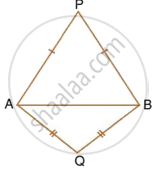 |
Prove, in each case, that PQ (produce, if required) is perpendicular bisector of AB. Hence, state the locus of the points equidistant from two given fixed points.
In parallelogram ABCD, side AB is greater than side BC and P is a point in AC such that PB bisects angle B. Prove that P is equidistant from AB and BC.
Use ruler and compasses only for this question.
- Construct ΔABC, where AB = 3.5 cm, BC = 6 cm and ∠ABC = 60°.
- Construct the locus of points inside the triangle which are equidistant from BA and BC.
- Construct the locus of points inside the triangle which are equidistant from B and C.
- Mark the point P which is equidistant from AB, BC and also equidistant from B and C. Measure and record the length of PB.
In the given triangle ABC, find a point P equidistant from AB and AC; and also equidistant from B and C.

Describe the locus of a runner, running around a circular track and always keeping a distance of 1.5 m from the inner edge.
Sketch and describe the locus of the vertices of all triangles with a given base and a given altitude.
ΔPBC and ΔQBC are two isosceles triangles on the same base. Show that the line PQ is bisector of BC and is perpendicular to BC.
Find the locus of points which are equidistant from three non-collinear points.
Show that the locus of the centres of all circles passing through two given points A and B, is the perpendicular bisector of the line segment AB.
Use ruler and compasses for the following question taking a scale of 10 m = 1 cm. A park in a city is bounded by straight fences AB, BC, CD and DA. Given that AB = 50 m, BC = 63 m, ∠ABC = 75°. D is a point equidistant from the fences AB and BC. If ∠BAD = 90°, construct the outline of the park ABCD. Also locate a point P on the line BD for the flag post which is equidistant from the corners of the park A and B.
