Advertisements
Advertisements
Question
In Δ ABC, the perpendicular bisector of AB and AC meet at 0. Prove that O is equidistant from the three vertices. Also, prove that if M is the mid-point of BC then OM meets BC at right angles.
Advertisements
Solution
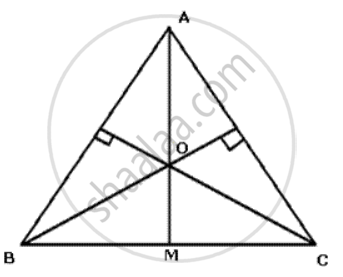
Since O lies on the perpendirular bisector of AB, O is equidistant from A and B.
OA = OB ........ (i)
Again, O lies on the perpendirular bisector of AC, O is equidistant from A and C.
OA = OC ......... (ii)
From (i) and (ii)
OB= OC
Now in Δ OBM and Δ OCM,
OB = OC (proved)
OM=OM
BM =CM ( M is mid-point of BC)
Therefore, Δ OBM and Δ OCM are congruent.
∠ OMB= ∠ OMC
But BMC is a straight line, so
∠ OMB =∠ OMC = 90°
Thus, OM meets BC at right angles.
APPEARS IN
RELATED QUESTIONS
The given figure shows a triangle ABC in which AD bisects angle BAC. EG is perpendicular bisector of side AB which intersects AD at point F.
Prove that:

F is equidistant from A and B.
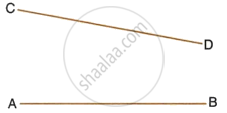
In the figure given below, find a point P on CD equidistant from points A and B.
Describe the locus of the centre of a wheel of a bicycle going straight along a level road.
Describe the locus of a stone dropped from the top of a tower.
Describe the locus of the door handle, as the door opens.
Describe the locus of the centres of all circles passing through two fixed points.
Describe the locus of points at distances less than or equal to 2.5 cm from a given point.
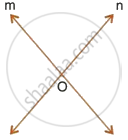
In the given figure, obtain all the points equidistant from lines m and n; and 2.5 cm from O.
A straight line AB is 8 cm long. Draw and describe the locus of a point which is:
- always 4 cm from the line AB.
- equidistant from A and B.
Mark the two points X and Y, which are 4 cm from AB and equidistant from A and B. Describe the figure AXBY.
Show that the locus of the centres of all circles passing through two given points A and B, is the perpendicular bisector of the line segment AB.
