Advertisements
Advertisements
Question
The given figure shows a triangle ABC in which AD bisects angle BAC. EG is perpendicular bisector of side AB which intersects AD at point F.
Prove that:

F is equidistant from AB and AC.
Advertisements
Solution

Construction: Draw LF ⊥ AC
Proof: In ΔAFL and ΔAFE,
∠FEA = ∠FLA ...(Each = 90°)
∠LAF = FAE ...(AD bisects ∠BAC)
AF = AF ...(Common)
∴ By angle – Angle side criterion of congruence,
ΔAFL ≅ AFE ...(AAS postulate)
The corresponding parts of the congruent triangles are congruent.
∴ FE = FL ...(C.P.C.T.)
Hence, F is equidistant from AB and AC.
RELATED QUESTIONS
In each of the given figures; PA = PB and QA = QB.
| i. |  |
| ii. | 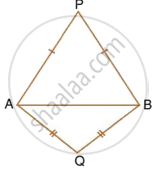 |
Prove, in each case, that PQ (produce, if required) is perpendicular bisector of AB. Hence, state the locus of the points equidistant from two given fixed points.
Construct a right angled triangle PQR, in which ∠Q = 90°, hypotenuse PR = 8 cm and QR = 4.5 cm. Draw bisector of angle PQR and let it meets PR at point T. Prove that T is equidistant from PQ and QR.
In triangle LMN, bisectors of interior angles at L and N intersect each other at point A. Prove that:
- Point A is equidistant from all the three sides of the triangle.
- AM bisects angle LMN.
The given figure shows a triangle ABC in which AD bisects angle BAC. EG is perpendicular bisector of side AB which intersects AD at point F.
Prove that:

F is equidistant from A and B.
In the given triangle ABC, find a point P equidistant from AB and AC; and also equidistant from B and C.

Construct a triangle ABC, with AB = 7 cm, BC = 8 cm and ∠ABC = 60°. Locate by construction the point P such that:
- P is equidistant from B and C.
- P is equidistant from AB and BC.
- Measure and record the length of PB.
Describe the locus of the centres of all circles passing through two fixed points.
By actual drawing obtain the points equidistant from lines m and n; and 6 cm from a point P, where P is 2 cm above m, m is parallel to n and m is 6 cm above n.
In a quadrilateral ABCD, if the perpendicular bisectors of AB and AD meet at P, then prove that BP = DP.
Find the locus of points which are equidistant from three non-collinear points.
