Advertisements
Advertisements
Question
Find the locus of points which are equidistant from three non-collinear points.
Advertisements
Solution
Let A, B and C be three non-collinear points. Join AB and BC. Let P be a moving point. Since, P is equidistant from A and B, it follows that P lies on the perpendicular bisector of AB.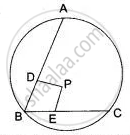
Again P is equidistant from B and C. So, P lies on the perpendicular bisector of BC.
Thus, P is the point of intersection of the perpendicular bisector of AB and BC. So, P coincides three given non-collinear points. Hence, the required locus is the centre of the circle passing through three given non-collinear points.
APPEARS IN
RELATED QUESTIONS
The given figure shows a triangle ABC in which AD bisects angle BAC. EG is perpendicular bisector of side AB which intersects AD at point F.
Prove that:

F is equidistant from AB and AC.
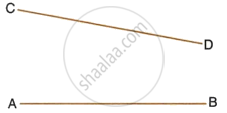
In the figure given below, find a point P on CD equidistant from points A and B.
Describe the locus of a runner, running around a circular track and always keeping a distance of 1.5 m from the inner edge.
Sketch and describe the locus of the vertices of all triangles with a given base and a given altitude.
In Δ ABC, the perpendicular bisector of AB and AC meet at 0. Prove that O is equidistant from the three vertices. Also, prove that if M is the mid-point of BC then OM meets BC at right angles.
Prove that the common chord of two intersecting circles is bisected at right angles by the line of centres.
In Fig. ABCD is a quadrilateral in which AB = BC. E is the point of intersection of the right bisectors of AD and CD. Prove that BE bisects ∠ABC.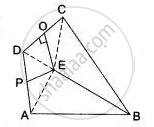
ΔPBC and ΔQBC are two isosceles triangles on the same base. Show that the line PQ is bisector of BC and is perpendicular to BC.
In Fig. AB = AC, BD and CE are the bisectors of ∠ABC and ∠ACB respectively such that BD and CE intersect each other at O. AO produced meets BC at F. Prove that AF is the right bisector of BC.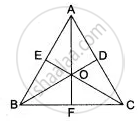
Use ruler and compasses for the following question taking a scale of 10 m = 1 cm. A park in a city is bounded by straight fences AB, BC, CD and DA. Given that AB = 50 m, BC = 63 m, ∠ABC = 75°. D is a point equidistant from the fences AB and BC. If ∠BAD = 90°, construct the outline of the park ABCD. Also locate a point P on the line BD for the flag post which is equidistant from the corners of the park A and B.
