Advertisements
Advertisements
Question
ΔPBC, ΔQBC and ΔRBC are three isosceles triangles on the same base BC. Show that P, Q and R are collinear.
Advertisements
Solution
Given: Three isosceles triangles PBC, QBC and RBC on the same base BC such that PB = PC, QB = QC and RB = RC.
To prove: P, Q, R are collinear.
Proof: Let l be the perpendicular bisector of BC. Since, the locus of points equidistant from B and C is the perpendicular of the segment joining them. Therefore,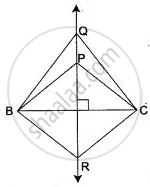
ΔPBC is an isosceles
⇒ PB = PC
⇒ P lies on l ...(i)
ΔQBC is isosceles
⇒ QB = QC
⇒ Q lies on l ...(ii)
ΔRBC is an isosceles
⇒ RB = RC
⇒ R lies on l ...(iii)
From (i), (ii) and (iii), it follows that P, Q and R lie on L.
Hence, P, Q and R are collinear.
Hence proved.
APPEARS IN
RELATED QUESTIONS
Construct a triangle ABC, in which AB = 4.2 cm, BC = 6.3 cm and AC = 5 cm. Draw perpendicular bisector of BC which meets AC at point D. Prove that D is equidistant from B and C.
In parallelogram ABCD, side AB is greater than side BC and P is a point in AC such that PB bisects angle B. Prove that P is equidistant from AB and BC.
The given figure shows a triangle ABC in which AD bisects angle BAC. EG is perpendicular bisector of side AB which intersects AD at point F.
Prove that:

F is equidistant from A and B.
Draw an angle ABC = 75°. Draw the locus of all the points equidistant from AB and BC.
In the given triangle ABC, find a point P equidistant from AB and AC; and also equidistant from B and C.

Describe the locus of points at a distance 2 cm from a fixed line.
Describe the locus of the centre of a wheel of a bicycle going straight along a level road.
Describe the locus of the moving end of the minute hand of a clock.
The speed of sound is 332 metres per second. A gun is fired. Describe the locus of all the people on the earth’s surface, who hear the sound exactly one second later.
Given: ∠BAC, a line intersects the arms of ∠BAC in P and Q. How will you locate a point on line segment PQ, which is equidistant from AB and AC? Does such a point always exist?
