Advertisements
Advertisements
प्रश्न
ΔPBC, ΔQBC and ΔRBC are three isosceles triangles on the same base BC. Show that P, Q and R are collinear.
Advertisements
उत्तर
Given: Three isosceles triangles PBC, QBC and RBC on the same base BC such that PB = PC, QB = QC and RB = RC.
To prove: P, Q, R are collinear.
Proof: Let l be the perpendicular bisector of BC. Since, the locus of points equidistant from B and C is the perpendicular of the segment joining them. Therefore,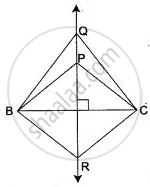
ΔPBC is an isosceles
⇒ PB = PC
⇒ P lies on l ...(i)
ΔQBC is isosceles
⇒ QB = QC
⇒ Q lies on l ...(ii)
ΔRBC is an isosceles
⇒ RB = RC
⇒ R lies on l ...(iii)
From (i), (ii) and (iii), it follows that P, Q and R lie on L.
Hence, P, Q and R are collinear.
Hence proved.
APPEARS IN
संबंधित प्रश्न
Construct a right angled triangle PQR, in which ∠Q = 90°, hypotenuse PR = 8 cm and QR = 4.5 cm. Draw bisector of angle PQR and let it meets PR at point T. Prove that T is equidistant from PQ and QR.
The given figure shows a triangle ABC in which AD bisects angle BAC. EG is perpendicular bisector of side AB which intersects AD at point F.
Prove that:

F is equidistant from A and B.
Draw an ∠ABC = 60°, having AB = 4.6 cm and BC = 5 cm. Find a point P equidistant from AB and BC; and also equidistant from A and B.
In the given triangle ABC, find a point P equidistant from AB and AC; and also equidistant from B and C.

Construct a triangle ABC, with AB = 7 cm, BC = 8 cm and ∠ABC = 60°. Locate by construction the point P such that:
- P is equidistant from B and C.
- P is equidistant from AB and BC.
- Measure and record the length of PB.
Describe the locus of points at distances greater than 4 cm from a given point.
Describe the locus of points at distances greater than or equal to 35 mm from a given point.
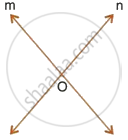
In the given figure, obtain all the points equidistant from lines m and n; and 2.5 cm from O.
Draw a triangle ABC in which AB = 6 cm, BC = 4.5 cm and AC = 5 cm. Draw and label:
- the locus of the centres of all circles which touch AB and AC,
- the locus of the centres of all the circles of radius 2 cm which touch AB.
Hence, construct the circle of radius 2 cm which touches AB and AC .
In a quadrilateral PQRS, if the bisectors of ∠ SPQ and ∠ PQR meet at O, prove that O is equidistant from PS and QR.
