Advertisements
Advertisements
Question
Prove that the common chord of two intersecting circles is bisected at right angles by the line of centres.
Advertisements
Solution
Given: Two interesting circles with centres C &D.
AB is their common chord.
To prove: AB bisected by CD at right angles.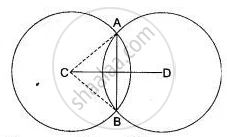
Proof : CA = CB ...(radii)
∴ C lies on the right bisector of AB.
Similarly, D lies on the right bisector of AB.
Therefore, CD is the right bisector of AB.
Hence proved.
RELATED QUESTIONS
Use ruler and compasses only for this question.
- Construct ΔABC, where AB = 3.5 cm, BC = 6 cm and ∠ABC = 60°.
- Construct the locus of points inside the triangle which are equidistant from BA and BC.
- Construct the locus of points inside the triangle which are equidistant from B and C.
- Mark the point P which is equidistant from AB, BC and also equidistant from B and C. Measure and record the length of PB.
The given figure shows a triangle ABC in which AD bisects angle BAC. EG is perpendicular bisector of side AB which intersects AD at point F.
Prove that:

F is equidistant from AB and AC.
Draw a line AB = 6 cm. Draw the locus of all the points which are equidistant from A and B.
Describe the locus of a point in rhombus ABCD, so that it is equidistant from
- AB and BC;
- B and D.
Describe the locus of points at distances less than 3 cm from a given point.
Describe the locus of points at distances greater than 4 cm from a given point.
Describe the locus of points at distances greater than or equal to 35 mm from a given point.
Find the locus of the centre of a circle of radius r touching externally a circle of radius R.
Given: ∠BAC, a line intersects the arms of ∠BAC in P and Q. How will you locate a point on line segment PQ, which is equidistant from AB and AC? Does such a point always exist?
The bisectors of ∠B and ∠C of a quadrilateral ABCD intersect in P. Show that P is equidistant from the opposite sides AB and CD.
