Advertisements
Advertisements
प्रश्न
Prove that the common chord of two intersecting circles is bisected at right angles by the line of centres.
Advertisements
उत्तर
Given: Two interesting circles with centres C &D.
AB is their common chord.
To prove: AB bisected by CD at right angles.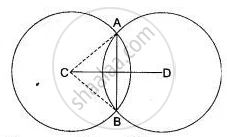
Proof : CA = CB ...(radii)
∴ C lies on the right bisector of AB.
Similarly, D lies on the right bisector of AB.
Therefore, CD is the right bisector of AB.
Hence proved.
संबंधित प्रश्न
In each of the given figures; PA = PB and QA = QB.
| i. |  |
| ii. | 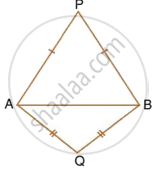 |
Prove, in each case, that PQ (produce, if required) is perpendicular bisector of AB. Hence, state the locus of the points equidistant from two given fixed points.
In parallelogram ABCD, side AB is greater than side BC and P is a point in AC such that PB bisects angle B. Prove that P is equidistant from AB and BC.
The given figure shows a triangle ABC in which AD bisects angle BAC. EG is perpendicular bisector of side AB which intersects AD at point F.
Prove that:

F is equidistant from A and B.
Draw a line AB = 6 cm. Draw the locus of all the points which are equidistant from A and B.
Describe the locus of the centres of all circles passing through two fixed points.
Describe the locus of points at distances greater than 4 cm from a given point.
Describe the locus of points at distances less than or equal to 2.5 cm from a given point.
Sketch and describe the locus of the vertices of all triangles with a given base and a given altitude.
In Fig. ABCD is a quadrilateral in which AB = BC. E is the point of intersection of the right bisectors of AD and CD. Prove that BE bisects ∠ABC.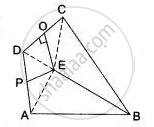
Given: ∠BAC, a line intersects the arms of ∠BAC in P and Q. How will you locate a point on line segment PQ, which is equidistant from AB and AC? Does such a point always exist?
