Advertisements
Advertisements
प्रश्न
In Fig. AB = AC, BD and CE are the bisectors of ∠ABC and ∠ACB respectively such that BD and CE intersect each other at O. AO produced meets BC at F. Prove that AF is the right bisector of BC.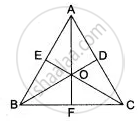
Advertisements
उत्तर
Given: A ΔABC in which AB = AC.
BD, the bisector of ∠ABC meets CE, the bisector of ∠ACB at O. AO produced meets BC at F.
To prove: AF is the right bisector of BC.
Proof: We have, AB = AC
⇒ A lies on the right bisector of BC ...(i)
and ∠ABC = ∠ACB
Now, ∠ABC = ∠ACB
⇒ `(1)/(2)`∠ABC = `(1)/(2)`∠ACB
⇒ ∠OBC = ∠OCB
[∵ BD and CE are bisector of ∠B and∠C respectively]
⇒ OB = OC
[∵ Sides opposite to equal angles are equal]
⇒ O lies on the right bisector of BC ...(iii)
From (i) and (ii), we obtain
⇒ A and O both lie on the right bisector of BC.
⇒ AO is the right bisector of BC
Hence, AF is the right bisector of BC.
Hence proved.
APPEARS IN
संबंधित प्रश्न
Construct a right angled triangle PQR, in which ∠Q = 90°, hypotenuse PR = 8 cm and QR = 4.5 cm. Draw bisector of angle PQR and let it meets PR at point T. Prove that T is equidistant from PQ and QR.
In parallelogram ABCD, side AB is greater than side BC and P is a point in AC such that PB bisects angle B. Prove that P is equidistant from AB and BC.
Describe the locus for questions 1 to 13 given below:
1. The locus of a point at a distant 3 cm from a fixed point.
Describe the locus of a runner, running around a circular track and always keeping a distance of 1.5 m from the inner edge.
Describe the locus of the centres of all circles passing through two fixed points.
Describe the locus of points at distances greater than 4 cm from a given point.
Sketch and describe the locus of the vertices of all triangles with a given base and a given altitude.
In a quadrilateral ABCD, if the perpendicular bisectors of AB and AD meet at P, then prove that BP = DP.
Find the locus of the centre of a circle of radius r touching externally a circle of radius R.
ΔPBC, ΔQBC and ΔRBC are three isosceles triangles on the same base BC. Show that P, Q and R are collinear.
