Advertisements
Advertisements
प्रश्न
ΔPBC and ΔQBC are two isosceles triangles on the same base BC but on the opposite sides of line BC. Show that PQ bisects BC at right angles.
Advertisements
उत्तर
Given: Two ΔSPBC and QBC on the same base BC but in the opposite sides of BC such that PB = PC and QB = QC.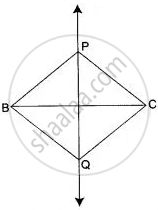
To prove: PQ bisects BC and is ⊥ to BC.
Proof: Since, the locus of points equidistant from two given points is the perpendicular bisector of the segment joining them. Therefore, ΔPBC is isoceles
⇒ P lies on the perpendicular bisector of BC
ΔQBC is isoceles ⇒ QB = QC
⇒ Q lies on the perpendicular bisectors of BC
∴ PQ is the perpendicular bisectors of BC
Hence, PQ bisects BC at right angles.
Hence proved.
APPEARS IN
संबंधित प्रश्न
The given figure shows a triangle ABC in which AD bisects angle BAC. EG is perpendicular bisector of side AB which intersects AD at point F.
Prove that:

F is equidistant from A and B.
The bisectors of ∠B and ∠C of a quadrilateral ABCD intersect each other at point P. Show that P is equidistant from the opposite sides AB and CD.
Draw an angle ABC = 75°. Draw the locus of all the points equidistant from AB and BC.
In the given triangle ABC, find a point P equidistant from AB and AC; and also equidistant from B and C.

Describe the locus of a stone dropped from the top of a tower.
Describe the locus of a runner, running around a circular track and always keeping a distance of 1.5 m from the inner edge.
The speed of sound is 332 metres per second. A gun is fired. Describe the locus of all the people on the earth’s surface, who hear the sound exactly one second later.
Sketch and describe the locus of the vertices of all triangles with a given base and a given altitude.
Prove that the common chord of two intersecting circles is bisected at right angles by the line of centres.
Use ruler and compasses for the following question taking a scale of 10 m = 1 cm. A park in a city is bounded by straight fences AB, BC, CD and DA. Given that AB = 50 m, BC = 63 m, ∠ABC = 75°. D is a point equidistant from the fences AB and BC. If ∠BAD = 90°, construct the outline of the park ABCD. Also locate a point P on the line BD for the flag post which is equidistant from the corners of the park A and B.
