Advertisements
Advertisements
प्रश्न
ΔPBC and ΔQBC are two isosceles triangles on the same base BC but on the opposite sides of line BC. Show that PQ bisects BC at right angles.
Advertisements
उत्तर
Given: Two ΔSPBC and QBC on the same base BC but in the opposite sides of BC such that PB = PC and QB = QC.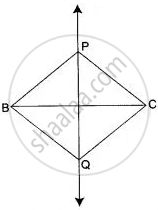
To prove: PQ bisects BC and is ⊥ to BC.
Proof: Since, the locus of points equidistant from two given points is the perpendicular bisector of the segment joining them. Therefore, ΔPBC is isoceles
⇒ P lies on the perpendicular bisector of BC
ΔQBC is isoceles ⇒ QB = QC
⇒ Q lies on the perpendicular bisectors of BC
∴ PQ is the perpendicular bisectors of BC
Hence, PQ bisects BC at right angles.
Hence proved.
APPEARS IN
संबंधित प्रश्न
In each of the given figures; PA = PB and QA = QB.
| i. |  |
| ii. | 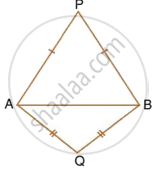 |
Prove, in each case, that PQ (produce, if required) is perpendicular bisector of AB. Hence, state the locus of the points equidistant from two given fixed points.
Construct a triangle ABC, with AB = 7 cm, BC = 8 cm and ∠ABC = 60°. Locate by construction the point P such that:
- P is equidistant from B and C.
- P is equidistant from AB and BC.
- Measure and record the length of PB.
Describe the locus of the centre of a wheel of a bicycle going straight along a level road.
Describe the locus of points at distances greater than 4 cm from a given point.
Sketch and describe the locus of the vertices of all triangles with a given base and a given altitude.
Draw a triangle ABC in which AB = 6 cm, BC = 4.5 cm and AC = 5 cm. Draw and label:
- the locus of the centres of all circles which touch AB and AC,
- the locus of the centres of all the circles of radius 2 cm which touch AB.
Hence, construct the circle of radius 2 cm which touches AB and AC .
Find the locus of the centre of a circle of radius r touching externally a circle of radius R.
ΔPBC and ΔQBC are two isosceles triangles on the same base. Show that the line PQ is bisector of BC and is perpendicular to BC.
ΔPBC, ΔQBC and ΔRBC are three isosceles triangles on the same base BC. Show that P, Q and R are collinear.
The bisectors of ∠B and ∠C of a quadrilateral ABCD intersect in P. Show that P is equidistant from the opposite sides AB and CD.
