Advertisements
Advertisements
प्रश्न
Construct a right angled triangle PQR, in which ∠Q = 90°, hypotenuse PR = 8 cm and QR = 4.5 cm. Draw bisector of angle PQR and let it meets PR at point T. Prove that T is equidistant from PQ and QR.
Advertisements
उत्तर

Steps of Construction:
- Draw a line segment QR = 4.5 cm
- At Q, draw a ray QX making an angle of 90°
- With centre R and radius 8 cm, draw an arc which intersects QX at P.
- Join RP. ΔPQR is the required triangle.
- Draw the bisector of ∠PQR that meets PR in T.
- From T, draw perpendicular PL and PM respectively on PQ and QR.
Proof: In ΔLTQ and ΔMTQ
∠TLQ = ∠TMQ ...(Each = 90°)
∠LQT = ∠TQM ...(QT is angle bisector)
QT = QT ...(Common)
∴ By Angle – Angle – side criterion of congruence,
∴ ΔLTQ ≅ ΔMTQ ...(AAS postulate)
The corresponding parts of the congruent triangles are congruent
∴ TL = TM ...(C.P.C.T.)
Hence, T is equidistant from PQ and QR.
संबंधित प्रश्न
In each of the given figures; PA = PB and QA = QB.
| i. |  |
| ii. | 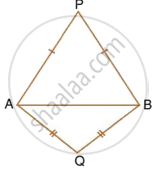 |
Prove, in each case, that PQ (produce, if required) is perpendicular bisector of AB. Hence, state the locus of the points equidistant from two given fixed points.
Draw an ∠ABC = 60°, having AB = 4.6 cm and BC = 5 cm. Find a point P equidistant from AB and BC; and also equidistant from A and B.
Describe the locus of the moving end of the minute hand of a clock.
Describe the locus of a runner, running around a circular track and always keeping a distance of 1.5 m from the inner edge.
Describe the locus of points at distances less than or equal to 2.5 cm from a given point.
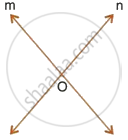
In the given figure, obtain all the points equidistant from lines m and n; and 2.5 cm from O.
A straight line AB is 8 cm long. Draw and describe the locus of a point which is:
- always 4 cm from the line AB.
- equidistant from A and B.
Mark the two points X and Y, which are 4 cm from AB and equidistant from A and B. Describe the figure AXBY.
Draw a triangle ABC in which AB = 6 cm, BC = 4.5 cm and AC = 5 cm. Draw and label:
- the locus of the centres of all circles which touch AB and AC,
- the locus of the centres of all the circles of radius 2 cm which touch AB.
Hence, construct the circle of radius 2 cm which touches AB and AC .
Prove that the common chord of two intersecting circles is bisected at right angles by the line of centres.
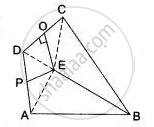
In Fig. ABCD is a quadrilateral in which AB = BC. E is the point of intersection of the right bisectors of AD and CD. Prove that BE bisects ∠ABC.