Advertisements
Advertisements
प्रश्न
Construct a right angled triangle PQR, in which ∠Q = 90°, hypotenuse PR = 8 cm and QR = 4.5 cm. Draw bisector of angle PQR and let it meets PR at point T. Prove that T is equidistant from PQ and QR.
Advertisements
उत्तर

Steps of Construction:
- Draw a line segment QR = 4.5 cm
- At Q, draw a ray QX making an angle of 90°
- With centre R and radius 8 cm, draw an arc which intersects QX at P.
- Join RP. ΔPQR is the required triangle.
- Draw the bisector of ∠PQR that meets PR in T.
- From T, draw perpendicular PL and PM respectively on PQ and QR.
Proof: In ΔLTQ and ΔMTQ
∠TLQ = ∠TMQ ...(Each = 90°)
∠LQT = ∠TQM ...(QT is angle bisector)
QT = QT ...(Common)
∴ By Angle – Angle – side criterion of congruence,
∴ ΔLTQ ≅ ΔMTQ ...(AAS postulate)
The corresponding parts of the congruent triangles are congruent
∴ TL = TM ...(C.P.C.T.)
Hence, T is equidistant from PQ and QR.
संबंधित प्रश्न
In each of the given figures; PA = PB and QA = QB.
| i. |  |
| ii. | 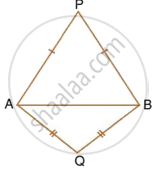 |
Prove, in each case, that PQ (produce, if required) is perpendicular bisector of AB. Hence, state the locus of the points equidistant from two given fixed points.
The given figure shows a triangle ABC in which AD bisects angle BAC. EG is perpendicular bisector of side AB which intersects AD at point F.
Prove that:

F is equidistant from A and B.
In the given triangle ABC, find a point P equidistant from AB and AC; and also equidistant from B and C.

Describe the locus for questions 1 to 13 given below:
1. The locus of a point at a distant 3 cm from a fixed point.
Describe the locus of points at a distance 2 cm from a fixed line.
Describe the locus of a runner, running around a circular track and always keeping a distance of 1.5 m from the inner edge.
The speed of sound is 332 metres per second. A gun is fired. Describe the locus of all the people on the earth’s surface, who hear the sound exactly one second later.
A straight line AB is 8 cm long. Draw and describe the locus of a point which is:
- always 4 cm from the line AB.
- equidistant from A and B.
Mark the two points X and Y, which are 4 cm from AB and equidistant from A and B. Describe the figure AXBY.
ΔPBC and ΔQBC are two isosceles triangles on the same base. Show that the line PQ is bisector of BC and is perpendicular to BC.
Show that the locus of the centres of all circles passing through two given points A and B, is the perpendicular bisector of the line segment AB.
