Advertisements
Advertisements
प्रश्न
Draw an angle ABC = 75°. Draw the locus of all the points equidistant from AB and BC.
Advertisements
उत्तर

Steps of construction:
- Draw a ray BC.
- Construct a ray RA making an angle of 75° with BC. Therefore, ABC = ABC = 75°
- Draw the angle bisector BP of ∠ABC.
BP is the required locus. - Take any point D on BP.
- From D, draw DE ⊥ AB and DF ⊥ BC.
Since D lies on the angle bisector BP of ∠ABC.
D is equidistant from AB and BC.
Hence, DE = DF
Similarly, any point on BP is equidistant from AB and BC.
Therefore, BP is the locus of all points which are equidistant from AB and BC.
संबंधित प्रश्न
Construct a triangle ABC, in which AB = 4.2 cm, BC = 6.3 cm and AC = 5 cm. Draw perpendicular bisector of BC which meets AC at point D. Prove that D is equidistant from B and C.
In each of the given figures; PA = PB and QA = QB.
| i. |  |
| ii. | 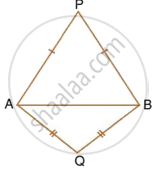 |
Prove, in each case, that PQ (produce, if required) is perpendicular bisector of AB. Hence, state the locus of the points equidistant from two given fixed points.
In parallelogram ABCD, side AB is greater than side BC and P is a point in AC such that PB bisects angle B. Prove that P is equidistant from AB and BC.
Draw a line AB = 6 cm. Draw the locus of all the points which are equidistant from A and B.
In the given triangle ABC, find a point P equidistant from AB and AC; and also equidistant from B and C.

Construct a triangle ABC, with AB = 7 cm, BC = 8 cm and ∠ABC = 60°. Locate by construction the point P such that:
- P is equidistant from B and C.
- P is equidistant from AB and BC.
- Measure and record the length of PB.
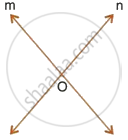
In the given figure, obtain all the points equidistant from lines m and n; and 2.5 cm from O.
In a quadrilateral ABCD, if the perpendicular bisectors of AB and AD meet at P, then prove that BP = DP.
Prove that the common chord of two intersecting circles is bisected at right angles by the line of centres.
Find the locus of the centre of a circle of radius r touching externally a circle of radius R.
