Advertisements
Advertisements
प्रश्न
Construct a triangle ABC, in which AB = 4.2 cm, BC = 6.3 cm and AC = 5 cm. Draw perpendicular bisector of BC which meets AC at point D. Prove that D is equidistant from B and C.
Advertisements
उत्तर
Given: In triangle ABC, AB = 4.2 cm, BC = 6.3 cm and AC = 5 cm

Steps of Construction:
- Draw a line segment BC = 6.3 cm
- With centre B and radius 4.2 cm, draw an arc.
- With centre C and radius 5 cm, draw another arc which intersects the first arc at A.
- Join AB and AC. ΔABC is the required triangle.
- Again with centre B and C and radius greater than 12 BC, draw arcs which intersects each other at L and M.
- Join LM intersecting AC at D and BC at E.
- Join DB.
Proof: In ΔDBE and ΔDCE
BE = EC ...(LM is bisector of BC)
∠DEB = ∠DEC ...(Each = 90°)
DE = DE ...(Common)
∴ By side angle side criterion of congruence, we have
ΔDBE ≅ ΔDCE ...(SAS postulate)
The corresponding parts of the congruent triangle are congruent
∴ DB = DC ...(C.P.C.T.)
Hence, D is equidistant from B and C.
APPEARS IN
संबंधित प्रश्न
In each of the given figures; PA = PB and QA = QB.
| i. |  |
| ii. | 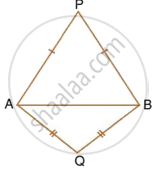 |
Prove, in each case, that PQ (produce, if required) is perpendicular bisector of AB. Hence, state the locus of the points equidistant from two given fixed points.
The bisectors of ∠B and ∠C of a quadrilateral ABCD intersect each other at point P. Show that P is equidistant from the opposite sides AB and CD.
Describe the locus of points at a distance 2 cm from a fixed line.
Describe the locus of the door handle, as the door opens.
Sketch and describe the locus of the vertices of all triangles with a given base and a given altitude.
In Δ ABC, the perpendicular bisector of AB and AC meet at 0. Prove that O is equidistant from the three vertices. Also, prove that if M is the mid-point of BC then OM meets BC at right angles.
In a quadrilateral ABCD, if the perpendicular bisectors of AB and AD meet at P, then prove that BP = DP.
Prove that the common chord of two intersecting circles is bisected at right angles by the line of centres.
In Fig. AB = AC, BD and CE are the bisectors of ∠ABC and ∠ACB respectively such that BD and CE intersect each other at O. AO produced meets BC at F. Prove that AF is the right bisector of BC.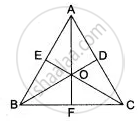
Use ruler and compasses for the following question taking a scale of 10 m = 1 cm. A park in a city is bounded by straight fences AB, BC, CD and DA. Given that AB = 50 m, BC = 63 m, ∠ABC = 75°. D is a point equidistant from the fences AB and BC. If ∠BAD = 90°, construct the outline of the park ABCD. Also locate a point P on the line BD for the flag post which is equidistant from the corners of the park A and B.
