Advertisements
Advertisements
प्रश्न
In Fig. ABCD is a quadrilateral in which AB = BC. E is the point of intersection of the right bisectors of AD and CD. Prove that BE bisects ∠ABC.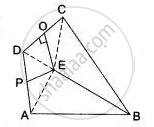
Advertisements
उत्तर
Given: A quadrilateral ABCD in which AB = BC. PE and QE are right bisectors or AD and CD respectively such that they meet at E.
To prove: BE bisects ∠ABC.
Construction: Join AE, DE and CE.
Proof: Since, PE is the right bisector of AD and E lies on it.
∴ AE = ED ...(i)
[∵ Points on the right bisector of a line segment are equidistant from the ends of the segment]
Also, QE is the right bisector of CD and E lies on it.
∴ ED = EC ...(ii)
From (i) and (ii), we get
AE = EC ...(iii)
Now, in Δs ABE and CBE, we have
AB = BC ...[Given]
BE = BE ...[Common]
and AE = EC ...[From (iii)]
So, by SSS criterion of congruence
ΔABE = ΔACE
⇒ ∠ABE = ∠CBE
⇒ BE bisects ∠ABC.
Hence, BE is the bisector of ∠ABC.
Hence proved.
APPEARS IN
संबंधित प्रश्न
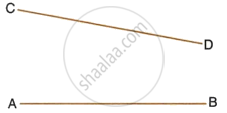
In the figure given below, find a point P on CD equidistant from points A and B.
In the given triangle ABC, find a point P equidistant from AB and AC; and also equidistant from B and C.

Describe the locus for questions 1 to 13 given below:
1. The locus of a point at a distant 3 cm from a fixed point.
Describe the locus of the moving end of the minute hand of a clock.
Sketch and describe the locus of the vertices of all triangles with a given base and a given altitude.
Draw a triangle ABC in which AB = 6 cm, BC = 4.5 cm and AC = 5 cm. Draw and label:
- the locus of the centres of all circles which touch AB and AC,
- the locus of the centres of all the circles of radius 2 cm which touch AB.
Hence, construct the circle of radius 2 cm which touches AB and AC .
In Δ ABC, the perpendicular bisector of AB and AC meet at 0. Prove that O is equidistant from the three vertices. Also, prove that if M is the mid-point of BC then OM meets BC at right angles.
ΔPBC and ΔQBC are two isosceles triangles on the same base. Show that the line PQ is bisector of BC and is perpendicular to BC.
ΔPBC, ΔQBC and ΔRBC are three isosceles triangles on the same base BC. Show that P, Q and R are collinear.
Given: ∠BAC, a line intersects the arms of ∠BAC in P and Q. How will you locate a point on line segment PQ, which is equidistant from AB and AC? Does such a point always exist?
