Advertisements
Advertisements
Question
Construct a triangle ABC, in which AB = 4.2 cm, BC = 6.3 cm and AC = 5 cm. Draw perpendicular bisector of BC which meets AC at point D. Prove that D is equidistant from B and C.
Advertisements
Solution
Given: In triangle ABC, AB = 4.2 cm, BC = 6.3 cm and AC = 5 cm

Steps of Construction:
- Draw a line segment BC = 6.3 cm
- With centre B and radius 4.2 cm, draw an arc.
- With centre C and radius 5 cm, draw another arc which intersects the first arc at A.
- Join AB and AC. ΔABC is the required triangle.
- Again with centre B and C and radius greater than 12 BC, draw arcs which intersects each other at L and M.
- Join LM intersecting AC at D and BC at E.
- Join DB.
Proof: In ΔDBE and ΔDCE
BE = EC ...(LM is bisector of BC)
∠DEB = ∠DEC ...(Each = 90°)
DE = DE ...(Common)
∴ By side angle side criterion of congruence, we have
ΔDBE ≅ ΔDCE ...(SAS postulate)
The corresponding parts of the congruent triangle are congruent
∴ DB = DC ...(C.P.C.T.)
Hence, D is equidistant from B and C.
APPEARS IN
RELATED QUESTIONS
In parallelogram ABCD, side AB is greater than side BC and P is a point in AC such that PB bisects angle B. Prove that P is equidistant from AB and BC.
Use ruler and compasses only for this question.
- Construct ΔABC, where AB = 3.5 cm, BC = 6 cm and ∠ABC = 60°.
- Construct the locus of points inside the triangle which are equidistant from BA and BC.
- Construct the locus of points inside the triangle which are equidistant from B and C.
- Mark the point P which is equidistant from AB, BC and also equidistant from B and C. Measure and record the length of PB.
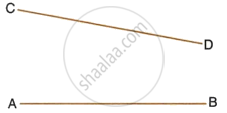
In the figure given below, find a point P on CD equidistant from points A and B.
Describe the locus of points at a distance 2 cm from a fixed line.
Describe the locus of a stone dropped from the top of a tower.
Describe the locus of points at distances greater than 4 cm from a given point.
By actual drawing obtain the points equidistant from lines m and n; and 6 cm from a point P, where P is 2 cm above m, m is parallel to n and m is 6 cm above n.
Draw a triangle ABC in which AB = 6 cm, BC = 4.5 cm and AC = 5 cm. Draw and label:
- the locus of the centres of all circles which touch AB and AC,
- the locus of the centres of all the circles of radius 2 cm which touch AB.
Hence, construct the circle of radius 2 cm which touches AB and AC .
ΔPBC and ΔQBC are two isosceles triangles on the same base. Show that the line PQ is bisector of BC and is perpendicular to BC.
ΔPBC and ΔQBC are two isosceles triangles on the same base BC but on the opposite sides of line BC. Show that PQ bisects BC at right angles.
