Advertisements
Advertisements
प्रश्न
Find the locus of points which are equidistant from three non-collinear points.
Advertisements
उत्तर
Let A, B and C be three non-collinear points. Join AB and BC. Let P be a moving point. Since, P is equidistant from A and B, it follows that P lies on the perpendicular bisector of AB.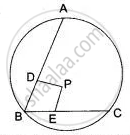
Again P is equidistant from B and C. So, P lies on the perpendicular bisector of BC.
Thus, P is the point of intersection of the perpendicular bisector of AB and BC. So, P coincides three given non-collinear points. Hence, the required locus is the centre of the circle passing through three given non-collinear points.
APPEARS IN
संबंधित प्रश्न
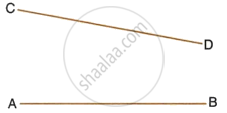
In the figure given below, find a point P on CD equidistant from points A and B.
Describe the locus for questions 1 to 13 given below:
1. The locus of a point at a distant 3 cm from a fixed point.
Describe the locus of points inside a circle and equidistant from two fixed points on the circumference of the circle.
Describe the locus of the centres of all circles passing through two fixed points.
The speed of sound is 332 metres per second. A gun is fired. Describe the locus of all the people on the earth’s surface, who hear the sound exactly one second later.
Describe the locus of points at distances greater than or equal to 35 mm from a given point.
In a quadrilateral PQRS, if the bisectors of ∠ SPQ and ∠ PQR meet at O, prove that O is equidistant from PS and QR.
In Fig. ABCD is a quadrilateral in which AB = BC. E is the point of intersection of the right bisectors of AD and CD. Prove that BE bisects ∠ABC.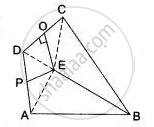
Find the locus of the centre of a circle of radius r touching externally a circle of radius R.
ΔPBC, ΔQBC and ΔRBC are three isosceles triangles on the same base BC. Show that P, Q and R are collinear.
