Advertisements
Advertisements
प्रश्न
Show that the locus of the centres of all circles passing through two given points A and B, is the perpendicular bisector of the line segment AB.
Advertisements
उत्तर
Let P and Q be the centres of two circles S and S', each passing through two given points A and B. Then,
PA = PB ...[Radii of the same circle]
⇒ P lies on the perpendicular bisector of AB ...(i)
Again, QA = QB ...[Radii of the same circle]
⇒ Q lies on the perpendicular bisector of AB ...(ii)
From (i) and (ii), it follows that P and Q both lies on the perpendicular bisector of AB.
Hence, the locus of the centres of all the circles passing through A and B is the perpendicular bisector of AB.
APPEARS IN
संबंधित प्रश्न
The bisectors of ∠B and ∠C of a quadrilateral ABCD intersect each other at point P. Show that P is equidistant from the opposite sides AB and CD.
In the figure given below, find a point P on CD equidistant from points A and B.
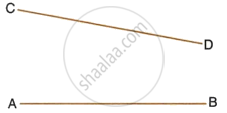
Describe the locus for questions 1 to 13 given below:
1. The locus of a point at a distant 3 cm from a fixed point.
Describe the locus of the door handle, as the door opens.
Describe the locus of points inside a circle and equidistant from two fixed points on the circumference of the circle.
Describe the locus of a point in rhombus ABCD, so that it is equidistant from
- AB and BC;
- B and D.
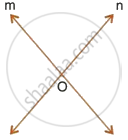
In the given figure, obtain all the points equidistant from lines m and n; and 2.5 cm from O.
A straight line AB is 8 cm long. Draw and describe the locus of a point which is:
- always 4 cm from the line AB.
- equidistant from A and B.
Mark the two points X and Y, which are 4 cm from AB and equidistant from A and B. Describe the figure AXBY.
In a quadrilateral PQRS, if the bisectors of ∠ SPQ and ∠ PQR meet at O, prove that O is equidistant from PS and QR.
Find the locus of points which are equidistant from three non-collinear points.
