Advertisements
Advertisements
प्रश्न
Describe the locus of a point in rhombus ABCD, so that it is equidistant from
- AB and BC;
- B and D.
Advertisements
उत्तर
i.
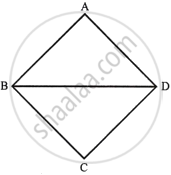
The locus of the point in a rhombus ABCD which is equidistant from AB and BC will be the diagonal BD.
ii.
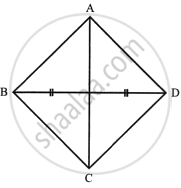
The locus of the point in a rhombus ABCD which is equidistant from B and D will be the diagonal AC.
APPEARS IN
संबंधित प्रश्न
In each of the given figures; PA = PB and QA = QB.
| i. |  |
| ii. | 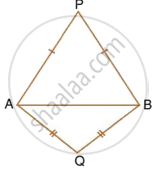 |
Prove, in each case, that PQ (produce, if required) is perpendicular bisector of AB. Hence, state the locus of the points equidistant from two given fixed points.
Use ruler and compasses only for this question.
- Construct ΔABC, where AB = 3.5 cm, BC = 6 cm and ∠ABC = 60°.
- Construct the locus of points inside the triangle which are equidistant from BA and BC.
- Construct the locus of points inside the triangle which are equidistant from B and C.
- Mark the point P which is equidistant from AB, BC and also equidistant from B and C. Measure and record the length of PB.
In the given triangle ABC, find a point P equidistant from AB and AC; and also equidistant from B and C.

Describe the locus of points at a distance 2 cm from a fixed line.
Describe the locus of the moving end of the minute hand of a clock.
Describe the locus of points at distances less than or equal to 2.5 cm from a given point.
Prove that the common chord of two intersecting circles is bisected at right angles by the line of centres.
Show that the locus of the centres of all circles passing through two given points A and B, is the perpendicular bisector of the line segment AB.
ΔPBC, ΔQBC and ΔRBC are three isosceles triangles on the same base BC. Show that P, Q and R are collinear.
The bisectors of ∠B and ∠C of a quadrilateral ABCD intersect in P. Show that P is equidistant from the opposite sides AB and CD.
