Advertisements
Advertisements
Question
The bisectors of ∠B and ∠C of a quadrilateral ABCD intersect in P. Show that P is equidistant from the opposite sides AB and CD.
Advertisements
Solution
Given: A quadrilateral ABCD in which bisectors of ∠B and ∠C meet in P. PM ⊥ ABand PN ⊥ CD.
To prove: PM = PN
Construction: Draw PL ⊥ BC
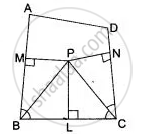
Proof: Since, P lies on the bisector of ∠B
∴ P is equidistant from BC and BA
⇒ PL = PM ...(i)
Also, P lies on the bisector of ∠C ...[Given]
∴ P is equidistant from CB and CD
⇒ PL = PN ...(ii)
From (i) and (ii), we have
PL = PM
and PL = PN
⇒ PM = PN.
Hence proved.
APPEARS IN
RELATED QUESTIONS
In triangle LMN, bisectors of interior angles at L and N intersect each other at point A. Prove that:
- Point A is equidistant from all the three sides of the triangle.
- AM bisects angle LMN.
The given figure shows a triangle ABC in which AD bisects angle BAC. EG is perpendicular bisector of side AB which intersects AD at point F.
Prove that:

F is equidistant from A and B.
Draw a line AB = 6 cm. Draw the locus of all the points which are equidistant from A and B.
Draw an angle ABC = 75°. Draw the locus of all the points equidistant from AB and BC.
Describe the locus of the door handle, as the door opens.
Describe the locus of points at distances less than 3 cm from a given point.
A straight line AB is 8 cm long. Draw and describe the locus of a point which is:
- always 4 cm from the line AB.
- equidistant from A and B.
Mark the two points X and Y, which are 4 cm from AB and equidistant from A and B. Describe the figure AXBY.
In a quadrilateral ABCD, if the perpendicular bisectors of AB and AD meet at P, then prove that BP = DP.
Prove that the common chord of two intersecting circles is bisected at right angles by the line of centres.
ΔPBC and ΔQBC are two isosceles triangles on the same base BC but on the opposite sides of line BC. Show that PQ bisects BC at right angles.
