Advertisements
Advertisements
Question
In answer to the second question, whose advice did the people say would be important to the king?
Advertisements
Solution
The second question also got varied responses. As answers to this question, some said that the people most necessary to the king were his councilors. Hence, their advice would be the most important. Others said that the priests were the most important. A few others chose the doctors. And yet others said that his soldiers were the most important.
RELATED QUESTIONS
Discuss in pairs and answer question below in a short paragraph (30 − 40 words.
How did George and Harris react to this? Did Jerome like their reaction?
Is Lushkoff a willing worker? Why, then, does he agree to chop wood for Sergei?
Understanding determiners.
Determiners are words that are used in front of nouns to indicate whether you are
referring to something specific or something of a particular type.
Singular nouns always need a determiner. In plural nouns, the determiner is
optional. Determiners may or may not be used with uncountable nouns depending
on context.
There are about 50 different determiners in the English language which include:
Articles: a, an, the
Possessives: my, your, our, their, his, hers, whose, etc.
Demonstratives: this, that these, those, which, etc.
Quantifiers: few, a few, many, much, each, every, some, any, etc.
Number: one, two, three, twenty, forty, etc.
Ordinals: first, second, last, next, etc.
Determiners are used
• to state the unit/ number of people, things or other nouns.
• to state possessives.
• to specify someone or something.
• to state how things or people are distributed.
• to state the difference between nouns.
Determiners can be classified under the following categories:
| EXAMPLES | ||
| MULTIPLIERS | double, twice, three times... | We want double portions. |
| FRACTIONS | half, a third, two fifths ..... | I drove at half speed. |
| INTENSIFIERS | What! Such! | Such impudence! |
| QUANTIFIERS | all, both, most | I like most people. |
| ARTICLES | a, an, the | Get a book from the shelf. |
| DEMONSTRATIVES | this, that, these, those, another, other | That tree is in another garden. |
| DISTRIBUTIVES | each, every, either, neither | I have a gift for each person. |
| POSSESSIVES | ||
| (i) PRONOMINAL | my, your, his, her, its, our, your, their | You can borrow Kim's video. |
| (ii) NOMINAL | Renata's, Adam's, People's ... | You can borrow my video. |
| INTERROGATIVES | What? Which? Whose? | Whose book is that? |
| QUANTIFIERS | some, any, no | I have no problem with them. |
| CARDINAL NUMBERS | one, two, three hundred ..... | Two heads are better than one. |
| ORDINAL NUMBERS | first, fewer, much, more, less, least ......... . | It was my first tennis match. |
| QUANTIFIERS | ||
| (i) SIMPLE | few, fewer, much, more, less, least ........... . |
I have few pals; Kim has more. |
| (ii) COMPOUND | a little, a lot of, a great deal of .... |
I have lots of time to spare. |
Exceeding peace had made Ben Adhem bold,
And to the presence in the room he said,
"What writest thou?"..... The vision raised its head,
And with a look made of all sweet accord,
Answered, "The names of those who love the Lord."
Read the lines given above and answer the following question.
What did Abou Adhem ask the angel?
Of the seven hundred villages dotting the map of India, in which the majority of India’s five hundred million live, flourish and die, Kritam was probably the tiniest, indicated on the district survey map by a microscopic dot, the map being meant more for the revenue official out to collect tax than for the guidance of the motorist, who in any case could not hope to reach it since it sprawled far from the highway at the end of a rough track furrowed up by the iron-hooped wheels of bullock carts. But its size did not prevent its giving itself the grandiose name Kritam, which meant in Tamil coronet or crown on the brow of the subcontinent. The village consisted of fewer than thirty houses, only one of them built from brick and cement and painted a brilliant yellow and blue all over with
gorgeous carvings of gods and gargoyles on its balustrade, it was known as the Big House. The other houses, distributed in four streets, were generally of bamboo thatch, straw, mud and other unspecified material. Muni’s was the last house in the fourth street, beyond which stretched the fields. In his prosperous days Muni had owned a flock of sheep and goats and sallied forth every morning driving the flock to the highway a couple of miles away.
Read the extract given below and answer the question that follow.
Describe Muni’s prosperous days.
She lighted another match, and then she found herself sitting under a beautiful Christmas-tree. It was larger and more beautifully decorated than the one which she had seen through the glass door at the rich merchant’s. Thousands of tapers were burning upon the green branches, and colored pictures, like those she had seen in the show- windows, looked down upon it all. The little one stretched out her hand towards them, and the match went out.
The Christmas lights rose higher and higher, till they looked to her like the stars in the sky. Then she saw a star fall, leaving behind it a bright streak of fire. “Someone is dying,” thought the little girl, for her old grandmother, the only one who had ever loved her, and who was now dead, had told her that when a star falls, a soul was going up to God.
Read the extract given below and answer the question that follow.
Describe the Christmas tree.
De Levis: Social Blackmail?
H'm ' Canynge: Not at all - simple warning. If you consider it necessary in your interests to start this scandal-no matter how we shall consider it necessary in ours to dissociate ourselves completely from one who so recklessly disregards the unwritten code.
(i) Where are the speakers at present? What is referred to as Social Black-mail?
Who was the General Manager of the Taj Hotel ' What role did he play?
Complete the following sentence.
The beggar said that the kind ladies of the household___________________________________.
Who used to give away everything he had, which even included his gold earrings?
Explain three ways in which the dog helped his master.
With the help of your partner, try to rewrite some lines in the poem, or add new ones of your own as in the following examples.
Trees are for birds to build nests in. Trees are for people to sit under.
Now try to compose a similar poem about water, or air
Answer the following question. (Refer to that part of the text whose number is given against the question. This applies to the comprehension questions throughout the book.)
How did Patrick help him? (7)
How did Patrick get supernatural help? Was the elf intelligent enough to answer questions in all the subjects?
How did Taro manage to meet the demand of his father?
Look at the following picture. One asks a question, the other answers it. Then the answer is noted in a form as shown below.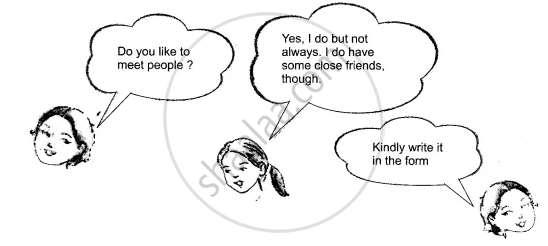
| Questions | Yes/No | Additional Response |
|
1. Do you like to meet people? |
Yes I do, but not always | I do have some close friends, though. |
|
2. Do you like the area you live in? |
No, I Don't | But I have no choice |
Choose a befitting adjective to describe the nature of squirrel.
Name the young lovers whose lives ended tragically because of a misunderstanding caused by the appearance of a lion.
Read the extract given below and answer the questions that follow:
| He gave her a shove. But she did not move, rather she let herself be moved only by him and nothing else. They edged away from her; they would not look at her. She felt them go away. |
- Who is ‘she’? On which planet is this story set? [2]
- Mention any two ways in which life on this planet differs from life on earth. [2]
- Who are ‘they’? Why did ‘they’ not come to her aid when William shoved her? [3]
- What do ‘they’ do to her at the end of the story? Why did they behave in this manner? [3]
