Advertisements
Advertisements
Question
What material Mr Gessler used to make the boots?
Advertisements
Solution
Mr Gessler made boots from the finest quality leather.
RELATED QUESTIONS
Who had these opinion about Einstein?
He was boring.
Now rewrite the pair of sentences given below as one sentence.
Grandfather told me about the old days. All books were printed on paper then.
Understanding the tenses:
The tense forms that have been practised and discussed in this chapter, allow
you to show accurately and subtly the time and the relationship of actions and
events with it. We use them in speech and writing.
Understanding and recognising how the tense forms are used.
Can you identity the present tense forms.
Simple Present Present Perfect
1. I llli!¥ tennis 1. I have played tennis
2. You read well. 2. You have read well.
3. She sees something 3. She has seen something.
Present Continuous
1. I am playing tennis
2. You are reading well
3. She is looking at something.
Simple Past Past Perfect
1. I knew about it 1. I had known about it
2. You took it away 2. You had taken it away
3. She finished her work. 3. She had finished her work.
Present Continuous Past Continuous
1. I am reading a book. I was reading a book.
2. They are playing football outside. They were playing football outside.
3. She is looking for her friend. Last week, she was looking for her friend.
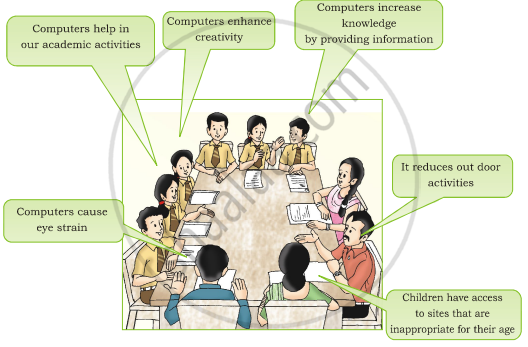
This is a meeting of the school’s Parent-Teacher Association. Some student representatives have also been invited to participate to discuss the role that Information technology/computers play in the growth and development of children.
What does he plant who plants a tree?
He plants cool shade and tender rain,
And seed and bud of days to be,
And years that fade and flush again;
He plants the glory of the plain;
He plants the forest's heritage;
The harvest of a coming age;
The joy that unborn eyes shall see___
These things he plants who plants a tree.
Read the lines given above and answer the question that follow:
What is meant by the ‘forest’s heritage’?
The black man's face bespoke revenge
As the fire passed from his sight.
For all he saw in his stick of wood
Was a chance to spite the white.
The last man of this forlorn group
Did nought except for gain.
Giving only to those who gave
Was how he played the game.
Their logs held tight in death's still hands
Was proof of human sin.
They didn't die from the cold without
They died from the cold within.
Read the lines given above and answer the question that follow.
Who are ‘they’ referred to here ? Where were they ?
It was a summer evening,
Old Kaspar's work was done,
And he before his cottage door
Was sitting in the sun,
And by him sported on the green
His little grandchild Wilhelmine.
She saw her brother Peterkin
Roll something large and round,
Which he beside the rivulet
In playing there had found;
He came to ask what he had found,
That was so large, and smooth, and round.
Read the lines given above and answer the question that follow.
What did Peterkin find?
Continuous as the stars that shine
And twinkle on the milky way,
They stretched in never-ending line
Along the margin of a bay:
Ten thousand saw I at a glance,
Tossing their heads in springhtly dance.
Read the lines given above and answer the question that follow.
How many did the poet see at a glance?
What are the three things Arragon was obliged by the oath to obey?
What information does Gilman give to Twisden? Why did Twisden decide to withdraw from the case ?
Define a dream in your own words.
The last two lines of the poem are not prohibitions or instructions. What is the adult now asking the child to do? Do you think the poet is suggesting that this is unreasonable? Why?
What happens when the adults give too many instructions to their children?
Which word in the extract means, ‘holes’?
Answer the following question:
Describe Kalpana Chawla’s first mission in space.
Multiple Choice Question:
What does the phrase pick their noses’ mean?
Fill in the blank to name a different kind of intelligence. One has been done for you.
When I enjoy listening to people and solving their problems I use my interpersonal intelligence
When I enjoy telling a story or arguing, I use my ____________ intelligence.
Answer the following question:
Why was the shop called ‘Lucky Shop’?
Who according to poet’s brother stares the poet?
Fill in the blanks with the words given in the box.
| how, what, when, where, which |
My friend lost his chemistry book. Now he doesn’t know ______ to do and ______ to look for it.
