Advertisements
Advertisements
Question
Now rewrite the pair of sentences given below as one sentence.
Grandfather told me about the old days. All books were printed on paper then.
Advertisements
Solution
Grandfather told me about the old days when all books were printed on paper.
RELATED QUESTIONS
What are the precious things mentioned in the story? Why are they precious?
Based on your reading of the story, answer the following question by choosing the correct option:
“The very naming of Harold had caused a sacrifice on his part.” The writer’s tone here is
Read the poem silently.
Two roads diverged in a yellow wood,
And sorry I could not travel both
And be one traveller, long I stood
And looked down one as far as I could
To where it bent in the undergrowth;
Then took the other, as just as fair,
And having perhaps the better claim,
Because it was grassy and wanted wear;
Though as for that the passing there
Had worn them really about the same,
And both that morning equally lay
In leaves no step had trodden black.
Oh, I kept the first for another day!
Yet knowing how way leads on to way,
I doubted if I should ever come back.
I shall be telling this with a sigh
Somewhere ages and ages hence:
Two roads diverged in a wood, and II
took the one less travelled by,
And that has made all the difference.
About the Poet
Robert Frost (1874-1963) was born in San Franscisco, Frost spent most of his adult
life in rural New England and his laconic language and emphasis on individualism in
his poetry reflect this region. He attended Dartmouth and Harvard but never earned a
degree. As a young man with a growing family he attempted to write poetry while
working on a farm and teaching in a school. American editors rejected his submitted
poems. With considerable pluck Frost moved his family to England in 1912 and the
following year, a London publisher brought out his first book. After publishing a
second book, Frost returned to America determined to win a reputation in his own
country, which he gradually achieved. He became one of the country's best-loved
poets. Unlike his contemporaries, Frost chose not to experiment with the new verse
forms but to employ traditional patterns, or as he said, he chose "the old-fashioned
way to be new." Despite the surface cheerfulness and descriptive accuracy of his
poems, he often presents a dark, sober vision of life, and there is a defined thoughtful
quality to his work which makes it unique.
I wandered lonely as a Cloud
That floats on high o'er vales and Hills,
When all at once I saw a crowd,
A host, of golden Daffodils;
Beside the Lake, beneath the trees,
Fluttering and dancing in the breeze.
Read the lines given above and answer the question that follow.
Who wandered like a lonely cloud and where ?
Abou Ben Adhem (may his tribe increase!)
Awoke one night from a deep dream of peace,
And saw, within the moonlight in his room,
Making it rich, and like a lily in bloom,
An angel writing in a book of gold:-
Read the lines given above and answer the following question.
What does the poet mean when he says “may his tribe increase”?
The athletes had come from all over the country
To run for the gold, for the silver and bronze
Many weeks and months of training
All coming down to these games.
The spectators gathered around the old field
To cheer on all the young women and men
The final event of the day was approaching
Excitement grew high to begin.
Read the lines given above and answer the following question:
Were the contestants well prepared for the event? Pick the line that illustrates this.
Mr. Oliver, an Anglo-Indian teacher, was returning to his school late one night on the outskirts of the hill station of Shimla. The school was conducted on English public school lines and the boys – most of them from well-to-do Indian families – wore blazers, caps and ties. “Life” magazine, in a feature on India, had once called this school the Eton of the East.
Mr. Oliver had been teaching in this school for several years. He’s no longer there. The Shimla Bazaar, with its cinemas and restaurants, was about two miles from the school; and Mr. Oliver, a bachelor, usually strolled into the town in the evening returning after dark, when he would take short cut through a pine forest.
Read the extract given below and answer the question that follow.
What did Mr Oliver generally do in the evening?
“You haven’t brought home that sick brat!” Anger and astonishment were in the tones of Mrs. Joe Thompson; her face was in a flame.
“I think women’s hearts are sometimes very hard,” said Joe. Usually Joe Thompson got out of his wife’s way, or kept rigidly silent and non-combative when she fired up on any subject; it was with some surprise, therefore, that she now encountered a firmly-set countenance and a resolute pair of eyes.
“Women’s hearts are not half so hard as men’s!”
Joe saw, by a quick intuition, that his resolute bearing h«d impressed his wife and he answered quickly, and with real indignation, “Be that as it may, every woman at the funeral turned her eyes steadily from the sick child’s face, and when the cart went off with her dead mother, hurried away, and left her alone in that old hut, with the sun not an hour in the sky.”
“Where were John and Kate?” asked Mrs. Thompson.
“Farmer Jones tossed John into his wagon, and drove off. Katie went home with Mrs. Ellis; but nobody wanted the poor sick one. ‘Send her to the poorhouse,’ was the cry.”
“Why didn’t you let her go, then. What did you bring her here for?”
“She can’t walk to the poorhouse,” said Joe; “somebody’s arms must carry her, and mine are strong enough for that task.”
Read the extract given below and answer the question that follow.
What was Mrs. Thompson’s reaction on seeing Maggie?
What was the inscription on the golden casket? How do the actions of the martlet illustrate this inscription?
What information does Gilman give to Twisden? Why did Twisden decide to withdraw from the case ?
With whom did the music teacher compared Ravi with?
What do you think the man said to his friend who waited at the door?
What was the connection between the motor and the fan’s Chatter?
Why did Plan B fail?
There are twelve words hidden in this table. Six can be found horizontally and the remaining six vertically. All of them are describing words like ‘good’, ‘happy’, etc. The first letters of the words are given below:
Horizontal: H R F F S G
Vertical: A W S F L Q 2020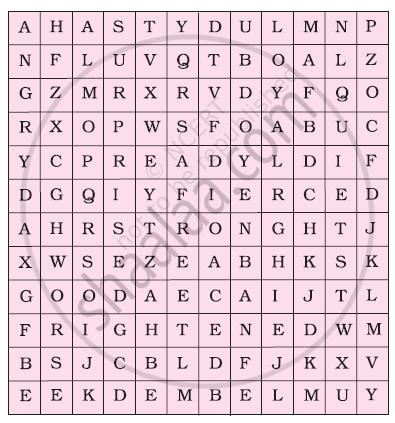
What changes came in Patrick’s behaviour in the end?
Multiple Choice Question:
Which one of the following is not associated with the kite’s movement?
Why do you think she/he has these worries? Can you think of ways to get rid of such worries?
Fill in the blanks with the words given in the box.
| how, what, when, where, which |
Do you know ______ to ride a bicycle? I don’t remember ______ and ______ I learnt it
Choose the option that lists the sequence of events from Alphonse Daudet’s short story ‘The Last Lesson’ in the correct order.
- But, when he arrived at school, Franz was dismayed to find his classmates already seated quietly and solemnly in their places ... and shocked when M. Hamel simply urged him to take his place.
- Franz hurried to school that morning he was very late and dreaded being scolded by M. Hamel, the teacher.
- After he had settled at his desk, he noticed something really odd: the back benches of the classroom were occupied by adults from the village!
- He hoped to slip into the classroom unnoticed, under cover of the bustle and noise of a typical school day morning.
