Advertisements
Advertisements
Question
The words helper, companion, partner and accomplice have very similar meanings, but each word is typically used in certain phrases. Can you fill in the blanks below with the most commonly used words? A dictionary may help you.
my ……………. on the journey.
Options
helper
companion
partner
accomplice
Advertisements
Solution
my companion on the journey.
RELATED QUESTIONS
Answer this question in 30–40 words.
Find at least two instances in the text which tell you that Bismillah Khan loves India and Benaras.
Thinking about the Poem
Which country or countries do you think “the Northland” refers to?
What is Johnsy’s illness? What can cure her, the medicine or the willingness to live?
Answer the following question in one or two sentences.
Who were Abdul Kalam’s school friends? What did they later become?
Now, it is your turn. Write and produce your own radio programme. You will need to select your own content. The following are some ideas. You are free, of course, to add your own ideas. Remember, the programme must be in English.
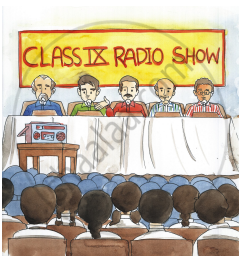
- News stories: about people in your class, about school, about sports (school and local), about the local community
- Comedy: jokes, short plays
- Interviews: with teachers, with exstudents of your school, with a Class IX student who has recently done something very interesting
- Games: general knowledge quiz, panel game, word game
- Advertisements: for shops/industries in the local community, things ‘for sale’ and ‘wanted’ by students
- Local sites: monuments/sites of historical importance and of tourist interest
- Special reports: e.g. safety at school, examination results, school uniform, school assemblies
- Interesting people: role-play interviews with film stars, sports personalities, TV personalities, etc.
- Entertainment reviews: music, films, videos, books, etc.
- Plays
- Songs with lyrics
- Speeches on important personalities
- Tele conference video conference with students, teachers, experts
Some are like fields of sunlit corn,
Meet for a bride on her bridal morn,
Some, like the flame of her marriage fire,
Or, rich with the hue of her heart's desire,
Tinkling,luminous,tender, and clear,
Like her bridal laughter and bridal tear.
Read the lines given above and answer the question that follow.
The poet has used several expressions which form pictures in the readers mind “fields of sunlit corn” and “circles of light”. Pick out more such expressions from the poem.
Its a cruel thing to leave her so.”
“Then take her to the poorhouse: she’ll have to go there,” answered the blacksmith’s wife, springing away, and leaving Joe behind.
For a little while the man stood with a puzzled air; then he turned back, and went into the hovel again. Maggie with painful effort, had raised herself to an upright position and was sitting on the bed, straining her eyes upon the door out of which all had just departed, A vague terror had come into her thin white face.
“O, Mr. Thompson!” she cried out, catching her suspended breath, “don’t leave me here all alone!” ,
Though rough in exterior, Joe Thompson, the wheelwright, had a heart, and it was very tender in some places. He liked children, and was pleased to have them come to his shop, where sleds and wagons were made or mended for the village lads without a draft on their hoarded sixpences.
“No, dear,” he answered, in a kind voice, going to the bed, and stooping down over the child, “You she’n’t be left here alone.” Then he wrapped her with the gentleness almost of a woman, in the clean bedclothes which some neighbor had brought; and, lifting her in his strong arms, bore her out into the air and across the field that lay between the hovel and his home.
Read the extract given below and answer the question that follow.
Who said, ‘It’s a cruel thing to leave her so.’ Why did he say this?
She lighted another match, and then she found herself sitting under a beautiful Christmas-tree. It was larger and more beautifully decorated than the one which she had seen through the glass door at the rich merchant’s. Thousands of tapers were burning upon the green branches, and colored pictures, like those she had seen in the show- windows, looked down upon it all. The little one stretched out her hand towards them, and the match went out.
The Christmas lights rose higher and higher, till they looked to her like the stars in the sky. Then she saw a star fall, leaving behind it a bright streak of fire. “Someone is dying,” thought the little girl, for her old grandmother, the only one who had ever loved her, and who was now dead, had told her that when a star falls, a soul was going up to God.
Read the extract given below and answer the question that follow.
How did the Christmas lights appear when the match went out?
Then there it lay in her wet palm, perfect, even pierced ready for use, with the sunset shuffled about inside it like gold—?dust. All her heart went up in flames of joy. After a bit she twisted it into the top of her skirt against her tummy so she would know if it burst through the poor cloth and fell. Then she picked up her fork and sickle and the heavy grass and set off home. Ai! Ai! What a day! Her barefeet smudged out the wriggle— ?mark of snakes in the dust; there was the thin singing of malaria mosquitoes among the trees now; and this track was much used at night by a morose old makna elephant—the Tuskless One; but Sibia was not thinking of any of them. The stars came out: she did not notice. On the way back she met her mother, out of breath, come to look for her, and scolding. “I did not see till I was home, that you were not there. I thought something must have happened to you.” And Sibia, bursting with her story, cried “Something did). I found a blue bead for my necklace, look!”
Read the extract given below and answer the question that follow.
Why did Sibia feel overjoyed?
What does ti» poet wish for al the end ~f the poem? What does tl1e poem tell the readers about the poet? Give a reason to justify yow· answer.
Read the following passage carefully and answer the questions that follow:
Every Monday, on his way back from work, Bipin Chowdhury would drop in at New Market to buy books. He had to buy at least five at a time to last him through the week. He lived alone, was not a good mixer, had few friends, and didn't like spending time in idle chat. Those who called in· the evening got through their business quickly and left. Those who didn't show signs of leaving would be told around eight o'clock by Bipin Babu that he was under doctor's orders to have dinner at eight-thirty. After dinner, he would rest for half an hour and then tum in with a book. This was a routine that had persisted unbroken for years
Today, Bipin Babu had the feeling that someone was observing him from close quarters. He turned around and found himself looking at a round-faced, meek-looking man who now broke into a smile.
"I don't suppose you recognize me." Bipin Babu felt ill at ease. It didn't seem that he had ever encountered this man before. The face seemed quite unfamiliar.
"Have we met before ?" asked Bipin Babu.
The man looked greatly surprised. "We met every day for a whole week. I arranged for a car to take you to the Hudroo falls. My name is Parimal Chose."
"Ranchi?"
Now Bipin Babu realized this man was making a mistake. Bipin Babu had never been to Ranchi. He smiled and said, "Do you know who I am?"
The man raised his eyebrows, and said, "Who doesn't know Bipin Chowdhury ?"
Bipin Babu turned towards the bookshelves and said, "You've to make a mistake. I've never been to Ranchi."
The man now laughed aloud.
"What are you saying, Mr. Chowdhury? You had a fall in Hudroo and cut your right knee. I brought you iodine. I had fixed up a car for you to go to Netarhat the next day, but you couldn't because of the pain in the knee. Can't you recall anything? Someone else you know was also in Ranchi at that time. Mr. Dinesh Mukherjee. You stayed in a bungalow. You said you didn't like hotel food. I'll tell you more; you always carried a bag with your books in it on your sightseeing trips. Am I right or not ?"
Bipin Babu spoke quietly, his eyes still on the books. "Which month in Nineteen fifty-eight are you talking about?"
The man said, "October."
"No, sir," said Bipin Babu. "I spent October Nineteen fifty-eight with a friend in Kanpur. You're making a mistake. Good day."
But the man didn't go, nor did he stop talking.
"Very strange. One evening I had tea with you on the verandah of your bungalow.
You spoke about your family. You said you had no children, and that you had lost your wife a decade ago."
When Bipin Babu had paid for the books and was leaving the shop, the man was still looking at him in utter disbelief.
Bipin Babu's car was safely parked in Bertram Street. He told the driver as he got into the car, "Just drive by the Ganga, will you, Sitaram." Driving up the Strand Road, Bipin Babu regretted having paid so much attention to the intn1der. He had never been to Ranchi. He had an excellent memory.
Unless he was losing his mind!
(a) Give the meaning of the following words as used in the passage.
One word answers or short phrases will be accepted.
(i) persisted (line 7)
(ii) decade (line 38)
(iii) intruder (line 43)
(b) Answer the following questions briefly in your our words:
(i) How did Bipin Chowdhury find time to read five books a week?
(ii) How did he get rid of visitors who stayed late?
(iii) Which sentence tells you that Bipin Babu will uncomfortable?
(iv) What strong argument did Bipin Babu give to prove that he was not in Ranchi at that time?
(v)What does Bipin Babu regret?
(vi) What is Bipin Babu's feelings at the end of the passage?
(c) (i) What memories of the trip does Parimal Ghose evoke to prove that Bipin Babu was indeed in Ranchi? Answer in not more than 60 words.
(ii) Give a title to your summary in 3(c) (i), Give a reason to justify your choice.
Answer the following question.
What are some of the signs of approaching winter referred to in the text?
Why did he buy a young goat?
Abbu Khan pushed Chandni into a small hut. This shows that he
In answer to the second question, whose advice did the people say would be important to the king?
Now write the story in your own words. Give it a title.
Does father lose all his hope of bringing the cat down?
Word in the box given below indicates a large number of… For example, ‘a herd of cows’ refers to many cows. Complete the following phrase with a suitable word from the box.
a _______________ of cattle
What is the mystery about the child’s school teacher? How does it plan to discover the truth?
Read the following passage carefully and answer the questions that follow:
|
That huge bell never stopped ringing. It got us out of bed, it summoned us for meals, it rang between class periods, it sent us unwillingly to bed. One morning it failed to ring, or rather, there was no bell to ring. Someone had removed it, and it wasn't found till late in the afternoon. What a glorious day! As there was no bell to rouse us, everyone got up late, and there was no morning PT. Some of us missed breakfast too. The teachers got confused and mixed up their classes. How could the school manage without it? Confusion reigned. Of course, no one owned up. It could have meant expulsion. Some suspicion fell on the Sports Captain because of our aversion to morning PT, but nothing could be proved. No one was very anxious to find the bell - we were quite happy without it - but it was finally discovered hanging from a branch of one of the trees. ‘It may have been Mr. Sharma,' surmised Brian. Mr. Sharma, our Maths teacher, was known to walk in his sleep. And sleepwalkers did funny things sometimes. ‘It could be Mool Chand himself,’ suggested Cyrus Satralkar. Mool Chand was the school chowkidar, who also had the job of banging the brass bell at appointed times. ‘Why would he throw it away?’ ‘He must be as fed up with ringing it as we are of hearing it.’ This was my theory. ‘Perhaps he wants a rise in salary.’ The identity of the culprit remained a mystery. Happily, the senior Hockey team went on a winning spree against all corners, and our month-end exits were restored. But soon there was another sensation. A girl was admitted to our class! The boys were scandalized. No girl had ever studied in our school before. We protested. ‘What’s the problem?’ asked Mr. Knight, our class master. ‘Haven’t you seen a girl before?’ ‘But - but. Sir ...’ Tata was our spokesman. ‘How will we concentrate on our studies?’ ‘When did you ever concentrate on your studies, Tata?’ ‘Are we going co-ed, sir?’ Adams wanted to know. ‘Not at all,’ said Mr. Knight. ‘This is a special case. She is the school accounts manager’s daughter, and he can’t afford the Girls school fees. So, I’m sure you’ll make her feel very welcome.’ The accountant was a popular man who also ran the school’s tuck shop and allowed most of us a certain amount of credit. All our objections faded away. At first, Sunita, our new entrant, was a bit of a distraction because, although she was very shy and demure, she had lovely curly hair, bright eyes, pink cheeks and a smile for everyone. All the boys were very polite and attentive to her and Brian in particular was always ready to help her. |
- For each word given below choose the correct meaning (as used in the passage) from the options provided: (3)
- summoned (line 1)
- totalled
- ordered
- requested
- shout
- aversion (line 10)
- hatred
- fear
- politeness
- creation
- restored (line 25)
- helped
- returned
- permit
- victory
- summoned (line 1)
- Answer the following questions briefly in your own words.
- Why did no one confess to having removed the missing bell? (1)
- Why did suspicion fall on the Sports Captain? (2)
- What made Brian think that it was Mr. Sharma? (2)
- Which sentence in the passage tells you that Mr. Knight thought poorly of Tata’s academic performance? (2)
- Why was the accountant a popular man? (2)
- In not more than 50 words describe the effects of the lost bell. (8)
