Advertisements
Advertisements
Question
Where did Mr Gessler live?
Advertisements
Solution
Mr Gessler lived in London in his shoe shop.
RELATED QUESTIONS
Expressions used to show fear
Can you find the expressions in the story that tell you that the author was frightened?
Read the story and complete the following sentences.
1. I was turned ______.
2. I sat there holding ______.
3. In the light of the lamp I sat there like ______.
Read the following passage carefully and answer the questions that follow :
Billy Weaver had travelled down from London, and by the time he arrived, it was nine o’clock in the night, and the moon was coming up.
“Excuse me,” he asked a porter. “But is there a cheap hotel nearby?”
“Try the Bell Hotel,” the porter answered, pointing down the road.
Billy thanked him, picked up his suitcase, and set out to walk the distance to the Bell Hotel. He had never been to Richmond before, but the man at the office had told him it was a splendid city.
Billy was seventeen years old. He was wearing a new navy blue overcoat, a new brown hat, and a new brown suit, and he was feeling fine. He walked briskly down the street. He was trying to do everything briskly these days. The big shots up at the head office were fantastically brisk all the time. They were amazing.
The road was lonely and dark, with a few scattered houses.
Suddenly, in a downstairs window, Billy saw a printed notice propped up against the window glass. It said bed and breakfast.
He moved a bit closer and peered through the window into the room, and the first thing he saw was a bright fire burning in the hearth. On the carpet in front of the fire, a little dog was curled up asleep with its nose tucked into its belly. The room, in its half-darkness, was filled with pleasant furniture. There was a piano, a big sofa, and several plump armchairs. In one corner, he spotted a large parrot in a cage. Animals were usually a good sign in a place like this, Billy told himself, and it looked to him as though it would be a pretty decent house to stay in.
Then a queer thing happened to him. He was in the act of stepping back and going away from the window when he felt a strange urge to ring the bell!
He pressed the bell. He heard it ring, and then, at once, the door swung open, and a woman stood there.
She gave him a warm, welcoming smile.
“Please come in,” she said pleasantly. Billy found himself automatically moving forward into the house.
“I saw the notice in the window,” he said, holding himself back.
“Yes, I know.”
“I was wondering about a room.”
“It’s already for you, my dear,” she said. She had a round, pink face and very gentle blue eyes.
“How much do you charge?”
“Five dollars a night, including breakfast.”
It was fantastically cheap. He could easily afford it.
(a) Give the meaning of the following words used in the passage: One-word answers or short phrases will be accepted. [3]
(i) splendid (line 7)
(ii) spotted (line 20)
(iii) automatically (line 29)
(b) Answer the following questions briefly in your own words.
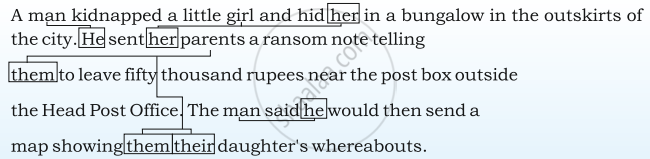
Look at the passage below and study how the personal pronouns refer to different people.
"They say it was a shocking sight
After the field was won;
For many thousand bodies here
Lay rotting in the sun;
But things like that, you know, must be
After a famous victory.
"Great praise the Duke of Marlbro'won,
And our good Prince Eugene."
"Why,'twas a very wicked thing!"
Said little Wilhelmine.
"Nay...nay...my little girl,"quoth he,
"It was a famous victory.
"And everybody praised the Duke
Who this great fight did win."
"But what good came of it at last?"
Quoth little Peterkin.
"Why that I cannot tell,"said he,
"But 'twas a famous victory."
Read the lines given above and answer the question that follow.
How do the skulls symbolize the theme in “The Battle of Blenheim”?
It matters little where we pass the remnant of our days. They will not be many. The Indian’s night promises to be dark. Not a single star of hope hovers above his horizon. Sad-voiced winds moan in the distance. Grim fate seems to be on the Red Man’s trail, and wherever he will hear the approaching footsteps of his fell destroyer and prepare stolidly to meet his doom, as does the wounded doe that hears the approaching footsteps of the hunter.
A few more moons, a few more winters, and not one of the descendants of the mighty hosts that once moved over this broad land or lived in happy homes, protected by the Great Spirit, will remain to mourn over the graves of a people once more powerful and hopeful than yours. But why should I mourn at the untimely fate of my people? Tribe follows tribe, and nation follows nation, like the waves of the sea. It is the order of nature, and regret is useless. Your time of decay may be distant, but it will surely come, for even the White Man whose God walked and talked with him as friend to friend, cannot be exempt from the common destiny. We may be brothers after all. We will see.
Read the extract given below and answer the question that follow.
How does the speaker realize that he should not mourn the untimely fate of his people?
She lighted another match, and then she found herself sitting under a beautiful Christmas-tree. It was larger and more beautifully decorated than the one which she had seen through the glass door at the rich merchant’s. Thousands of tapers were burning upon the green branches, and colored pictures, like those she had seen in the show- windows, looked down upon it all. The little one stretched out her hand towards them, and the match went out.
The Christmas lights rose higher and higher, till they looked to her like the stars in the sky. Then she saw a star fall, leaving behind it a bright streak of fire. “Someone is dying,” thought the little girl, for her old grandmother, the only one who had ever loved her, and who was now dead, had told her that when a star falls, a soul was going up to God.
Read the extract given below and answer the question that follow.
What did she see when she lighted another match?
Read the extract given below and answer the questions that follow:
Where the mind is without fear and the head is held high
Where knowledge is free
Where the world has not been broken up into fragments
By narrow domestic walls (Where the Mind is Without Fear: Rabindranath Tagore)
(i) To whom is the poet praying? Whose mind is the poet referring to at the beginning of the poem? Why?
(ii) In which situation is the lead held high? What does he mean by 'knowledge is free'? What are 'narrow domestic walls'?
(iii) What does the poet mean by 'tireless striving'? What does 'clear stream' refer to? Explain.
(iv) What is meant by 'dead habit'? What is 'dead habits' compared to and why?
(v) What does ti» poet wish for al the end ~f the poem? What does tl1e poem tell the readers about the poet? Give a reason to justify yow· answer.
What did the kind farmer do with the money he made from the gold?
Mr Gessler in his last wasn’t in good health. Give three examples to prove this.
Why do the ants train the greenfly?
How did the customer feel after freeing the doves?
Why was everyone delighted to see the iron chest on the camel’s back?
What do you think the man said to his friend who waited at the door?
Who is giving these instructions?
What are the games or human activities which use trees, or in which trees also ‘participate’?
Which incident made the visitor to the school ten times more thoughtful than ever?
What are some of the particular habits of the mongoose and the camel?
Look at the following phrases and their meanings. Use the phrase to fill in the blank in the sentence given below.
A fund has been _____________ for the soldiers’ families.
According to the speaker’s brother, where did the ghost hid himself?
Based on the following points write a story.
- Your aunt has gone to her mother’s house.
- Your uncle does his cooking.
- He is absent-minded.
- He puts vegetables on stove
- He begins to clean his bicycle outside.
- The neighbour calls out saying something is burning.
- Your uncle rushes to the kitchen.
- To save vegetables, he puts some oil in them.
- Unfortunately, it’s machine oil, not cooking oil.
- What do you think happens to the vegetables?

Begin like this: Last month my aunt decided to visit her parents...
