Advertisements
Advertisements
Question
Answer these question in one or two sentences. (The paragraph numbers within brackets provide clues to the answer.)
Why was the ‘holy man’ who gave Santosh’s mother his blessings surprised?
Advertisements
Solution
The ‘holy man’ had assumed that Santosh’s mother wanted a son as the part of the society she belonged to regarded birth of a son as a blessing. However, he was surprised when the unborn child’s grandmother told him that they did not want a son.
RELATED QUESTIONS
Can you think of any scientists, who have also been statesmen?
Reviewing verb forms
India's Major concerns
Read the following paragraph. Then work in pairs and list the different ways in which you can contribute to save Mother Earth. As an individual you can make a major contribution towards reducing India's over all emission level.

How to save the Environment at Home
There are plenty of small steps that people can take at home to help save the environment. While the eco-footprint of each step is small, thousands of people doing the same thing can make a difference. In making some small changes to the way that you do things at home, you are gradually making a difference, even as an individual. You will kill costs and improve your health at the same time, so helping to save the environment isn't an entirely altruistic exercise after all!
|
SAVE MOTHER EARTH CAMPAIGN |
Working in groups of four, create your own mystery story. You may use the following chart to plan your story.
| Title of ‘Solve-it Story’ | |
| Main Character | |
| Secondary character | |
| Setting (where and when) | |
| Problem | |
| Main events | |
| Climax | |
| Solution/Conclusion |
The blocks were all lined up for those who would use them
The hundred-yard dash and the race to be run
These were nine resolved athletes in back of the starting line
Poised for the sound of the gun.
The signal was given, the pistol exploded
And so did the runners all charging ahead
But the smallest among them,he stumbled and staggered
And fell to the asphalt instead.
He gave out a cry in frustration and anguish
His dreams ands his efforts all dashed in the dirt
But as sure I'm standing here telling this story
The same goes for what next occurred.
Read the lines given above and answer the following question:
Explain with reference to context.
“You haven’t brought home that sick brat!” Anger and astonishment were in the tones of Mrs. Joe Thompson; her face was in a flame.
“I think women’s hearts are sometimes very hard,” said Joe. Usually Joe Thompson got out of his wife’s way, or kept rigidly silent and non-combative when she fired up on any subject; it was with some surprise, therefore, that she now encountered a firmly-set countenance and a resolute pair of eyes.
“Women’s hearts are not half so hard as men’s!”
Joe saw, by a quick intuition, that his resolute bearing h«d impressed his wife and he answered quickly, and with real indignation, “Be that as it may, every woman at the funeral turned her eyes steadily from the sick child’s face, and when the cart went off with her dead mother, hurried away, and left her alone in that old hut, with the sun not an hour in the sky.”
“Where were John and Kate?” asked Mrs. Thompson.
“Farmer Jones tossed John into his wagon, and drove off. Katie went home with Mrs. Ellis; but nobody wanted the poor sick one. ‘Send her to the poorhouse,’ was the cry.”
“Why didn’t you let her go, then. What did you bring her here for?”
“She can’t walk to the poorhouse,” said Joe; “somebody’s arms must carry her, and mine are strong enough for that task.”
Read the extract given below and answer the question that follow.
How did Joe counter his wife on her remark about Maggie?
Lights were shining from every window, and there was a savoury smell of roast goose, for it was New-year’s eve—yes, she remembered that. In a corner, between two houses, one of which projected beyond the other, she sank down and huddled herself together. She had drawn her little feet under her, but she could not keep off the cold; and
she dared not go home, for she had sold no matches, and could not take home even a penny of money. Her father would certainly beat her; besides, it was almost as cold at home as here, for they had only the roof to cover them, through which the wind howled, although the largest holes had been stopped up with straw and rags. Her little hands were almost frozen with the cold. Ah! perhaps a burning match might be some good, if she could draw it from the bundle and strike it against the wall, just to warm her fingers. She drew one out—“scratch!” how it sputtered as it burnt! It gave a warm, bright light, like a little candle, as she held her hand over it. It was really a wonderful light. It seemed to the little girl that she was sitting by a large iron stove, with polished brass feet and a brass ornament. How the fire burned! and seemed so beautifully warm that the child stretched out her feet as if to warm them, when, lo! the flame of the match went out, the stove vanished, and she had only the remains of the half-burnt match in her hand.
Read the extract given below and answer the question that follow.
Why could the girl not go home?
Then, trying to hide my nervousness, I added, “How are you?”
“I’m fine. The question is: How are you?“
“What do you mean?” 1 asked “Something must be eating you,” he said—proud the way foreigners are when they’ve mastered a bit of American slang. “You should be able to qualify with your eyes closed.”
“Believe me, I know it,” I told him—and it felt good to say that to someone.
For the next few minutes we talked together. I didn’t tell Long what was “eating” me, but he seemed to understand my anger, and he took pains to reassure me. Although he’d been schooled in the Nazi youth movement, he didn’t believe in the Aryan-supremacy business any more than I did. We laughed over the fact that he really looked the part, though. An inch taller than I, he had a lean, muscular frame, clear blue eyes, blond hair and a strikingly handsome, chiseled face. Finally, seeing that I had calmed down somewhat, he pointed to the take-off board.
“Look,” he said. “Why don’t you draw a line a few inches in back of the board and aim at making your take-off from there? You’ll be sure not to foul, and you certainly ought to jump far enough to qualify. What does it matter if you’re not first in the trials? Tomorrow is what counts.”
Read the extract given below and answer the question that follow.
Why did Jesse Owens foul the first two jumps in the trial?
Answer the following question.
Who advised Golu to go to the Limpopo river?
How does Ravi get milk for the kitten?
Describe the king in your own words.
Mridu had noticed in front of Meena’s house a pair of chappals. Whom did they belong to?
Describe the process of invention of Vita-Wonk.
Give some examples of fuel.
What misfortune came to Chandni after sunset?
What must have been called as the ‘drinking straws’ by the poet?
Read the newspaper report to find the following facts about Columbia’s ill-fated voyage.
Number of experiments done by scientists: ____________
Look at the following picture. One asks a question, the other answers it. Then the answer is noted in a form as shown below.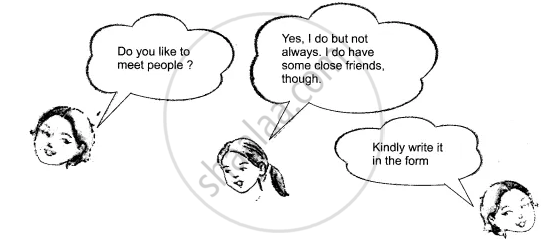
| Questions | Yes/No | Additional Response |
|
1. Do you like to meet people? |
Yes I do, but not always | I do have some close friends, though. |
|
2. Do you like the area you live in? |
No, I Don't | But I have no choice |
Who does not like the rebels?
Ray Bradbury’s short story ‘The Pedestrian’, can be best described as ______.
