English

The Teacher Will Read Out the Story of a Young Girl About a Special Day Given - English - Communicative

Advertisements
Advertisements

Question

The teacher will read out the story of a young girl about a special day.

One day our teacher announced that there was a surprise awaiting us the next day. We were asked to get whatever little pocket money we could.
The next day our teacher said, 'Today is Grandparents' Day' and you will be meeting many grandparents who do not live with their families. Yes, we were going to an Old Age Home! On the way we bought a nice big cake, chart paper and balloons. We entered an old, big building. Later we were taken into a hall and were allowed to decorate it.
We blew balloons and hung them around the hall. We cut out chart paper, wrote quotes, drew pictures and stuck them on the wall. Then came in all the grey–haired sweethearts, some alone, some couples, some in groups ans settled down.
It was time to welcome them. Robert, who was a good speaker, greeted them and told them that we had come along to make their day a little special. We gathered in front and started singing songs for them. Most of the people were single grandparents whose spouses had expired. The other few were couples; many of them were smiling and singing along too. But there were a few who sat without any expression. While some of us sang the others sat beside them and spoke to them.
Two of us cut the cake into several pieces to be distributed. We were informed by the caretaker that there were diabetic people amongst them and they couldn't have sweets. He said they could have fruit instead the non-diabetics and fruit to those who were diabetic. Many of them missed their grand children. One of them told me that her son was in the U.S. and as he found it difficult to look after her, he had left her at this Home.
While returning home we realized that our grandparents are lonely and insecure. They spend their second childhood in their old age homes. Most of those living in old age homes do not complain. It is left to us to decide how happy their old age can be. We do not need any special day to make them feel their worth. If you have never told them how much you love them, say it before it's too late.

(b) List any three feelings of the old people in this story.

  1. _____________________________
  2. _____________________________
  3. _____________________________

(c) Complete the following :

  1. We can make our grandparents happy by ________________
  2. We can avoid constructing more and more Old Age Homes by___________
Fill in the Blanks
Advertisements

Solution

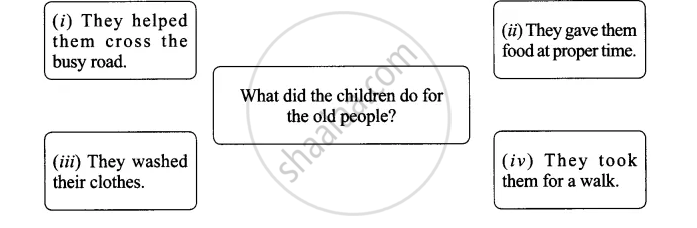
(a)Answer

(b) Answer

  1. They feel dependent.
  2. They feel helpless due to extreme old age.
  3. They feel proud of their children who are so caring to them.

(c) Answer

  1. giving them proper care.
  2. giving them honourable place in our own house.
shaalaa.com
Reading
  Is there an error in this question or solution?
Chapter 1.1: How I Taught My Grandmother to Read - Exercise [Page 9]

APPEARS IN

CBSE English Communicative - Literature Reader [English] Class 9
Chapter 1.1 How I Taught My Grandmother to Read
Exercise | Q 7 | Page 9

RELATED QUESTIONS

Answer these question in a few words or a couple of sentence.

What things about the book did she find strange?


Can you think of some other ending for the story?


Choose extracts from the story that illustrate the characters of these people in it.

Person character Extracts from the story What does it tell us about their character 
Mrs Bramble (Para 12) "Bill we must keep it from Harold" She was not honest and open with her son; concerned mother
Mrs Bramble (Para 33)  
Percy (Para 109)  
Jerry Fisher (Para 110)  


The world's most famous female aviator, Amelia Earhart, disappeared in 1937, as she attempted to become the first woman to fly around the world with her navigator, Fred Noonan. She was last heard when she was around 100 miles from the tiny Pacific Howland Island on July 2, 1937. 

Read the story of her 'Final Flight'. 

On June 1, 1937 Amelia and her navigator Fred Noonan departed from Miami, Florida; bound for California. Their first destination was San Juan, Puerto Rico; from there, skirting the northeast edge of South America; and then on to Africa and the Red Sea. 

The flight to Karachi was another first. No one had previously flown non-stop from the Red Sea to India before. From Karachi, the Electra flew to Calcutta on June 17 from there on, to Rangoon, Bangkok, Singapore and Bandoeng. 

The monsoon prevented departure from Bandoeng for several days. Repairs were made on some of the 'long distance' instruments which had given trouble previously. During this time, Amelia became ill, and suffered from dysentery that lasted several days. 

It was June 27 before Amelia and Noonan were able to leave Bandoeng for Port Darwin, Australia. At Darwin, the direction finder was repaired, and the parachutes were packed and shipped home as they would be of no value over the Pacific .

Amelia reached Lae in New Guinea on June 29. At this point they had flown 22,000 miles and there were 7,000 more to go over the Pacific. Amelia cabled her last commissioned article to the Herald Tribune. Photos show her looking very tired and ill during her time at Lac.

The U.S. Coast Guard cutter, Itasca had been standing off Howland Island for some day to act as a radio contact for Amelia Radio communications in the area were very poor as Itasca was overwhelmed with commercial radio traffic that the flight had generated . 

Amelie left Lae at preciaely 00:00 hours Greenwich Mean Time on July 2 . It is believed that the Electra was loaded with 1,000 gallons of fuel , allowing for 20-21 hours of flying .
At 07:20 hours GMT Amelia provided a position report placing the Electra on course as some 20 miles southwest of the Nukumanu Islands . The last weather report Amelia was known to have received was before take-off . The head wind speed had increased by 10-12 mph, but it is not known if she ever received the report.
At 08:00 GMT Amelia made her last radio contact with Lae . she reported being on course for Howland Island at 12,000 feet . There is no real evidence as to the precise track of the aircraft after Nukumanu . No one saw or heard the plane fly over .
Several short transmissions were received by the Itasca with varying signal strengths but they were unable to get a fix on her location because they were too brief. At 19:30 GMT the following transmission was received from the Electra at maximum strength. 
"KHAQQ calling Itasca. We must be on you but cannot see you ... gas is running low ... " 

At 20: 14 GMT, the Itasca received the last voice transmission from Amelia giving positioning data. The Itasca continued to transmit on all frequencies until 21:30 hours GMT. They determined that Amelia must have died at sea and began to implement search procedures. 

It has been determined that the plane went down some 35-100 miles off the coast of Howland Island. A life raft was stowed on board but no trace was ever found of the raft. Some experts felt that the empty fuel tanks could keep the plane afloat for a period of time. 

President Roosevelt authorized a search party of 9 naval ships and 66 aircrafts at an estimated cost of over $4 million. On July 18, the search was abandoned by ships in the Howland area. George continued to seek help in the search, but by October he too abandoned all hope of finding them alive. 

Amelia had been sending letters to George at stopovers all along her route quite regularly. These were published in the book 'Last Flight'. The book has a note from her to George .... 
"Please know I am quite aware of the hazards ... I want to do it because I want to do it. Women must try to do things as men have tried. If they fail, their failure must be, but a challenge to others. " 

Amelia created a number of aviation records : 
o The first woman to fly across the Atlantic in 1928 
o The second person to fly solo across the Atlantic in 1932 
o The first person to fly solo from Hawaii to California in 1935 Guided by her publicist and husband, George Putnam, she made headlines in an era when aviation had gripped the public's imagination. 


Notice how ideas are connected in the story.

Write what the following words you just used in 1.1 imply by choosing suitable options from the box.

  • and:
  • but:
  • where:
  • while:
  • after:
  • until:
  • so :

connects similar actions, objects
denotes contrast
denotes time.

The words given above are called connectors. Connectors do not simply join sentences together; they also show how ideas are related.
There are many different ways of classifying connectors according to their meaning. We shall start with the ones you are already familiar with.


Some are like fields of sunlit corn,
Meet for a bride on her bridal morn,
Some, like the flame of her marriage fire,
Or, rich with the hue of her heart's desire,
Tinkling,luminous,tender, and clear,
Like her bridal laughter and bridal tear.

Read the lines given above and answer the question that follow.

Explain with reference to context.


A free bird leaps on the back
Of the wind and floats downstream
Till the current ends and dips his wing
In the orange suns rays
And dares to claim the sky.

Read the above lines and answer the question that follow.

What does the caged bird’s singing reveal about him?


The angel wrote and vanished.
The next night, It came again with a great wakening light,
And show's the names whom love of God had blest,
And Lo! Bin Adhem's name led all the rest.

Read the lines given above and answer the following question.

Did the angel appear again?


Mr Gessler in his last wasn’t in good health. Give three examples to prove this.


The monkey was happy living in the fruit tree, but his happiness was not complete, what did he miss?


Who hides behind the trees in “Hide and Seek.”


Does father lose hope?


Complete the following sentence.
The old banyan tree “did not belong” to grandfather, but only to the boy, because _________


In groups of four, discuss the following lines and their meanings.

For many of the loveliest things
Have never yet been said


Multiple Choice Question:

When do strange questions strike the poet?


Answer the following question.
When Jumman’s aunt realised that she was not welcome in his house, what arrangement did she suggest?


What change occurs in the attitude of the speaker?


Encircle the correct article.

Would you like (a/an/the) apple or (a/an/the) banana?


Why did the author order so many pairs of boots? Did he really need them?


In what ways does power corrupt in the play Macbeth? Discuss any one character who is corrupted by power in the play. Incorporate the following details and answer in 100-150 words.

  1. The character’s traits before coming to power
  2. The character’s degeneration after coming into power

Share
Notifications

Englishहिंदीमराठी


      Forgot password?
Use app×