Advertisements
Advertisements
Question
Look at the following sentences. They each have two clauses, or two parts each with their own subject and verb or verb phrase. Often, one part (italicised) tells us when or why something happened.
• I reached the market when most of the shops had closed. (Tells us when I reached.)
• When Rahul Dravid walked back towards the pavilion, everyone stood up. (Tells us when everyone stood up.)
• The telephone rang and Ganga picked it up. (Tells us what happened next.)
• Gunjan has been with us ever since the school began. (Tells us for how long he has been with us.)
I. Identify the two parts in the sentences below by underlining the part that gives us the information in brackets.
1. Where other girls wore traditional Indian dresses, Santosh preferred shorts.
(Contrasts her dress with that of others)
2. She left home and got herself enrolled in a school in Delhi. (Tells us what happened after the first action.)
3. She decided to fight the system when the right moment arrived. (Tells us when she was going to fight the system.)
4. Little Maria had not yet celebrated her tenth birthday when she was packed off to train in the United States. (Tells us when Maria was sent to the U.S.)
Advertisements
Solution
1. Where other girls wore traditional Indian dresses, Santosh preferred shorts.
2. She left home and got herself enrolled in a school in Delhi.
3. She decided to fight the system when the right moment arrived.
4. Little Maria had not yet celebrated her tenth birthday when she was packed off to train in the United States.
RELATED QUESTIONS
Match the phrases in Column A with their meanings in Column B.
| A | B | ||
| (i) | broke out | (a) | an attitude of kindness, a readiness to give freely |
| (ii) |
in accordance with |
(b) | was not able to tolerate |
| (iii) | a helping hand | (c) | began suddenly in a violent way |
| (iv) | could not stomach | (d) | assistance |
| (v) | generosity of spirit | (e) | persons with power to make decisions |
| (vi) | figures of authority | (f) | according to a particular rule, principle, or system |
A Russian girl, Maria Sharapova, reached the summit of women’s tennis when she was barely eighteen. As you read about her, see if you can draw a comparison between her and Santosh Yadav.
As you read, look for the answers to these questions.
– Why was Maria sent to the United States?
– Why didn’t her mother go with her?
– What are her hobbies? What does she like?
– What motivates her to keep going?
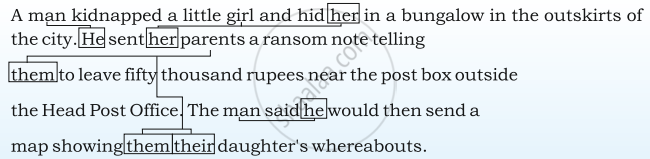
Look at the passage below and study how the personal pronouns refer to different people.
Some are like fields of sunlit corn,
Meet for a bride on her bridal morn,
Some, like the flame of her marriage fire,
Or, rich with the hue of her heart's desire,
Tinkling,luminous,tender, and clear,
Like her bridal laughter and bridal tear.
Read the lines given above and answer the question that follow.
Explain:
Some, like the flame of her marriage fire,
Or, rich with the hue of her heart’s desire,
The most important thing we've learned,
So far as children are concerned,
Is never, NEVER, NEVER let
Them near your television set-----
Or better still, just don't install
The Idiotic thing at all.
In almost every house we've been,
we've watched them gaping at the screen
They loll and slop and lounge about,
And stare until their eyes pop out.
(Last week in someone's place we saw
A dozen eyeballs on the floor.
They sit and stare and stare and sit
Until they're hypnotised by it,
Until they're absolutely drunk
With all that shocking ghastly junk.
Read the lines given above and answer the question given below.
Explain with reference to context.
Exceeding peace had made Ben Adhem bold,
And to the presence in the room he said,
"What writest thou?"..... The vision raised its head,
And with a look made of all sweet accord,
Answered, "The names of those who love the Lord."
Read the lines given above and answer the following question.
Why was Abou not afraid?
And is mine one?' said Abou.
'Nay, or not so,'Replied the angel,
Abou spoke more low,
But cheery still; and said ,'I pray thee, then,
Write me as one that loves His fellow men.'
Read the lines given above and answer the following question.
Explain with reference to context.
After considering the matter, and talking it over with his wife, farmer Jones said that he would take John, and do well by him, now that his mother was out of the way; and Mrs. Ellis, who had been looking out for a bound girl, concluded that it would be charitable in her to make choice of Katy, even though she was too young to be of much use for several years.
“I could do much better, I know,” said Mrs. Ellis; “but as no one seems inclined to take her, I must act from a sense of duty expect to have trouble with the child; for she’s an undisciplined thing—used to having her own way.”
But no one said “I’ll take Maggie.” Pitying glances were cast on her wan and wasted form and thoughts were troubled on her account. Mothers brought cast-off garments and, removing her soiled and ragged clothes, dressed her in clean attire. The sad eyes and patient face of the little one touched many hearts, and even knocked at them for entrance. But none opened to take her in. Who wanted a bed-ridden child?
“Take her to the poorhouse,” said a rough man, of whom the question “What’s to be done with Maggie?” was asked. “Nobody’s going to be bothered with her.”
“The poorhouse is a sad place for a sick and helpless child,” answered one.
“For your child or mine,” said the other, lightly speaking; “but for tis brat it will prove a blessed change, she will be kept clean, have healthy food, and be doctored, which is more than can be said of her past condition.”
Read the extract given below and answer the question that follow.
What solution did the rough man suggest for Maggie? Why would the poorhouse be a good place for Maggie?
“You haven’t brought home that sick brat!” Anger and astonishment were in the tones of Mrs. Joe Thompson; her face was in a flame.
“I think women’s hearts are sometimes very hard,” said Joe. Usually Joe Thompson got out of his wife’s way, or kept rigidly silent and non-combative when she fired up on any subject; it was with some surprise, therefore, that she now encountered a firmly-set countenance and a resolute pair of eyes.
“Women’s hearts are not half so hard as men’s!”
Joe saw, by a quick intuition, that his resolute bearing h«d impressed his wife and he answered quickly, and with real indignation, “Be that as it may, every woman at the funeral turned her eyes steadily from the sick child’s face, and when the cart went off with her dead mother, hurried away, and left her alone in that old hut, with the sun not an hour in the sky.”
“Where were John and Kate?” asked Mrs. Thompson.
“Farmer Jones tossed John into his wagon, and drove off. Katie went home with Mrs. Ellis; but nobody wanted the poor sick one. ‘Send her to the poorhouse,’ was the cry.”
“Why didn’t you let her go, then. What did you bring her here for?”
“She can’t walk to the poorhouse,” said Joe; “somebody’s arms must carry her, and mine are strong enough for that task.”
Read the extract given below and answer the question that follow.
What was Mrs. Thompson’s reaction on seeing Maggie?
She again rubbed a match on the wall, and the light shone round her; in the brightness stood her old grandmother, clear and shining, yet mild and loving in her appearance. “Grandmother,” cried the little one, “O take me with you; I know you will go away when the match burns out; you will vanish like the warm stove, the roast goose, and the large, glorious Christmas-tree.” And she made haste to light the whole bundle of matches, for she wished to keep her grandmother there. And the matches glowed with a light that was brighter than the noon-day, and her grandmother had never appeared so large or so beautiful. She took the little girl in her arms, and they both flew upwards in brightness and joy far above the earth, where there was neither cold nor hunger nor pain, for they were with God.
In the dawn of morning there lay the poor little one, with pale cheeks and smiling mouth, leaning against the wall; she had been frozen to death on the last evening of the year; and the New-year’s sun rose and shone upon a little corpse! The child still sat, in the stiffness of death, holding the matches in her hand, one bundle of which was burnt. “She tried to warm herself,” said some. No one imagined what beautiful things she had seen, nor into what glory she had entered with her grandmother, on New-year’s day.
Read the extract given below and answer the question that follow.
Why was there a smile on the girl’s lips? Did the people understand?
Margot stood alone. She was a very frail girl who looked as if she had been lost in the rain for years and the rain had washed out the blue from her eyes and the red from her mouth and the yellow from her hair. She was an old photograph dusted from an album, whitened away, and if she spoke at all her voice would be a ghost. Now she stood, separate, staring at the rain and the loud wet world beyond the huge glass. “What’re you looking at ?” said William. Margot said nothing. “Speak when you’re spoken to.” He gave her a shove. But she did not move; rather she let herself be moved only by him and nothing else. They edged away from her, they would not look at her. She felt them go away. And this was because she would play no games with them in the echoing tunnels of the underground city. If they tagged her and ran, she stood blinking after them and did not follow. When the class sang songs about happiness and life and games her lips barely moved. Only when they sang about the sun and the summer did her lips move as she watched the drenched windows.
Read the extract given below and answer the question that follow.
Why did they behave in this manner towards Margot?
Answer the following question.
“But the cop’s mind would not consider Soapy”. What did the cop not consider, and why?
What was unique about the Great Glass Elevator?
What did the narrator do with the hatchet?
Why did Swami Haridas say Tansen was ‘talented’?
Answer the following question:
Why did Taro run in the direction of the stream?
Multiple Choice Question:
What is the significance of four o'clock?
Replace the italicised portion of the sentence below with a suitable phrase from the box. Make necessary changes, wherever required.
Unfortunately, the train I was trying to catch was cancelled.
How did Algu and Jumman treat each other?
Read the passage given below and answer the questions (i), (ii) and (iii) that follow:
|
(1) |
The Police Superintendent is walking across the market square followed by a constable. Suddenly he hears a loua shout, "So you bite, you damned brute? Lads, don't let the dog go! Biting is prohibited nowadays!" There is the sound of 'yelping and the Superintendent sees a dog running out of a timber-yard. A man runs after it and tries to seize the dog by its hind legs'. Sleepy countenances protrude from the shops and soon a crowd gathers. |
5 |
|
(2) |
"It looks like a row, your honour", says the constable. The Superintendent turns to his left and strides towards the crowd. He sees the aforementioned man standing close by the gate of the timber-yard, holding his right hand in the air and displaying a bleeding finger to the crowd. He was the town's goldsmith. The culprit who has caused the sensation, a white puppy with a sharp muzzle and a yellow patch on its back, is sitting on the ground. "What's it all about?", the Superintendent inquires, pushing his way through the crowd, "Who was it that shouted?" |
10 |
|
(3) |
The goldsmith answers, "I was walking along here not interfering with anyone when this low brute, for no rhyme or reason, bit my finger. I am a working man. Mine is fine work. I must have damages, for I shan't be able to use this finger for a week." |
15 |
|
(4) |
"I won't let this pass! Find out whose dog it is and draw up a report!", the Superintendent commands the constable. |
20 |
|
(5) |
"I fancy it's General Zhigalov's dog", says someone in the crowd. Suddenly indignant, the Superintendent turns to the goldsmith and asks, "There's one thing I can't make out. How it could have bitten you? Surely it couldn't reach your finger. It's a little dog, and you are a great hulking fellow! You must have scratched your finger with a nail, and then the idea struck you to get damages for it. I know your sort!" |
25 |
|
(6) |
"No, that's not the General's dog", says the constable, with profound conviction, "the General has valuable dogs, and goodness knows what this is! No coat, no shape, a low creature." The Superintendent says, "You have been injured, goldsmith and we can't let the matter drop. You must be compensated for the damage." |
30 |
|
(7) |
"It is the General's, that's certain!", says a voice in the crowd. "Oh! Constable, take the dog to the General's and inquire there. Say I found it and sent it. And tell them not to let it out into the street. A dog is a delicate animal. And you, you goldsmith, put your hand down. It's your own fault." On seeing the General's cook approaching, the Superintendent asks him, "Is it one of yours?" "We have never had one like this", says the cook. "There's no need to waste time asking", decides the Superintendent, "it's a stray dog. Chase it away!" |
35 |
|
(8) |
"It's not our dog", the cook goes on, "it belongs to the General's brother who arrived the other day." "Is his Excellency's brother here? Delighted to hear if', says the Superintendent, and his whole face beams with an ecstatic smile, "it's not a bad pup. A lively creature, indeed. Come, why are you shivering, you nice little pup?" |
40 |
|
(9) |
The cook calls the dog and walks away from the timber-yard. |
45 |
|
(10) |
The crowd laughs at the goldsmith. |
|
|
|
Adapted from : A Chameleon by Anton Chekov |
|
-
- Given below are three words and phrases. Find the words which have a similar meaning in the passage: [3]
- faces
- walks purposefully
- precious
- For each of the words given below, choose the sentence that uses the same word unchanged in form, but with a different meaning from that which it carries in the passage: [3]
- row (line 7)
- We sat in a row at the back of the room.
- The vegetables were planted in neat rows.
- A row has broken out amongst the vendors.
- The fisherman rowed us back to the shore.
- left (line 8)
- I instructed the driver to take a left turn at the intersection.
- The bank is situated to the left of the library.
- They left the house at six o'clock in the morning to reach the airport on time.
- He's giving away money left, right and centre.
- fancy (line 21)
- He fancies himself as a serious actor.
- I was foot-loose and fancy-free in those days.
- He had some fanciful notion about crossing the Atlantic in a barrel.
- He sells poor goods, but charges fancy prices.
- row (line 7)
- Given below are three words and phrases. Find the words which have a similar meaning in the passage: [3]
- Answer the following questions in your own words as briefly as possible:
- How does power play an important role in the Superintendent's decisions? [2]
- Why does the goldsmith ask for damages? [2]
- Who does the dog belong to? How do we know it? [2]
- Trace the Superintendent's reactions from the time the initial voice in the crowd is heard till the cook takes the dog away (paragraphs 5 to 9). You are required to write the summary in the form of a connected passage in about 100 words. Failure to keep within the word limit will be penalised. [8]
