Advertisements
Advertisements
Question
What did the leader of the van do with the kind old man?
Advertisements
Solution
The leader of the van allowed the old man to remain seated at the cherry tree considering him to be very old.
RELATED QUESTIONS
Discuss in pair and answer question below in a short paragraph (30 − 40 words.
What “horrible idea” occurred to Jerome a little later?
Thinking about the Text
Answer these question.
Why does the intruder choose Gerrard as the man whose identity he wants to take on?
Thinking about the Poem
How did he punish her?
How does Toto take a bath? Where has he learnt to do this? How does Toto almost boil himself alive?
Parents alone are responsible for inculcating a good sense of dental hygiene amongst children. Do you agree/disagree? Discuss with your partner.
Notice how ideas are connected in the story.
Write what the following words you just used in 1.1 imply by choosing suitable options from the box.
- and:
- but:
- where:
- while:
- after:
- until:
- so :
connects similar actions, objects
denotes contrast
denotes time.
The words given above are called connectors. Connectors do not simply join sentences together; they also show how ideas are related.
There are many different ways of classifying connectors according to their meaning. We shall start with the ones you are already familiar with.
Form pairs - one student will read the text for 'Hockey', and the second student will read the text for 'Football'.
Hockey

The game starts when the umpire blows his whistle for the opening pass-back. The passback is made at the centre of the field to start the game (also after half- time and after each goal is scored). The ball, which may be pushed or hit, must not be directed over the centre line. All players of the opposing team must stand at least 5 yard from the ball and all players of both teams, other than the player making the pass-back must be in their own half of the field.
There are two umpires to control the game and to administer the rules. These umpires are the sole judges of the game. The umpires are responsible for keeping time for the duration of the game.


In front of each goal is an area known as the penalty area. This is a rectangular area, 40.2m wide and extending 16. Sm into the field where the goalkeeper operates.
A standard adult football match consists of two periods of 45 minutes each, known as halves. Each half runs continuously, meaning that the clock is not stopped when the ball is out of play. There is usually a 15-minute half-time break between halves. The end of the match is known as full-time. Anytime during the match, a team can substitute upto three players maximum.
The game is controlled by a referee who is the official timekeeper for the match, and may make an allowance for time lost through substitutions, injured players requiring attention, or other stoppages. There are also two linesmen who keep guard of the touchlines or sidelines, signalling when the ball crosses the boundary lines. The referee alone signals the end of the match.
Handling the ball deliberately, pushing or tripping an opponent, or hitting a player from behind are examples of fouls, punishable by a direct free kick or penalty kick depending on where the offence occurred. Other fouls are punishable by an indirect free kick.
The referee may punish a player's or substitute's misconduct by a caution (yellow card) or sending-off (red card). A player is given a yellow card is said to have been 'booked'.
• Red - Serious misconduct resulting in ejection from the game. If a player has been sent off, no substitute can be brought in his place.
Most terribly cold it was; it snowed, and was nearly quite dark, and evening— the last evening of the year. In this cold and darkness there went along the street a poor little girl, bareheaded, and with naked feet. When she left home she had slippers on, it is true; but what was the good of that? They were very large slippers, which her mother had hitherto worn; so large were they; and the poor little thing lost them as she scuffled away across the street, because of two carriages that rolled by dreadfully fast.
One slipper was nowhere to be found; the other had been laid hold of by an urchin, and off he ran with it; he thought it would do capitally for a cradle when he some day or other should have children himself. So the little maiden walked on with her tiny naked feet, that were quite red and blue from cold. She carried a quantity of matches in an old apron, and she held a bundle of them in her hand. Nobody had bought anything of her the whole livelong day; no one had given her a single farthing. She crept along trembling with cold and hunger—a very picture of sorrow, the poor little thing!
Read the extract given below and answer the question that follow.
Which day of the year was it in the story?
Suddenly all the tension seemed to ebb out of my body as the truth of what he said hit me. Confidently, I drew a line a full foot in back of the board and proceeded to jump from there. I qualified with almost a foot to spare.
That night I walked over to Luz Long’s room in the Olympic village to thank him. I knew that if it hadn’t been for him I probably wouldn’t be jumping in the finals the following day. We sat in his quarters and talked for two hours—about track and field, ourselves, the world situation, a dozen other things.
When I finally got up to leave, we both knew that a real friendship had been formed. Luz would go out to the field the next day trying to beat me if he could. But I knew that he wanted me to do my best—even if that meant my winning.
Read the extract given below and answer the question that follow.
How did Luz Long help Jesse Owens?
Read the extract given below and answer the questions that follow :
Duke: You hear the team’d Bellario, what he writes:
And here, I take it, is the doctor come.
[Enter Portia, dressed like a Doctor of Laws]
Give me your hand. Come you from old Bellario”?
Portia: I did, my lord.
Duke: You are welcome : take your place.
Are you acquainted with the difference
That holds this present question in the court?
(i) Where is this scene set? Why was Portia there?
(ii) What reason had Bellario given for his absence? Whom had he sent in this stead?
(iii) Bellario's letter stated that he had taken some measures to prepare the 'young and learned doctor' to deal with the case. What were they?
(iv) What was the 'difference' between Shylock the Jew and Antonio the merchant that the Duke was unable to resolve?
(v) How does Portia succeed in saving Antonio? What does this reveal of her character?
Is there a room in your house or a house in your neighborhood/locality where you would rather not go alone, and never at night? If there is such a place and a story to go with it, let others hear all about it.
How did Ravi link his cat with the Pallava kings?
How much time do grubstake for becoming cocoons? What do the cocoons do after that?
How the author and his friend spent the entire day?
How did the other bird greet the king?
How did Vijay Singh use the egg? How did he use the lump of salt?
Use the clues given below to complete this crossword puzzle.
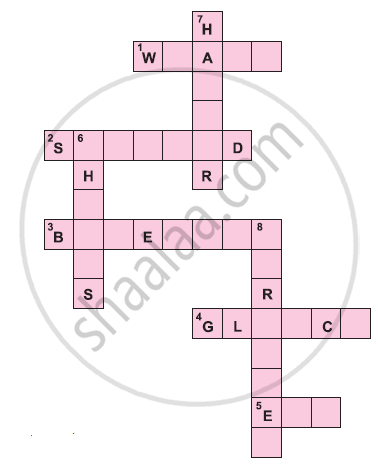
Across
1. very tired
2. had an angry look on the face
3. short trousers
4. a fault in a machine that prevents it from working properly
5. a small and naughty boy-fairy
Down
6. work that must be done every day, often boring
7. a basket with a lid
8. gave a short, high-pitched cry
Complete the following sentence.
In the spring, the banyan tree ________________, and _______________ would come there.
Multiple Choice Question:
What are these doubts and worries called?
Replace the italicised portion of the sentence below with a suitable phrase from the box. Make necessary changes, wherever required.
It will free me from worry to know that I had done nothing wrong.
