Advertisements
Advertisements
Question
Why is it a great pleasure to walk through the meadows?
Advertisements
Solution
It is a great pleasure to walk through the meadows because its grass is as soft as a velvet that gives you a pleasant walk.
RELATED QUESTIONS
The black man's face bespoke revenge
As the fire passed from his sight.
For all he saw in his stick of wood
Was a chance to spite the white.
The last man of this forlorn group
Did nought except for gain.
Giving only to those who gave
Was how he played the game.
Their logs held tight in death's still hands
Was proof of human sin.
They didn't die from the cold without
They died from the cold within.
Read the lines given above and answer the question that follow.
Discuss personification as used by the poet.
Such wondrous, fine, fantastic tales
Of dragons, gypsies, queens, and whales
And treasure isles, and distant shores
Where smugglers rowed with muffled oars,
And pirates wearing purple pants,
And sailing ships and elephants,
And cannibals crouching 'round the pot,
Stirring away at something hot.
(It smells so good , what can it be?
Good gracious, it's Penelope.)
The younger ones had Beatrix Potter
With Mr.Tod,the dirty rotter,
And Squirrel Nutkin,Pigling Bland,
And Mrs.Tiggy-Winkle and-
Just How The Camel Got His Hump,
And How the Monkey Lost His Rump,
And Mr. Toad, and bless my soul,
There's Mr.Rat and Mr. Mole-
Oh, books, what books they used to know,
Those children living long ago!
Read the lines given above and answer the question given below.
Explain with reference to context.
The waves beside them danced, but they
Out-did the sparkling leaves in glee;
A poet could not be but gay,
In such a jocund company!
I gazed-and gazed-but little thought
What wealth the show to me had brought:
Read the lines given above and answer the question that follow.
Explain with reference to context.
The horse was nearly life-size, moulded out of clay, baked, burnt, and brightly coloured, and reared its head proudly, prancing its forelegs in the air and flourishing its tail in a loop; beside the horse stood a warrior with scythelike mustachios, bulging eyes, and aquiline nose. The old image-makers believed in indicating a man of strength by bulging out his eyes and sharpening his moustache tips, and also decorated the man’s chest with beads which looked today like blobs of mud through the ravages of sun and wind and rain (when it came), but Muni would insist that he had known the beads to sparkle like the nine gems at one time in his life.
Read the extract given below and answer the question that follow.
What was the effect of the construction of the highway?
Lights were shining from every window, and there was a savoury smell of roast goose, for it was New-year’s eve—yes, she remembered that. In a corner, between two houses, one of which projected beyond the other, she sank down and huddled herself together. She had drawn her little feet under her, but she could not keep off the cold; and
she dared not go home, for she had sold no matches, and could not take home even a penny of money. Her father would certainly beat her; besides, it was almost as cold at home as here, for they had only the roof to cover them, through which the wind howled, although the largest holes had been stopped up with straw and rags. Her little hands were almost frozen with the cold. Ah! perhaps a burning match might be some good, if she could draw it from the bundle and strike it against the wall, just to warm her fingers. She drew one out—“scratch!” how it sputtered as it burnt! It gave a warm, bright light, like a little candle, as she held her hand over it. It was really a wonderful light. It seemed to the little girl that she was sitting by a large iron stove, with polished brass feet and a brass ornament. How the fire burned! and seemed so beautifully warm that the child stretched out her feet as if to warm them, when, lo! the flame of the match went out, the stove vanished, and she had only the remains of the half-burnt match in her hand.
Read the extract given below and answer the question that follow.
What did she imagine when she lighted the first match?
“Do the scientists really know? Will it happen today, will it ?”
“Look, look; see for yourself !”The children pressed to each other like so many roses, so many weeds, intermixed, peering out for a look at the hidden sun. It rained. It had been raining for seven years; thousands upon thousands of days compounded and filled from one end to the other with rain, with the drum and gush of water, with the sweet crystal fall of showers and the concussion of storms so heavy they were tidal waves come over the islands. A thousand forests had been crushed under the rain and grown up a thousand times to be crushed again. And this was the way life was forever on the planet Venus, and this was the schoolroom of the children of the rocket men and women who had come to a raining world to set up civilization and live out their lives.
Read the extract given below and answer the question that follow.
What is the weather like on Venus? How long has it been like this?
Answer the following question.
Where did the lady find the bear cub? How did she bring it up?
Find in the poem an antonym (a word opposite in meaning) of the following word
grow
Mark the right item.
The old farmer and his wife loved the dog
How did the daimios reward the kind farmer?
What was the problem of the two shoppers? What were they going to try?
Vijay Singh complained of insects in the cave. What was he referring to, and why?
Describe the tone in which the narrator’s father dismissed his wife’s warnings every single time.
Use the clues given below to complete this crossword puzzle.
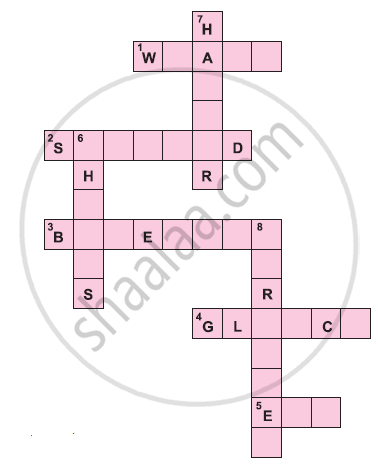
Across
1. very tired
2. had an angry look on the face
3. short trousers
4. a fault in a machine that prevents it from working properly
5. a small and naughty boy-fairy
Down
6. work that must be done every day, often boring
7. a basket with a lid
8. gave a short, high-pitched cry
Why did the magic waterfall disappoint other villagers? What reward did Taro get and from whom?
Answer the following question:
Why did the waterfall give Taro saké and others water?
Why does the rebel choose to Wear fantastic Clothes?
Study the following phrases and their meanings. Use them appropriately to complete the sentences that follow.
The police are …………… the matter thoroughly.
The words helper, companion, partner and accomplice have very similar meanings, but each word is typically used in certain phrases. Can you fill in the blanks below with the most commonly used words? A dictionary may help you.
my ……………. on the journey.
