Advertisements
Advertisements
Question
How fire is a good servant?
Advertisements
Solution
Fire is a good servant. When kept under control fire helps us do many things. In most of our home we cook our food on fire.
We use fire to keep us warm during extreme winter. It is also used in generating electricity.
RELATED QUESTIONS
The cat and the author are very fond of each other. How has this been shown in the story? Where was the cat after the fire? Who brings it back and how?
Pick out word from the text that mean the same as the following word or expression. (Look in the paragraph indicated.)
the power to endure, without falling ill : _________
An e-mail, short for electronic mail is a store and forward method of composing, sending, storing, and receiving messages over electronic communication systems. It is the quickest way to communicate in writing.
Now, it is your turn. Write and produce your own radio programme. You will need to select your own content. The following are some ideas. You are free, of course, to add your own ideas. Remember, the programme must be in English.
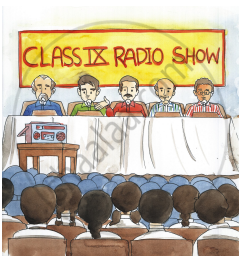
- News stories: about people in your class, about school, about sports (school and local), about the local community
- Comedy: jokes, short plays
- Interviews: with teachers, with exstudents of your school, with a Class IX student who has recently done something very interesting
- Games: general knowledge quiz, panel game, word game
- Advertisements: for shops/industries in the local community, things ‘for sale’ and ‘wanted’ by students
- Local sites: monuments/sites of historical importance and of tourist interest
- Special reports: e.g. safety at school, examination results, school uniform, school assemblies
- Interesting people: role-play interviews with film stars, sports personalities, TV personalities, etc.
- Entertainment reviews: music, films, videos, books, etc.
- Plays
- Songs with lyrics
- Speeches on important personalities
- Tele conference video conference with students, teachers, experts
Based on your reading of the passage, complete the statements using given connectors.
(a) The mother, father ______ thought ______ (and)
(b) They planned to walk to the woods ______ (which)
(c) They reached the place ______ in eighteen months (which)
(d) They eagerly unpacked their picnic basket ______ (but)
(e) It was ______, when the three tortoises arrived at the picnic place, (after)
(f) The mother tortoise ordered the baby to go home for the opener, saying ______ (that).
(g) ______ (but) was not willing at first.
(h) The mother and father promised to wait ______ (until)
(i) ______ they began to get very hungry, (after)
What does he plant who plants a tree? a
He plants a friend of sun and sky;b
He plants the flag of breezes free;
The shaft of beauty, towering high;
He plants a home to heaven anigh;
For song and mother-croon of bird
In hushed and happy twilight heard____
The treble of heaven's harmony_____
These things he plants who plants a tree.
Read the lines given above and answer the question that follow:
Explain with reference to context.
What does he plant who plants a tree? a
He plants a friend of sun and sky;b
He plants the flag of breezes free;
The shaft of beauty, towering high;
He plants a home to heaven anigh;
For song and mother-croon of bird
In hushed and happy twilight heard____
The treble of heaven's harmony_____
These things he plants who plants a tree.
Read the lines given above and answer the question that follow:
Some are meet for a maiden's wrist,
Silver and blue as the mountain mist,
Some are flushed like the buds that dream
On the tranquil brow of a woodland stream,
Some are aglow with the bloom that cleaves
To the limpid glory of new born leaves
Read the lines given above and answer the question that follow.
Explain with reference to context.
Mr. Oliver, an Anglo-Indian teacher, was returning to his school late one night on the outskirts of the hill station of Shimla. The school was conducted on English public school lines and the boys – most of them from well-to-do Indian families – wore blazers, caps and ties. “Life” magazine, in a feature on India, had once called this school the Eton of the East.
Mr. Oliver had been teaching in this school for several years. He’s no longer there. The Shimla Bazaar, with its cinemas and restaurants, was about two miles from the school; and Mr. Oliver, a bachelor, usually strolled into the town in the evening returning after dark, when he would take short cut through a pine forest.
Read the extract given below and answer the question that follow.
Why was the school where Mr Oliver worked called the Eton of the East?
Its a cruel thing to leave her so.”
“Then take her to the poorhouse: she’ll have to go there,” answered the blacksmith’s wife, springing away, and leaving Joe behind.
For a little while the man stood with a puzzled air; then he turned back, and went into the hovel again. Maggie with painful effort, had raised herself to an upright position and was sitting on the bed, straining her eyes upon the door out of which all had just departed, A vague terror had come into her thin white face.
“O, Mr. Thompson!” she cried out, catching her suspended breath, “don’t leave me here all alone!” ,
Though rough in exterior, Joe Thompson, the wheelwright, had a heart, and it was very tender in some places. He liked children, and was pleased to have them come to his shop, where sleds and wagons were made or mended for the village lads without a draft on their hoarded sixpences.
“No, dear,” he answered, in a kind voice, going to the bed, and stooping down over the child, “You she’n’t be left here alone.” Then he wrapped her with the gentleness almost of a woman, in the clean bedclothes which some neighbor had brought; and, lifting her in his strong arms, bore her out into the air and across the field that lay between the hovel and his home.
Read the extract given below and answer the question that follow.
What idea do we get of the character of Mr Thompson?
As it turned out, Luz broke his own past record. In doing so, he pushed me on to a peak performance. I remember that at the instant I landed from my final jump—the one which set the Olympic record of 26 feet 5-5/16 inches—he was at my side, congratulating me. Despite the fact that Hitler glared at us from the stands not a hundred yards away, Luz shook my hand hard—and it wasn’t a fake “smile with a broken heart” sort of grip, either.
You can melt down all the gold medals and cups I have, and they couldn’t be a plating on the 24-carat friendship I felt for Luz Long at that moment. I realized then, too, that Luz was the epitome of what Pierre de Coubertin, founder of the modern Olympic Games, must have had in mind when he said, “The important thing in the Olympic Games is not winning but taking part. The essential thing in life is not conquering but fighting well.”
Read the extract given below and answer the question that follow.
Why did Hitler glare at Luz Long and Jesse Owens?
What does the poet mean by 'tireless striving'? What does 'clear stream' refer to? Explain.
Answer the following question.
Where was the tiger cub hiding when Grandfather found him?
What surprised Mr. Purcell one day?
What type of shopkeeper was Mr. Purcell?
With your partner, complete the following sentence in your own word using the ideas in the poem.
Words are the __________________ of thought.
“You should be able to qualify with your eyes closed.” Who said these words and to whom?
Complete the following sentence by providing a reason:
In the poem, The Darkling Thrush, the poet thinks the bird had some awareness which the poet did not because ______.
What is the central idea of the poem, John Brown?
In the poem, The Darkling Thrush, the poet uses the words “evensong" and “carolling” to describe the thrush's song because ______.
