Advertisements
Advertisements
प्रश्न
How fire is a good servant?
Advertisements
उत्तर
Fire is a good servant. When kept under control fire helps us do many things. In most of our home we cook our food on fire.
We use fire to keep us warm during extreme winter. It is also used in generating electricity.
संबंधित प्रश्न
Answer the following question in one or two sentences.
What was Kezia’s father’s routine
(i) before going to his office?
(ii) after coming back from his office?
(iii) on Sundays?
Irony is when we say one thing but mean another, usually the opposite of what we say. When someone makes a mistake and you say, Oh! That was clever!” that is irony. You’re saying ‘clever’ to mean ‘not clever’.
Expressions we often use in an ironic fashion are:
• Oh, wasn’t that clever!/Oh that was clever!
• You have been a great help, I must say!
• You’ve got yourself into a lovely mess, haven’t you?
• Oh, very funny!/How funny!
We use a slightly different tone of voice when we use these words ironically.
Read the play carefully and find the words and expressions Gerrard uses in an ironic way.
Then say what these expressions really mean. Two examples have been given below.
Write down three such expressions along with what they really mean.
| What the author says | What he means |
| Why, this is a surprise, Mr – er – |
He pretends that the intruder is a social visitor whom he is welcoming. In this way he hides his fear. |
| At last a sympathetic audience! | He pretends that the intruder wants to listen to him, whereas actually the intruder wants to find out information for his own use. |
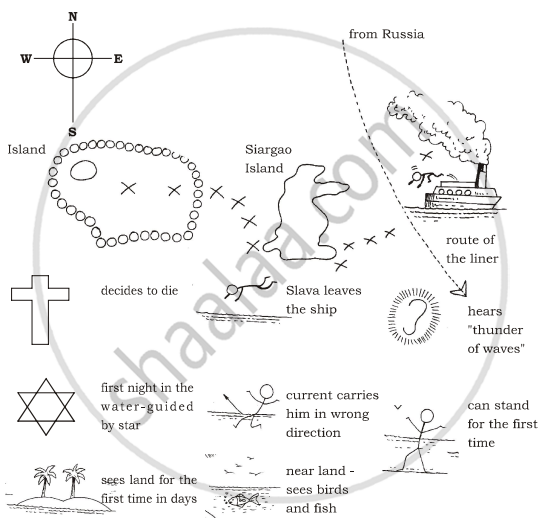
Given below is a map of the area in which Slava Kurilov faced his ordeal. You will also see the major events in the story, in mixed order, each accompanied by a symbol. After you have read ‘Ordeal in the Ocean’, draw the appropriate symbol against each x mark. (One is already drawn for you.) Draw the symbols or number the symbols, and transfer them to the map.)
Read the following conversation:
Malavika and Deepak are looking through some photographs of Malavika’s family.
| Malavika: | Now ... this is my brother Shantanu. Shantanu is in Class VIII. Shantanu is brilliant at playing tennis. Shantanu is also good at singing. Shantanu sings a lot. |
| Deepak: | Shantanu sounds interesting. I’d like to meet Shantanu. I’m looking for someone to play tennis with. |
| Malavika: | Well ... why don’t you come around tonight and meet Shantanu? My parents will be out. My parents always go out on Tuesdays. |
Improve the above conversation by using suitable pronouns where required.
Some are meet for a maiden's wrist,
Silver and blue as the mountain mist,
Some are flushed like the buds that dream
On the tranquil brow of a woodland stream,
Some are aglow with the bloom that cleaves
To the limpid glory of new born leaves
Read the lines given above and answer the question that follow.
Pick out two simile from this stanza.
Exceeding peace had made Ben Adhem bold,
And to the presence in the room he said,
"What writest thou?"..... The vision raised its head,
And with a look made of all sweet accord,
Answered, "The names of those who love the Lord."
Read the lines given above and answer the following question.
Explain with reference to context.
Of the seven hundred villages dotting the map of India, in which the majority of India’s five hundred million live, flourish and die, Kritam was probably the tiniest, indicated on the district survey map by a microscopic dot, the map being meant more for the revenue official out to collect tax than for the guidance of the motorist, who in any case could not hope to reach it since it sprawled far from the highway at the end of a rough track furrowed up by the iron-hooped wheels of bullock carts. But its size did not prevent its giving itself the grandiose name Kritam, which meant in Tamil coronet or crown on the brow of the subcontinent. The village consisted of fewer than thirty houses, only one of them built from brick and cement and painted a brilliant yellow and blue all over with
gorgeous carvings of gods and gargoyles on its balustrade, it was known as the Big House. The other houses, distributed in four streets, were generally of bamboo thatch, straw, mud and other unspecified material. Muni’s was the last house in the fourth street, beyond which stretched the fields. In his prosperous days Muni had owned a flock of sheep and goats and sallied forth every morning driving the flock to the highway a couple of miles away.
Read the extract given below and answer the question that follow.
Where was Muni’s house located?
The village consisted of less than thirty houses, only one of them built with brick and cement. Painted a brilliant yellow and blue all over with gorgeous carvings of gods and gargoyles on its balustrade, it was known as the Big House. The other houses, distributed in four streets, were generally of bamboo thatch, straw, mud, and other unspecified material. Muni’s was the last house in the fourth street, beyond which stretched the fields. In his prosperous days Muni had owned a flock of forty sheep and goats and sallied forth every morning driving the flock to the highway a couple of miles away.
Read the extract given below and answer the question that follow.
What is the name of the village referred to here? Where is it situated?
The village consisted of less than thirty houses, only one of them built with brick and cement. Painted a brilliant yellow and blue all over with gorgeous carvings of gods and gargoyles on its balustrade, it was known as the Big House. The other houses, distributed in four streets, were generally of bamboo thatch, straw, mud, and other unspecified material. Muni’s was the last house in the fourth street, beyond which stretched the fields. In his prosperous days Muni had owned a flock of forty sheep and goats and sallied forth every morning driving the flock to the highway a couple of miles away.
Read the extract given below and answer the question that follow.
What did Muni feed his flock with? When did he come back home? What did he carry home?
“Do the scientists really know? Will it happen today, will it ?”
“Look, look; see for yourself !”The children pressed to each other like so many roses, so many weeds, intermixed, peering out for a look at the hidden sun. It rained. It had been raining for seven years; thousands upon thousands of days compounded and filled from one end to the other with rain, with the drum and gush of water, with the sweet crystal fall of showers and the concussion of storms so heavy they were tidal waves come over the islands. A thousand forests had been crushed under the rain and grown up a thousand times to be crushed again. And this was the way life was forever on the planet Venus, and this was the schoolroom of the children of the rocket men and women who had come to a raining world to set up civilization and live out their lives.
Read the extract given below and answer the question that follow.
Describe the rain and its effect on life on Venus.
Who were wrongly blamed for the theft of the bananas?
Why/when did Abbu Khan become unhappy?
How do we know that Akbar was fond of Tansen? Give two reasons.
Read the lines in which the following phrases occur. Then discuss with your partner the meaning of each phrase in its context.
fuzzy head
Answer the question.
What does he imagine about
where teachers live?
Answer the following question:
Why was Rasheed upset?
How did uncle explain the ‘game of chance’?
Read the following sets of words loudly and clearly.
cot – coat
cost – coast
tossed – toast
got – goat
rot – rote
blot – bloat
knot – note
Name the young lovers whose lives ended tragically because of a misunderstanding caused by the appearance of a lion.
Read the extract given below and answer the questions that follow:
| Caesar: | Are we all ready? What is now amiss, That Caesar and his Senate must redress? |
| Metellus: | Most high, most mighty, and most puissant Caesar, Metellus Cimber throws before thy seat A humble heart, .... [He kneels] |
- Where are the speakers?
What does ‘puissant’ mean?
Explain: ‘Metellus Cimber throws before thy seat a humble heart’. [3] - At the beginning of the scene, Caesar says, ‘The Ides of March are come.’
Why do you think Caesar said this?
What does the Soothsayer say in response? [3] - What specific duties do the conspirators allot to Trebonius and Casca?
Why does Cassius become nervous when Popilius Lena speaks to him as they enter? [3] - What does Artemidorus want of Caesar?
How does Caesar respond to his plea? [3] - Shortly after this exchange, Caesar is stabbed to death by the conspirators. Whom do you sympathise with — Julius Caesar or the conspirators? Give reasons for your choice. [4]
