Advertisements
Advertisements
Question
Do you think Prashant is good leader? Do you think young people can get together to help people during natural calamities?
Advertisements
Solution
Yes, Prashant is a very good leader. Though he himself was too grief-stricken, he got a hold of himself and decided to step in as the leader of the village. He carried out his role effectively and helped the people of his village in every possible manner.
Yes. Young people can definitely get together to help people during natural calamities and otherwise. They can use their strength and vigour to help people.
RELATED QUESTIONS
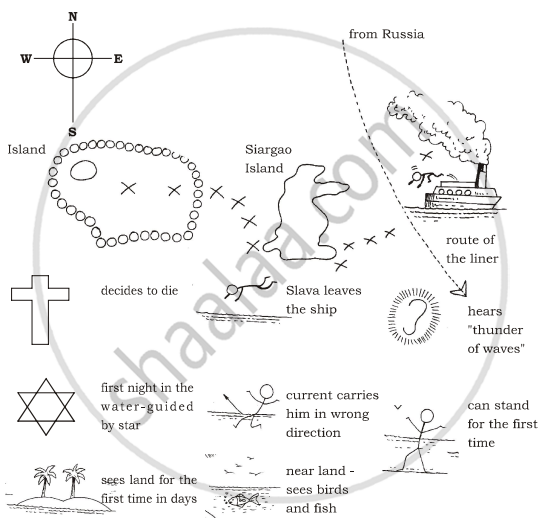
Given below is a map of the area in which Slava Kurilov faced his ordeal. You will also see the major events in the story, in mixed order, each accompanied by a symbol. After you have read ‘Ordeal in the Ocean’, draw the appropriate symbol against each x mark. (One is already drawn for you.) Draw the symbols or number the symbols, and transfer them to the map.)
Mrs. Thompson did not reply, but presently turned towards the little chamber where her husband had deposited Maggie; and, pushing open the door, went quietly in. Joe did not follow; he saw that, her state had changed, and felt that it would be best to leave her alone with the child. So he went to his shop, which stood near the house, and worked until dusky evening released him from labor. A light shining through the little chamber windows was the first object that attracted Joe’s attention on turning towards the house: it was a good omen. The path led him by this windows and, when opposite, he could not help pausing to look in. It was now dark enough outside to screen him from observation. Maggie lay, a little raised on the pillow with the lamp shining full upon her face. Mrs. Thompson was sitting by the bed, talking to the child; but her back was towards the window, so that her countenance was not seen. From Maggie’s face, therefore, Joe must read the character of their intercourse. He saw that her eyes were intently fixed upon his wife; that now and then a few words came, as if in answers from her lips; that her expression was sad and tender; but he saw nothing of bitterness or pain. A deep-drawn breath was followed by one of relief, as a weight lifted itself from his heart.
Read the extract given below and answer the question that follow.
Why was Joe relieved?
After washing from his hands and face the dust and soil of work, Joe left the kitchen, and went to the little bedroom. A pair of large bright eyes looked up at him from the snowy bed; looked at him tenderly, gratefully, pleadingly. How his heart swelled in his bosom! With what a quicker motion came the heart-beats! Joe sat down, and now, for the first time, examining the thin free carefully under the lamp light, saw that it was an attractive face, and full of a childish sweetness which suffering had not been able to obliterate.
“Your name is Maggie?” he said, as he sat down and took her soft little hand in his.
“Yes, sir.” Her voice struck a chord that quivered in a low strain of music.
“Have you been sick long?”
“Yes, sir.” What a sweet patience was in her tone!
“Has the doctor been to see you?”
“He used to come”
“But not lately?”
“No, sir.”
Read the extract given below and answer the questions that follow.
How did Maggie look at Joe when he entered her room?
Then there it lay in her wet palm, perfect, even pierced ready for use, with the sunset shuffled about inside it like gold—?dust. All her heart went up in flames of joy. After a bit she twisted it into the top of her skirt against her tummy so she would know if it burst through the poor cloth and fell. Then she picked up her fork and sickle and the heavy grass and set off home. Ai! Ai! What a day! Her barefeet smudged out the wriggle— ?mark of snakes in the dust; there was the thin singing of malaria mosquitoes among the trees now; and this track was much used at night by a morose old makna elephant—the Tuskless One; but Sibia was not thinking of any of them. The stars came out: she did not notice. On the way back she met her mother, out of breath, come to look for her, and scolding. “I did not see till I was home, that you were not there. I thought something must have happened to you.” And Sibia, bursting with her story, cried “Something did). I found a blue bead for my necklace, look!”
Read the extract given below and answer the question that follow.
Why did Sibia feel overjoyed?
Then, trying to hide my nervousness, I added, “How are you?”
“I’m fine. The question is: How are you?“
“What do you mean?” 1 asked “Something must be eating you,” he said—proud the way foreigners are when they’ve mastered a bit of American slang. “You should be able to qualify with your eyes closed.”
“Believe me, I know it,” I told him—and it felt good to say that to someone.
For the next few minutes we talked together. I didn’t tell Long what was “eating” me, but he seemed to understand my anger, and he took pains to reassure me. Although he’d been schooled in the Nazi youth movement, he didn’t believe in the Aryan-supremacy business any more than I did. We laughed over the fact that he really looked the part, though. An inch taller than I, he had a lean, muscular frame, clear blue eyes, blond hair and a strikingly handsome, chiseled face. Finally, seeing that I had calmed down somewhat, he pointed to the take-off board.
“Look,” he said. “Why don’t you draw a line a few inches in back of the board and aim at making your take-off from there? You’ll be sure not to foul, and you certainly ought to jump far enough to qualify. What does it matter if you’re not first in the trials? Tomorrow is what counts.”
Read the extract given below and answer the question that follow.
How did Owens manage to qualify for the finals with a foot to spare?
“Do the scientists really know? Will it happen today, will it ?”
“Look, look; see for yourself !”The children pressed to each other like so many roses, so many weeds, intermixed, peering out for a look at the hidden sun. It rained. It had been raining for seven years; thousands upon thousands of days compounded and filled from one end to the other with rain, with the drum and gush of water, with the sweet crystal fall of showers and the concussion of storms so heavy they were tidal waves come over the islands. A thousand forests had been crushed under the rain and grown up a thousand times to be crushed again. And this was the way life was forever on the planet Venus, and this was the schoolroom of the children of the rocket men and women who had come to a raining world to set up civilization and live out their lives.
Read the extract given below and answer the question that follow.
What is the weather like on Venus? How long has it been like this?
Read the extract given below and answer the questions that follow:
Portia: ........But this reasoning is not in fashion to choose me a husband. O me, the word “choose”! I may neither choose who I would nor refuse whom I dislike; so is the will of a living daughter curbed by the will of a dead father. Is it not hard, Nerissa, that I cannot choose one, nor refuse none?
(i) What test had Portia’s father devised for her suitors? What oath did the suitors have to take before making their choice? [3]
(ii) Who is Nerissa? What does she say to cheer up Portia? [3]
(iii) Why does Portia disapprove of the County Palatine? Who would she rather marry? [3]
(iv) How, according to Portia, can the Duke of Saxony’s nephew be made to choose the wrong casket? What do these suitors ultimately decide? Why? [3]
(v) Whom does Portia ultimately marry? Who were the two other suitors who took the test? Why, in your opinion, is the person whom she marries worthy of her? [4]
Answer the following questions with reference to Ray Douglas Bradbury's short story, 'All Summer in a Day'.
(i) Name the planet on which this story is set. Describe everyday life on this planet.
(ii) Why was there so much excitement in the schoolroom that morning? What sets Margot apart from the other children?
(iii) Describe how the planet was transformed when the sun came out and shone briefly over it.
Why was Margot not able to witness this phenomenon?
What emotion of you supposes the children experienced when Margot emerged at the end of the story?
Why did the king refuse to give reward to anyone?
We should not give up in any situation. If we try hard we can definitely find a solution. Why do you think so?
Mr Gessler in his last wasn’t in good health. Give three examples to prove this.
Which ways did Soapy try to reach the prison in vain?
What questions did Golu ask the python?
Find pictures of the kinds of birds, insects and scenes mentioned in the poem.
Word in the box given below indicates a large number of… For example, ‘a herd of cows’ refers to many cows. Complete the following phrase with a suitable word from the box.
a _______________ of fish
Speak the following sentences clearly but as quickly as you can learn them by heart.
1. How much wood would a woodchuck chuck if a woodchuck would chuck wood.
2. Betty bought a bit of butter, but the bit of butter was a little bitter so she bought some better butter to make the bitter butter better.
With your partner, complete the following sentence in your own word using the ideas in the poem.
One has to match __________________.
Multiple Choice Question:
When do strange questions strike the poet?
Who do you think is the character of rebel based on?
Read the following conversation.
Ravi: What are you doing?
Mridu: I’m reading a book.
Ravi: Who wrote it?
Mridu: Ruskin Bond.
Ravi: Where did you find it?
Mridu: In the library.
Notice that ‘what’, ‘who’, ‘where’, are question words. Questions that require information begin with question words. Some other question words are ‘when’, ‘why’, ‘where’, ‘which’ and ‘how’.
Remember that
- What asks about acting, things etc.
- Who asks about people.
- Which asks about people or things.
- Where asks about place.
- When asks about time.
- Why asks about reason or purpose.
- How asks about means, manner or degree.
- Whose asks about possessions.
Read the following paragraph and frame questions on the italicised phrases.
Anil is in school. I am in school too. Anil is sitting in the left row. He is reading a book. Anil’s friend is sitting in the second row. He is sharpening his pencil. The teacher is writing on the blackboard. Children are writing in their copybooks. Some children are looking out of the window.
