Advertisements
Advertisements
Question
Working in small groups of 4−5 students, go back over the two passages on Santosh Yadav and Maria Sharapova and complete the table given below with relevant phrases or sentences.
|
Points of Comparison/Contrast |
Santosh Yadav | Maria Sharapova |
|
1. Their humble beginning |
|
|
|
2 . Their parents’ approach |
|
|
|
3. Their will power and strong desire to succeed |
|
|
|
4. Evidence of their mental toughness |
|
|
|
5. Their patriotism |
|
Advertisements
Solution
|
Points of Comparison/Contrast |
Santosh Yadav | Maria Sharapova |
|
1. Their humble beginning |
-“She was born in the small village of Joniyawas of Rewari District in Haryana.” |
“the Siberian born teenager” |
|
2 . Their parents’ approach |
- “in line with the prevailing custom in the family, Santosh had to make do with the local village school.” - “At sixteen, most of the girls in her village used to get married. Santosh was also under pressure from her parents to do the same.” - “her parents refused to pay for her education” - “her father slowly getting used to her urge” |
- “she was packed off to train in the United States.” - “trip to Florida with her father Yuri launched her on the path to success and stardom.” - “My father was working as much as he could to keep my tennis-training going.” |
|
3. Their will power and strong desire to succeed |
-“Wishing always to study 'a bit more'” -“her urge for more education” -“She left home and got herself enrolled in a school in Delhi.” - “She saved money and enrolled in a course at Uttarkashi’s Nehru Institute of Mountaineering.” - “I headed straight for the training.” |
- “Instead of letting that depress me, I became more quietly determined and mentally tough.” - “unwavering desire to succeed and readiness to sacrifice” - “I work hard at what I do.” - “the most important thing is to become number one in the world. That’s the dream that kept me going.” |
|
4. Evidence of their mental toughness |
-“She began living life on her own terms from the start.” -“From the very beginning I was quite determined that if I chose a correct and a rational path, the others around me had to change, not me.” -“she politely informed them of her plans to earn money by working part time to pay her school fees.” - “Santosh went on an expedition every year.” - “an amazing mental toughness” - “mental strength impressed her seniors” |
-“I learnt how to take care of myself. I never thought of quitting because I knew what I wanted.” -“I would have put up with much more humiliation and insults than that to steadfastly pursue my dream.” |
|
5. Their patriotism |
-“Then I unfurled the Indian tricolour and held it aloft on the roof of the world. The feeling is indescribable. The Indian flag was flying on top of the world. It was truly a spiritual moment. I felt proud as an Indian.” |
“I’m Russian. It’s true that the U.S. is a big part of my life. But I have Russian citizenship. My blood is totally Russian. I will play the Olympics for Russia if they want me.” |
RELATED QUESTIONS
Tick the right answer.
When a government bans something, it wants it (stopped/started).
Listen to the poem.
Oh, I wish I'd looked after me teeth,
And spotted the perils beneath.
All the toffees I chewed,
And the sweet sticky food,
Oh, I wish I'd looked after me teeth.
I wish I'd been that much more willin'
When I had more tooth there than fillin'
To pass up gobstoppers.
From respect to me choppers,
And to buy something else with me shillin'.
When I think of the lollies I licked,
And the liquorice all sorts I picked,
Sherbet dabs, big and little,
All that hard peanut brittle,
My conscience gets horribly pricked.
My mother, she told me no end.
'If you got a tooth, you got a friend.'
I was young then, and careless,
My toothbrush was hairless,
I never had much time to spend.
Oh, I showed them the toothpaste all right,
I flashed it about late at night,
But up-and-down brushin'
And pokin' and fussin'
Didn't seem worth time-I could bite!
If I'd known, I was paving the way
To cavities, caps and decay,
The murder of fillin's
Injections and drillin's,
I'd have thrown all me sherbet away.
So I lay in the old dentist's chair,
And I gaze up his nose in despair,
And his drill it do whine,
In these molars of mine.
"Two amalgum," he'll say, "for in there."
How I laughed at my mother's false teeth,
As they foamed in the waters beneath.
But now comes the reckonin'
It's me they are beckonin'
Oh, I wish I'd looked after me teeth.
About the Poet
Pam Ayres (1947- ) is a contemporary writer, a great entertainer who writes and performs
comic verse. She started writing poems and verses as a hobby and has appeared in every
major TV show in the U.K. She has published six books of poems, and cut seven record
albums including a collection of 50 best known poems.
Old Kaspar took it from the boy,
Who stood expectant by;
And then the old man shook his head,
And,with a natural sigh,
"Tis some poor fellow's skull," said he,
"Who fell in the great victory.
"I find them in the garden,
For there's many here about;
And often when I go to plough,
The ploughshare turns them out!
For many thousand men,"said he,
"Were slain in that great victory."
Read the lines given above and answer the question that follow.
What did Kasper say?
Abou Ben Adhem (may his tribe increase!)
Awoke one night from a deep dream of peace,
And saw, within the moonlight in his room,
Making it rich, and like a lily in bloom,
An angel writing in a book of gold:-
Read the lines given above and answer the following question.
Explain with reference to context.
“I love the West,” said the girl irrelevantly. Her eyes were shining softly. She looked away out the car window. She began to speak truly and simply without the gloss of style and manner: “Mamma and I spent the summer in Deliver. She went home a week ago
because father was slightly ill. I could live and be happy in the West. I think the air here agrees with me. Money isn’t everything. But people always misunderstand things and remain stupid—” “Say, Mr. Marshal,” growled the glum-faced man. “This isn’t quite fair. I’m needing a drink, and haven’t had a smoke all day. Haven’t you talked long enough? Take me in the smoker now, won’t you? I’m half dead for a pipe.”
The bound travellers rose to their feet, Easton with the Same slow smile on his face. “I can’t deny a petition for tobacco,” he said, lightly. “It’s the one friend of the unfortunate. Good-bye, Miss Fairchild. Duty calls, you know.” He held out his hand for a farewell. “It’s too bad you are not going East,” she said, reclothing herself with manner and style. “But you must go on to Leavenworth, I suppose?” “Yes,” said Easton, “I must go on to Leavenworth.”
The two men sidled down the aisle into the smoker. The two passengers in a seat near by had heard most of the conversation. Said one of them: “That marshal’s a good sort of chap. Some of these Western fellows are all right.” “Pretty young to hold an office like that, isn’t he?” asked the other. “Young!” exclaimed the first speaker, “why—Oh! didn’t you catch on? Say—did you ever know an officer to handcuff a prisoner to his right hand?”
Read the extract given below and answer the question that follow.
What does the glum faced man want to do and how does Easton take leave from Miss Fairchild?
“Jane,” said the wheelwright, with an impressiveness of tone that greatly subdued his wife, “I read in the Bible sometimes, and find much said about little children. How the Savior rebuked the disciples who would not receive them; how he took them up in his arms, and blessed them; and how he said that ‘whosoever gave them even a cup of cold water should not go unrewarded.’ Now, it is a small thing for us to keep this poor motherless little one for a single night; to be kind to her for a single night; to make her life comfortable for a single night.”
The voice of the strong, rough man shook, and he turned his head away, so that the moisture in his eyes might not be seen. Mrs. Thompson did not answer, but a soft feeling crept into her heart.
“Look at her kindly, Jane; speak to her kindly,” said Joe. “Think of her dead mother, and the loneliness, the pain, the sorrow that must be on all her coming life.” The softness of his heart gave unwonted eloquence to his lips.
Read the extract given below and answer the question that follow.
What brought eloquence to Joe’s lips when he spoke to his wife?
What does ti» poet wish for al the end ~f the poem? What does tl1e poem tell the readers about the poet? Give a reason to justify yow· answer.
Discuss the following topic in groups.
“Death in an open field is better than life in a small hut,” Chandni said to herself. Was it the right decision? Give reasons for your answer.
Complete the following sentence.
The teacher played a few notes on his violin, and Lalli____________________________________.
Why did Soapy like to go to the prison?
Bring out a contrast between Mr. Purcell and the customer.
What do you think the man said to his friend who waited at the door?
Who really helped Vijay Singh in defeating the ghost? How?
Why was all the ‘mystery’ spoilt?
Answer the following question:
Why did Taro run in the direction of the stream?
Multiple Choice Question:
What are the people always eager to hear?
Multiple Choice Question:
The ‘Whatif song haunts the speaker ______
Look at the following picture. One asks a question, the other answers it. Then the answer is noted in a form as shown below.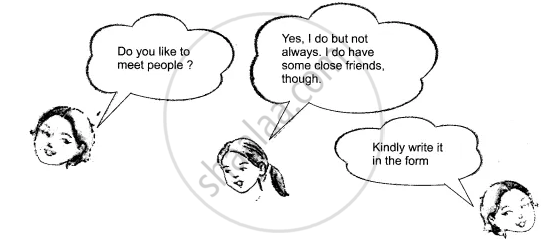
| Questions | Yes/No | Additional Response |
|
1. Do you like to meet people? |
Yes I do, but not always | I do have some close friends, though. |
|
2. Do you like the area you live in? |
No, I Don't | But I have no choice |
Find out the meaning of the following words by looking them up in the dictionary. Then use them in sentences of your own.
mystic
Choose the option that lists the sequence of events in the correct order.
- When the rain stopped, they rushed outdoors, forgetting all about Margot in their eagerness to experience the warmth of the sun.
- The children carried the pleading and protesting Margot to the closet and locked her in.
- It was then that they realised with shame that Margot was still locked in the closet; they had deprived her of what she longed for the most-the sun.
- All too soon, the brief summer ended, and the children hurried indoors to escape the heavy rains.
