Advertisements
Advertisements
Question
After reading the poem answer the following questions.
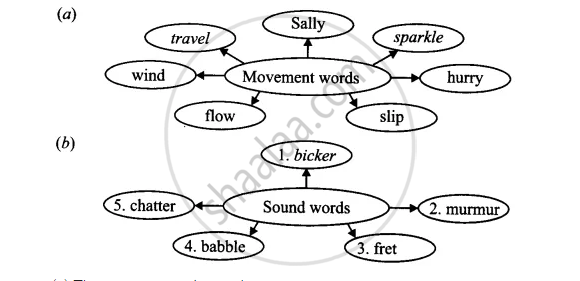
The poet has used a number of words which indicate 'movement' and 'sound'. Working
with your partner make a list of these words from the poem and complete the web chart.

(c.) A word or a combination of words, whose sound seems to resemble the sound it
denotes (for example: "hiss", "buzz", "etc.) is called onomatopoeia. From the words that
you have filled in the blurbs above point out these words.
Advertisements
Solution

(c) The onomatopoeic words are:
(i) chatter
(ii) murmur
(iii) babble
(iv) treble
APPEARS IN
RELATED QUESTIONS
Look at the words the poet uses to describe what he sees and hears at Innisfree
- Bee-loud glade
- Evenings full of the linnet’s wings
- Lake water lapping with low sounds
What pictures do these words create in your mind?
Think of an occasion when you led a team for a competition. Were you successful? Did you exhibit any of the qualities given in question 2.? If so, to what extent were these qualities exhibited and how did it lead to your success? Through an e-mail, share your experience with a friend.
Read a short story about an exemplary boss.
|
Working 12 to 18 hours a day was not uncommon for scientists at the rocket launching station, Thumba. A group of such scientists was frustrated due to the work pressure and meeting their boss's demands; however, they were loyal to him. With a jolt he remembered his promise to his children. He looked for his boss who was not in his omee. Having told him just that morning. he wrapped up his work and hurried home. |
Based on your reading of the story answer the following question by choosing the correct option:
With reference to Hooper, the author says, “Every thing was going for him”. What does it imply?
Choose extracts from the story that illustrate the characters of these people in it.
| Person character | Extracts from the story | What does it tell us about their character |
| Mrs Bramble | (Para 12) "Bill we must keep it from Harold" | She was not honest and open with her son; concerned mother |
| Mrs Bramble | (Para 33) | |
| Percy | (Para 109) | |
| Jerry Fisher | (Para 110) |
Understanding determiners.
Determiners are words that are used in front of nouns to indicate whether you are
referring to something specific or something of a particular type.
Singular nouns always need a determiner. In plural nouns, the determiner is
optional. Determiners may or may not be used with uncountable nouns depending
on context.
There are about 50 different determiners in the English language which include:
Articles: a, an, the
Possessives: my, your, our, their, his, hers, whose, etc.
Demonstratives: this, that these, those, which, etc.
Quantifiers: few, a few, many, much, each, every, some, any, etc.
Number: one, two, three, twenty, forty, etc.
Ordinals: first, second, last, next, etc.
Determiners are used
• to state the unit/ number of people, things or other nouns.
• to state possessives.
• to specify someone or something.
• to state how things or people are distributed.
• to state the difference between nouns.
Determiners can be classified under the following categories:
| EXAMPLES | ||
| MULTIPLIERS | double, twice, three times... | We want double portions. |
| FRACTIONS | half, a third, two fifths ..... | I drove at half speed. |
| INTENSIFIERS | What! Such! | Such impudence! |
| QUANTIFIERS | all, both, most | I like most people. |
| ARTICLES | a, an, the | Get a book from the shelf. |
| DEMONSTRATIVES | this, that, these, those, another, other | That tree is in another garden. |
| DISTRIBUTIVES | each, every, either, neither | I have a gift for each person. |
| POSSESSIVES | ||
| (i) PRONOMINAL | my, your, his, her, its, our, your, their | You can borrow Kim's video. |
| (ii) NOMINAL | Renata's, Adam's, People's ... | You can borrow my video. |
| INTERROGATIVES | What? Which? Whose? | Whose book is that? |
| QUANTIFIERS | some, any, no | I have no problem with them. |
| CARDINAL NUMBERS | one, two, three hundred ..... | Two heads are better than one. |
| ORDINAL NUMBERS | first, fewer, much, more, less, least ......... . | It was my first tennis match. |
| QUANTIFIERS | ||
| (i) SIMPLE | few, fewer, much, more, less, least ........... . |
I have few pals; Kim has more. |
| (ii) COMPOUND | a little, a lot of, a great deal of .... |
I have lots of time to spare. |
"My father lived at Blenheim then,
Yon little stream hard by;
They burnt his dwelling to the ground,
And he was forced to fly;
So with his wife and child he fled,
Nor had he where to rest his head.
"With fire and sword the country round
Was wasted far and wide,
And many a childing mother then,
And new-born baby died;
But things like that, you know, must be
At every famous victory;
Read the lines given above and answer the question that follow.
What happened to Kaspar’s family in the war?
'All right!' you 'll cry.'All right!' you'll say,
'But if we take the set away,
What shall we do to entertain
Our darling children?Please explain!'
We'll answer this by asking you,
'What used the darling ones to do?
'How used they keep themselves contented
Before this monster was invented?'
Have you forgotten? Don't you know?
We'll say it very loud and slow:
THEY ... USED ... TO ... READ! They'd READ and READ,
AND READ and READ, and then proceed
To READ some more. Great Scott! Gadzooks!
One half their lives was reading books!
The nursery shelves held books galore!
Books cluttered up the nursery floor!
And in the bedroom, by the bed,
More books were waiting to be read!
Read the lines given above and answer the question given below.
What should be done to keep the children occupied?
When there was a strong wind, the pine trees made sad, eerie sounds that kept most people to the main road. But Mr. Oliver was not a nervous or imaginative man. He carried a torch – and on the night I write of, its pale gleam, the batteries were running down – moved fitfully over the narrow forest path. When its flickering light fell on the figure of a boy, who was sitting alone on a rock, Mr. Oliver stopped.
Boys were not supposed to be out of school after seven P.M. and it was now well past nine. What are you doing out here, boy, asked Mr. Oliver sharply, moving closer so that he could recognize the miscreant.
Read the extract given below and answer the question that follow.
Why did Mr Oliver take the shortcut? What did he carry with him?
“Jane,” said the wheelwright, with an impressiveness of tone that greatly subdued his wife, “I read in the Bible sometimes, and find much said about little children. How the Savior rebuked the disciples who would not receive them; how he took them up in his arms, and blessed them; and how he said that ‘whosoever gave them even a cup of cold water should not go unrewarded.’ Now, it is a small thing for us to keep this poor motherless little one for a single night; to be kind to her for a single night; to make her life comfortable for a single night.”
The voice of the strong, rough man shook, and he turned his head away, so that the moisture in his eyes might not be seen. Mrs. Thompson did not answer, but a soft feeling crept into her heart.
“Look at her kindly, Jane; speak to her kindly,” said Joe. “Think of her dead mother, and the loneliness, the pain, the sorrow that must be on all her coming life.” The softness of his heart gave unwonted eloquence to his lips.
Read the extract given below and answer the question that follow.
Why does the author make the character repeat the phrase, ‘a single night’?
Suddenly all the tension seemed to ebb out of my body as the truth of what he said hit me. Confidently, I drew a line a full foot in back of the board and proceeded to jump from there. I qualified with almost a foot to spare.
That night I walked over to Luz Long’s room in the Olympic village to thank him. I knew that if it hadn’t been for him I probably wouldn’t be jumping in the finals the following day. We sat in his quarters and talked for two hours—about track and field, ourselves, the world situation, a dozen other things.
When I finally got up to leave, we both knew that a real friendship had been formed. Luz would go out to the field the next day trying to beat me if he could. But I knew that he wanted me to do my best—even if that meant my winning.
Read the extract given below and answer the question that follow.
How did Owens manage to qualify for the finals with a foot to spare?
What do you think of Antonio and of Shylock 1vi' regard to the signing of the bond?
Mention three things we can learn from the ‘tiny teacher’. Give reasons for choosing these items.
How do desert plants and animals differ from most plants and animals?
How did the other governors try to humiliate the new governor (the shepherd)?
Fill in the blank in the sentence below with the words or phrases from the box. (You may not know the meaning of all the words. Look such words up in a dictionary, or ask your teacher.)
I started early to be on time, but I was ______. There was a traffic jam!
In what respect was Miss Beam’s school different from others?
What does the child think about his/her teacher?
The words given against the sentences below can be used both as nouns and verbs. Use them appropriately to fill in the blanks.
(i) He said he _________________________ to be invited to the party. (hope)
(ii) We gave up _______________________ of his joining the party.
Read the following extract from H.W. Longfellow’s poem, ‘Haunted Houses' and answer the questions that follow:
| The stranger at my fireside cannot see The forms I see, nor hear the sounds I hear; He but perceives what is; while unto me All that has been is visible and clear. |
- What makes the poet-narrator different from the stranger at his fireside? [3]
- What, according to the poet, turns a house into a ‘haunted’ house? [3]
- Where is one likely to meet the ‘phantoms’ in a haunted house? [3]
- What are the poet-narrator’s views on owning property? [3]
- How do the poet’s views of ghosts differ from the traditional perception of ghosts? How would you describe the mood that the poem evokes? Give ONE reason for your answer. [4]