हिंदी

After Reading the Poem Answer the Following Questions. - English - Communicative

Advertisements
Advertisements

प्रश्न

After reading the poem answer the following questions.
The poet has used a number of words which indicate 'movement' and 'sound'. Working
with your partner make a list of these words from the poem and complete the web chart.

(c.) A word or a combination of words, whose sound seems to resemble the sound it
denotes (for example: "hiss", "buzz", "etc.) is called onomatopoeia. From the words that
you have filled in the blurbs above point out these words.

संक्षेप में उत्तर
टिप्पणी लिखिए
Advertisements

उत्तर
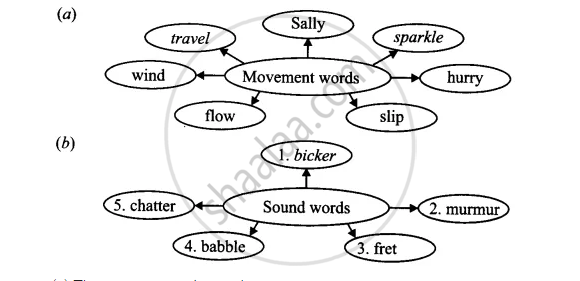
(c) The onomatopoeic words are:
(i) chatter
(ii) murmur
(iii) babble
(iv) treble

shaalaa.com
Reading
  क्या इस प्रश्न या उत्तर में कोई त्रुटि है?
अध्याय 2.1: The Brook - Exercise [पृष्ठ ५९]

APPEARS IN

सीबीएसई English Communicative - Literature Reader [English] Class 9
अध्याय 2.1 The Brook
Exercise | Q 4 | पृष्ठ ५९

संबंधित प्रश्न

Answer these question in a few words or a couple of sentence.

Had Margie ever seen a book before?


Answer these question in a few words or a couple of sentence.

What subjects did Margie and Tommy learn?


Discuss in pairs and answer question below in a short paragraph (30 − 40 words.

How did George and Harris react to this? Did Jerome like their reaction?


Thinking about the Poem

In stanza 1, find five ways in which we all are alike. Pick out the words.


The world's most famous female aviator, Amelia Earhart, disappeared in 1937, as she attempted to become the first woman to fly around the world with her navigator, Fred Noonan. She was last heard when she was around 100 miles from the tiny Pacific Howland Island on July 2, 1937. 

Read the story of her 'Final Flight'. 

On June 1, 1937 Amelia and her navigator Fred Noonan departed from Miami, Florida; bound for California. Their first destination was San Juan, Puerto Rico; from there, skirting the northeast edge of South America; and then on to Africa and the Red Sea. 

The flight to Karachi was another first. No one had previously flown non-stop from the Red Sea to India before. From Karachi, the Electra flew to Calcutta on June 17 from there on, to Rangoon, Bangkok, Singapore and Bandoeng. 

The monsoon prevented departure from Bandoeng for several days. Repairs were made on some of the 'long distance' instruments which had given trouble previously. During this time, Amelia became ill, and suffered from dysentery that lasted several days. 

It was June 27 before Amelia and Noonan were able to leave Bandoeng for Port Darwin, Australia. At Darwin, the direction finder was repaired, and the parachutes were packed and shipped home as they would be of no value over the Pacific .

Amelia reached Lae in New Guinea on June 29. At this point they had flown 22,000 miles and there were 7,000 more to go over the Pacific. Amelia cabled her last commissioned article to the Herald Tribune. Photos show her looking very tired and ill during her time at Lac.

The U.S. Coast Guard cutter, Itasca had been standing off Howland Island for some day to act as a radio contact for Amelia Radio communications in the area were very poor as Itasca was overwhelmed with commercial radio traffic that the flight had generated . 

Amelie left Lae at preciaely 00:00 hours Greenwich Mean Time on July 2 . It is believed that the Electra was loaded with 1,000 gallons of fuel , allowing for 20-21 hours of flying .
At 07:20 hours GMT Amelia provided a position report placing the Electra on course as some 20 miles southwest of the Nukumanu Islands . The last weather report Amelia was known to have received was before take-off . The head wind speed had increased by 10-12 mph, but it is not known if she ever received the report.
At 08:00 GMT Amelia made her last radio contact with Lae . she reported being on course for Howland Island at 12,000 feet . There is no real evidence as to the precise track of the aircraft after Nukumanu . No one saw or heard the plane fly over .
Several short transmissions were received by the Itasca with varying signal strengths but they were unable to get a fix on her location because they were too brief. At 19:30 GMT the following transmission was received from the Electra at maximum strength. 
"KHAQQ calling Itasca. We must be on you but cannot see you ... gas is running low ... " 

At 20: 14 GMT, the Itasca received the last voice transmission from Amelia giving positioning data. The Itasca continued to transmit on all frequencies until 21:30 hours GMT. They determined that Amelia must have died at sea and began to implement search procedures. 

It has been determined that the plane went down some 35-100 miles off the coast of Howland Island. A life raft was stowed on board but no trace was ever found of the raft. Some experts felt that the empty fuel tanks could keep the plane afloat for a period of time. 

President Roosevelt authorized a search party of 9 naval ships and 66 aircrafts at an estimated cost of over $4 million. On July 18, the search was abandoned by ships in the Howland area. George continued to seek help in the search, but by October he too abandoned all hope of finding them alive. 

Amelia had been sending letters to George at stopovers all along her route quite regularly. These were published in the book 'Last Flight'. The book has a note from her to George .... 
"Please know I am quite aware of the hazards ... I want to do it because I want to do it. Women must try to do things as men have tried. If they fail, their failure must be, but a challenge to others. " 

Amelia created a number of aviation records : 
o The first woman to fly across the Atlantic in 1928 
o The second person to fly solo across the Atlantic in 1932 
o The first person to fly solo from Hawaii to California in 1935 Guided by her publicist and husband, George Putnam, she made headlines in an era when aviation had gripped the public's imagination. 


The horse was nearly life-size, moulded out of clay, baked, burnt, and brightly coloured, and reared its head proudly, prancing its forelegs in the air and flourishing its tail in a loop; beside the horse stood a warrior with scythelike mustachios, bulging eyes, and aquiline nose. The old image-makers believed in indicating a man of strength by bulging out his eyes and sharpening his moustache tips, and also decorated the man’s chest with beads which looked today like blobs of mud through the ravages of sun and wind and rain (when it came), but Muni would insist that he had known the beads to sparkle like the nine gems at one time in his life.

Read the extract given below and answer the question that follow.

Had anyone seen the splendour of the horse?


“I love the West,” said the girl irrelevantly. Her eyes were shining softly. She looked away out the car window. She began to speak truly and simply without the gloss of style and manner: “Mamma and I spent the summer in Deliver. She went home a week ago

because father was slightly ill. I could live and be happy in the West. I think the air here agrees with me. Money isn’t everything. But people always misunderstand things and remain stupid—” “Say, Mr. Marshal,” growled the glum-faced man. “This isn’t quite fair. I’m needing a drink, and haven’t had a smoke all day. Haven’t you talked long enough? Take me in the smoker now, won’t you? I’m half dead for a pipe.”

The bound travellers rose to their feet, Easton with the Same slow smile on his face. “I can’t deny a petition for tobacco,” he said, lightly. “It’s the one friend of the unfortunate. Good-bye, Miss Fairchild. Duty calls, you know.” He held out his hand for a farewell. “It’s too bad you are not going East,” she said, reclothing herself with manner and style. “But you must go on to Leavenworth, I suppose?” “Yes,” said Easton, “I must go on to Leavenworth.”

The two men sidled down the aisle into the smoker. The two passengers in a seat near by had heard most of the conversation. Said one of them: “That marshal’s a good sort of chap. Some of these Western fellows are all right.” “Pretty young to hold an office like that, isn’t he?” asked the other. “Young!” exclaimed the first speaker, “why—Oh! didn’t you catch on? Say—did you ever know an officer to handcuff a prisoner to his right hand?”

Read the extract given below and answer the question that follow.

Why is it ironic when Fairchild says, “people always misunderstand things and remain stupid —”?


At Denver there was an influx of passengers into the coaches on the eastbound B. & M. express. In one coach there sat a very pretty young woman dressed in elegant taste and surrounded by all the luxurious comforts of an experienced traveler. Among the newcomers were two young men, one of handsome presence with a bold, frank countenance and manner; the other a ruffled, glum-faced person, heavily built and roughly dressed. The two were handcuffed together.

As they passed down the aisle of the coach the only vacant seat offered was a reversed one facing the attractive young woman. Here the linked couple seated themselves. The young woman’s glance fell upon them with a distant, swift disinterest; then with a lovely smile brightening her countenance and a tender pink tingeing her rounded cheeks, she held out a little gray-gloved hand. When she spoke her voice, full, sweet, and deliberate, proclaimed that its owner was accustomed to speak and be heard.

“Well, Mr. Easton, if you will make me speak first, 1 suppose 1 must. Don’t vou ever recognize old friends when you meet them in the West?”

The younger man roused himself sharply at the sound of her voice, seemed to struggle with a slight embarrassment which he threw off instantly, and then clasped her fingers with his left hand.

“It’s Miss Fairchild,” he said, with a smile. “I’ll ask you to excuse the other hand; “it’s otherwise engaged just at present.”

He slightly raised his right hand, bound at the wrist by the shining “bracelet” to the left one of his companion.

Read the extract given below and answer the question that follow.

Why does the author call the two men as the ‘linked couple?’


Joe did not see the Guardians of the Poor on that day, on the next, nor on the day following. In fact, he never saw them at all on Maggie’s account, for in less than a week Mrs. Joe Thompson would as soon leave thought of taking up her own abode in the almshouse as sending Maggie there.

What light and blessing did that sick and helpless child bring to the home of Joe Thompson, the poor wheelwright! It had been dark, and cold, and miserable there for a long time just because his wife had nothing to love and care for out of herself, and so became soar, irritable, ill-tempered, and self-afflicting in the desolation of her woman’s nature. Now the sweetness of that sick child, looking ever to her in love, patience, and gratitude, was as honey to her soul, and she carried her in her heart as well as in her arms, a precious burden. As for Joe Thompson, there was not a man in all the neighbourhood who drank daily of a more precious wine of life than he. An angel had come into his house, disguised as a sick, helpless, and miserable child, and filled all its dreary chambers with the sunshine of love.

Read the extract given below and answer the question that follow.

Who was the angel? Why does the author say she was disguised?


She again rubbed a match on the wall, and the light shone round her; in the brightness stood her old grandmother, clear and shining, yet mild and loving in her appearance. “Grandmother,” cried the little one, “O take me with you; I know you will go away when the match burns out; you will vanish like the warm stove, the roast goose, and the large, glorious Christmas-tree.” And she made haste to light the whole bundle of matches, for she wished to keep her grandmother there. And the matches glowed with a light that was brighter than the noon-day, and her grandmother had never appeared so large or so beautiful. She took the little girl in her arms, and they both flew upwards in brightness and joy far above the earth, where there was neither cold nor hunger nor pain, for they were with God.

In the dawn of morning there lay the poor little one, with pale cheeks and smiling mouth, leaning against the wall; she had been frozen to death on the last evening of the year; and the New-year’s sun rose and shone upon a little corpse! The child still sat, in the stiffness of death, holding the matches in her hand, one bundle of which was burnt. “She tried to warm herself,” said some. No one imagined what beautiful things she had seen, nor into what glory she had entered with her grandmother, on New-year’s day.

Read the extract given below and answer the question that follow.

What happened when she lighted another match?


It was the summer of 1936. The Olympic Games were being held in Berlin. Because Adolf Hitler childishly insisted that his performers were members of a “master race,” nationalistic feelings were at an all-time high.

I wasn’t too worried about all this. I’d trained, sweated and disciplined myself for six years, with the Games in mind. While I was going over on the boat, all I could think about was taking home one or two of those gold medals. I had my eyes especially on the running broad jump. A year before, as a sophomore at the Ohio State, I’d set the world’s record of 26 feet 8 1/4 inches. Nearly everyone expected me to win this event.

Read the extract given below and answer the question that follow.

Who is Jesse Owens?


Answer the following question.

The bear grew up but “he was a most amiable bear”. Give three examples to prove this


Who is Mridu and with whom Mridu went to Rukku Manni’s place?


Which ways did Soapy try to reach the prison in vain?


When did “the unfriendly face” of the visitor turn truly friendly?


Multiple Choice Question:

The ‘Whatif song haunts the speaker ______


Answer the following question:

How many prizes did the boy win? What were they?


The words given against the sentences below can be used both as nouns and verbs. Use them appropriately to fill in the blanks.

(i) You deserve a ________________________ on the back for your good performance. (pat)

(ii) The teacher _________________________ the child on the cheek to encourage her.


Do you think it is good to be a rebel?


Read the extract given below and answer the questions that follow:

Exceeding peace had made Ben Adhem bold,
And to the presence in the room he said,
"What writest thou?"
  1. To whom did Ben Adhem address these words? Mention the context in which he said this.        [2]
  2. What was the ‘presence’ doing in Ben Adhem’s room? What did the presence say in response to Ben Adhem’s question?      [2]
  3. What did Abou ben Adhem say after this exchange? How did the presence respond to his words?     [3]
  4. Describe the events of the following night.        [3]

Share
Notifications

Englishहिंदीमराठी


      Forgot password?
Use app×