मराठी

After Reading the Poem Answer the Following Questions. - English - Communicative

Advertisements
Advertisements

प्रश्न

After reading the poem answer the following questions.
The poet has used a number of words which indicate 'movement' and 'sound'. Working
with your partner make a list of these words from the poem and complete the web chart.

(c.) A word or a combination of words, whose sound seems to resemble the sound it
denotes (for example: "hiss", "buzz", "etc.) is called onomatopoeia. From the words that
you have filled in the blurbs above point out these words.

थोडक्यात उत्तर
टीपा लिहा
Advertisements

उत्तर
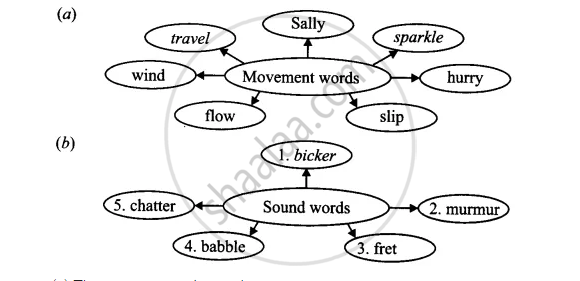
(c) The onomatopoeic words are:
(i) chatter
(ii) murmur
(iii) babble
(iv) treble

shaalaa.com
Reading
  या प्रश्नात किंवा उत्तरात काही त्रुटी आहे का?
पाठ 2.1: The Brook - Exercise [पृष्ठ ५९]

APPEARS IN

सीबीएसई English Communicative - Literature Reader [English] Class 9
पाठ 2.1 The Brook
Exercise | Q 4 | पृष्ठ ५९

संबंधित प्रश्‍न

Answer these question in 30–40 words.

Why did Bismillah Khan refuse to start a shehnai school in the U.S.A.?


Thinking about Poem

How has the tree grow to its full size? List the words suggestive of its life and activity.


Bangle sellers are we who bear
Our shining loads to the temple fair...
Who will buy these delicate, bright
Rainbow-tinted circles of light?
Lustrous tokens of radiant lives,
For happy daughters and happy wives.

Read the lines given above and answer the question that follow.

What is the tone in this stanza? Quote.


"They say it was a shocking sight
After the field was won;
For many thousand bodies here
Lay rotting in the sun;
But things like that, you know, must be 
After a famous victory.
"Great praise the Duke of Marlbro'won,
And our good Prince Eugene."
"Why,'twas a very wicked thing!"
Said little Wilhelmine.

"Nay...nay...my little girl,"quoth he,
"It was a famous victory.
"And everybody praised the Duke
Who this great fight did win."
"But what good came of it at last?"
Quoth little Peterkin.
"Why that I cannot tell,"said he,
"But 'twas a famous victory."

Read the lines given above and answer the question that follow.

How does kasper justify the thousands of death in the war?


The most important thing we've learned,
So far as children are concerned,
Is never, NEVER, NEVER let
Them near your television set-----
Or better still, just don't install
The Idiotic thing at all.
In almost every house we've been,
we've watched them gaping at the screen
They loll and slop and lounge about,
And stare until their eyes pop out.
(Last week in someone's place we saw
A dozen eyeballs on the floor.
They sit and stare and stare and sit
Until they're hypnotised by it,
Until they're absolutely drunk
With all that shocking ghastly junk.

Read the lines given above and answer the question given below. 

Explain with reference to context.


The most important thing we've learned,
So far as children are concerned,
Is never, NEVER, NEVER let
Them near your television set-----
Or better still, just don't install
The Idiotic thing at all.
In almost every house we've been,
we've watched them gaping at the screen
They loll and slop and lounge about,
And stare until their eyes pop out.
(Last week in someone's place we saw
A dozen eyeballs on the floor.
They sit and stare and stare and sit
Until they're hypnotised by it,
Until they're absolutely drunk
With all that shocking ghastly junk.

Read the lines given above and answer the question given below. 

What is the most important thing that the poet has learnt?


For oft, when on my couch I lie
In vacant or in pensive mood,
They flash upon that inward eye
Which is the bliss of solitude;
And then my heart with pleasure fills,
And dances with the daffodils.

Read the lines given above and answer the question that follow.

Explain with reference to context.


Of the seven hundred villages dotting the map of India, in which the majority of India’s five hundred million live, flourish and die, Kritam was probably the tiniest, indicated on the district survey map by a microscopic dot, the map being meant more for the revenue official out to collect tax than for the guidance of the motorist, who in any case could not hope to reach it since it sprawled far from the highway at the end of a rough track furrowed up by the iron-hooped wheels of bullock carts. But its size did not prevent its giving itself the grandiose name Kritam, which meant in Tamil coronet or crown on the brow of the subcontinent. The village consisted of fewer than thirty houses, only one of them built from brick and cement and painted a brilliant yellow and blue all over with

gorgeous carvings of gods and gargoyles on its balustrade, it was known as the Big House. The other houses, distributed in four streets, were generally of bamboo thatch, straw, mud and other unspecified material. Muni’s was the last house in the fourth street, beyond which stretched the fields. In his prosperous days Muni had owned a flock of sheep and goats and sallied forth every morning driving the flock to the highway a couple of miles away.

Read the extract given below and answer the question that follow.

Where was Muni’s house located?


What information does Gilman give to Twisden? Why did Twisden decide to withdraw from the case ? 


Why Maya called Nishad Seven?


How can you say that Abbu Khan’s goats were of the best hill breed?


Narrate the story of the friendship between the monkey and the crocodile in about 80 words.


Who made the pact with the sun? What was it about?


“Trees are to make no shade in winter.” What does this mean? (Contrast this line with the line immediately before it.)


Use the clues given below to complete this crossword puzzle.

Across

1. very tired
2. had an angry look on the face
3. short trousers
4. a fault in a machine that prevents it from working properly
5. a small and naughty boy-fairy

Down

6. work that must be done every day, often boring
7. a basket with a lid
8. gave a short, high-pitched cry


Make noun from the word given below by adding –ness, ity, ty or y 
Sincere ___________.


Answer the following question.

How do mongooses kill snakes?


How did the old aunt get justice?


Why does the rebel choose to Wear fantastic Clothes?


Read the following extract from T.S. Arthur's short story. 'An Angel in Disguise' and answer the questions that follow:

"What is to be done with the children?' That was the chief questions now. The dead mother would go underground and be forever beyond all care or concern of the villagers. But the children must not be left to starve.
  1. Describe the way in which the children's mother died.
    What are the factors that led to her death? [3]
  2. How do the people of the village treat the woman before her death?
    How does their manner change after she dies?
    What does their behaviour tell us about human nature? [3]
  3. Name the woman's three children.
    State one fact about each of them that the author mentions at the very beginning of the story. [3]
  4. What happens to each of the children after the mother's funeral? [3]
  5. Which of the three children can be considered the 'Angel in Disguise'?
    What does the term 'disguise' refer to in the context of this story?
    How does the child's arrival transform the home she enters? [4]

Share
Notifications

Englishहिंदीमराठी


      Forgot password?
Use app×