Advertisements
Chapters
F.1: How I Taught My Grandmother to Read
F.2: A Dog Named Duke
F.3: The Man Who Knew Too Much
F.4: Keeping lt from Harold
F.5: Best Seller
POETRY
▶ P.1: The Brook
P.2: The Road Not Taken
P.3: The Solitary Reaper
P.4: The Seven Ages
P.5: Oh, I Wish I'd Looked After Me Teeth
P.6: Song of The Rain
DRAMA
D.1: Villa for Sale
D.2: The Bishop's Candlesticks
Advertisements
Solutions for Chapter P.1: The Brook
Below listed, you can find solutions for Chapter P.1 of CBSE CBSE for इंग्लिश लिटरेचर रीडर कक्षा ९.
CBSE solutions for इंग्लिश लिटरेचर रीडर कक्षा ९ P.1 The Brook Exercise [Pages 63 - 70]
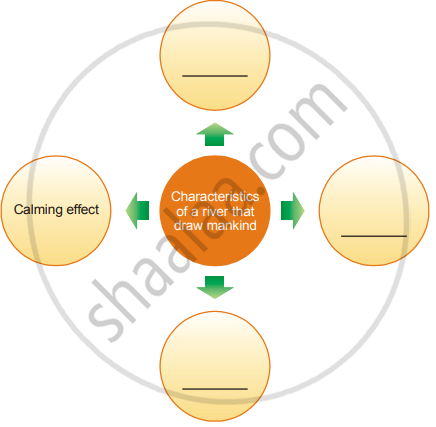
Since centuries, human beings have always been drawn to rivers, streams and other natural sources of water. Can you think of some characteristics of a river that make it fascinating to mankind?
Here is a list of a few things. Can you tell how long each of them can live /exist?
(a) a dog
(b) an elephant
(c) a tree
(d) a human being
(e) a star
(f) a mountain
(g) a river
The poem is about a brook. A dictionary would define a brook, as a stream or a
small river. Read the poem silently first. After the first reading, the teacher will
make you listen to a recording of the poem. What do you think the poem is all
about?
I come from haunts of coot and hern;
I make a sudden sally
And sparkle out among the fern,
To bicker down a valley.
By thirty hills I hurry down,
Or slip between the ridges,
By twenty thorpes, a little town,
And half a hundred bridges.
Till last by Philip's farm I flow
10 To join the brimming river,
For men may come and men may go,
But I go on for ever.
I chatter over stony ways,
In little sharps and trebles,
15 I bubble into eddying bays,
I babble on the pebbles.
With many a curve my banks I fret
By many a field and fallow,
And many a fairy foreland set
20 With willow-weed and mallow.
I chatter, chatter, as I flow
To join the brimming river,
For men may come and men may go,
But I go on for ever.
25 I wind about, and in and out,
With here a blossom sailing,
And here and there a lusty trout,
And here and there a grayling,
And here and there a foamy flake
30 Upon me, as I travel
With many a silvery waterbreak
Above the golden gravel,
And draw them all along, and flow
To join the brimming river
35 For men may come and men may go,
But I go on for ever.
I steal by lawns and grassy plots,
I slide by hazel covers
I move the sweet forget-me-nots
40 That grow for happy lovers.
I slip, I slide, I gloom, I glance,
Among my skimming swallows;
I make the netted sunbeam dance
Against my sandy shallows.
45 I murmur under moon and stars
In brambly wildernesses;
I linger by my shingly bars;
I loiter round my cresses;
And out again I curve and flow
50 To join the brimming river,
For men may come and men may go,
But I go on for ever.
About the Poet
Lord Tennyson (1809-92) was born in Lincolnshire. Poet Laureate for over 40 years, Tennyson is representative of the Victorian age. His skilled craftsmanship and noble ideals retained a large audience for poetry in an age when the novel was engrossing more and more readers. Tennyson's real contribution lies in his shorter poems like The Lady of Shallot, The Princess, Ulysses, The Palace of Art etc. His fame rests on his perfect control of sound, the synthesis of sound and meaning, and the union of visual and musical.
After reading the poem answer the following questions.
The poet has used a number of words which indicate 'movement' and 'sound'. Working
with your partner make a list of these words from the poem and complete the web chart.

(c.) A word or a combination of words, whose sound seems to resemble the sound it
denotes (for example: "hiss", "buzz", "etc.) is called onomatopoeia. From the words that
you have filled in the blurbs above point out these words.
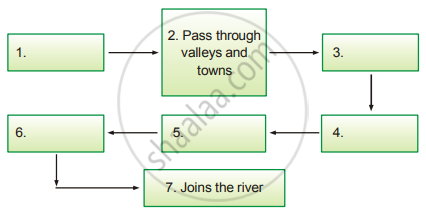
The following is a flow chart showing the course of the brook. Can you fill in the blank spaces with help from the phrases given below?
|
On the basis of your understanding of the poem, answer the following questions by ticking the correct choice.
On the basis of your understanding of the poem, answer the following questions
by ticking the correct choice.
The message of the poem is that the life of a brook is ___________.
temporary
short-lived
eternal
momentary
On the basis of your understanding of the poem, answer the following questions
by ticking the correct choice.
The poet draws a parallelism between the journey of the brook with ___________.
the life of a man
the death of man
the difficulties in a man’s life
the endless talking of human beings
In the poem, the below mentioned lines suggest that ______.
“And here and there a lusty trout,
And here and there a grayling”
the brook is a source of life.
people enjoy the brook.
fishes survive because of water.
the brook witnesses all kinds of scenes.
Select the option that matches the given words/phrases with the appropriate literary device used by the poet.
| Words | Literary Device |
| i) Chatter; Babble; Murmur | 1. Alliteration - the occurrence of the same letter or sound at the beginning of adjacent or closely connected words |
| ii) Men may come and men may go but I go on forever | 2. Onomatopoeia - the formation of a word from a sound associated with what is named |
| iii) fairly foreland; with willow seed; foamy flake; golden gravel | 3. Inversion - reversal of the normal order of the words and phrases in a sentence |
| 4. Refrain - a word, line or phrase that is repeated within the lines or stanzas of the poem itself. |
i - 2, ii - 1, iii - 4
i - 4, ii - 2, iii - 3
i - 2, ii - 4, iii - 1
i - 1, ii - 2, iii - 3
The first-person narration of the brook allows the reader to ______.
appreciate Tennyson’s use of symbols.
realize the ultimate goal of the brook.
experience the soothing effect of the sound of water.
understand the brook’s experience as a living organism.
Read the given extract and answer the questions that follow by selecting the correct options.
| With many a curve my banks I fret By many a field and fallow, And many a fairy foreland set With willow-weed and mallow. |
(i) Choose the option that best describes the brook’s journey in the given stanza. It is a journey full of ______.
- comfort and luxury
- trials and tribulations
- sorrow and misery
- joy and laughter
(ii) The poet has used the pronoun ‘I’ to refer to the brook and thus employed a literary device in his depiction. Choose the option that uses the same literary device as used in the first line.
- The magnitude of the bottomless ocean was divine.
- The angry walls echoed his fury.
- A mother is like a lioness protecting her cubs.
- I felt the power of the gushing stream.
(iii) The brook seems to be fretting in the given stanza. This word has been used by the poet to depict the ______ of the flowing brook.
- force
- kindness
- silence
- beauty
Read the given extract and answer the questions that follow by selecting the correct options.
| I linger by my shingly bars; I loiter round my cresses; And out again I curve and flow To join the brimming river, For men may come and men may go, But I go on forever |
(i) Choose the option that includes words that best describe the characteristics of the brook, as revealed in the given extract.
- perpetual
- silent
- twisted
- unbound
- interrupted
- 1, 3 and 4
- 1, 2, 4 and 5
- 1, 2, and 3
- 1, 2 and 4
(ii) The line, ‘men may come and men may go’ ______.
- mocks the shortness of the brook’s life as it goes through its journey.
- highlights the eternal nature of human life as opposed to its own.
- contrasts the eternal nature of brook against short-lived human life-span.
- highlights the eternal story of men that the brook comes across during its journey.
(iii) What do the words, ‘linger and loiter’ show about the brook?
- Its continuity
- Its slow movement
- Its powerful force
- Its ultimate purpose
Answer the following questions.
Why does the brook ‘sparkle’?
Answer the following questions:
Bicker’ means ‘to quarrel’. Why does the poet use this word here?
Answer the following questions:
Why has the word ‘chatter’ been repeated in the poem?
Answer the following questions: ‘
I wind about, and in and out’. What kind of a picture does this line create in your mind?
Answer the following questions:
What does the poet want to convey by using the words ‘steal’ and ‘slide’?
Answer the following questions:
‘I make the netted sunbeam dance’. What does ‘the netted sunbeam’ mean? How does it dance?
Answer the following question.
What is a 'refrain' in a poem? What effect does it create?
Why has the poet used the word ‘brimming’ in the line, to join the brimming river?
Identify the rhyme scheme of the poem.
The poem is full of images that come alive through skilful use of words. Describe
any two images that appeal to you the most, quoting the lines from the poem.
The brook appears to be a symbol for life. Pick out examples of parallelism
between life and the brook from the poem.
This poem describes the journey of a stream from its place of origin to the river that it joins. The poem has been written in the form of an autobiography where the brook relates its experiences as it flows towards the river. In Literature, such a device by which an inanimate object is made to appear as a living creature is called Personification. Just as the brook has been personified in this poem, write a poem on any inanimate object making it come alive. You could begin with a poem of 6-8 lines. The poem should have a message. Maintain a rhyme scheme. Try and include similes, metaphors, alliteration etc. to enhance the beauty of the poem. You could write a poem on objects such as a candle/a tree/a rock/a desert etc.
Solutions for P.1: The Brook
CBSE solutions for इंग्लिश लिटरेचर रीडर कक्षा ९ chapter P.1 - The Brook
Shaalaa.com has the CBSE Mathematics इंग्लिश लिटरेचर रीडर कक्षा ९ CBSE solutions in a manner that help students grasp basic concepts better and faster. The detailed, step-by-step solutions will help you understand the concepts better and clarify any confusion. CBSE solutions for Mathematics इंग्लिश लिटरेचर रीडर कक्षा ९ CBSE P.1 (The Brook) include all questions with answers and detailed explanations. This will clear students' doubts about questions and improve their application skills while preparing for board exams.
Further, we at Shaalaa.com provide such solutions so students can prepare for written exams. CBSE textbook solutions can be a core help for self-study and provide excellent self-help guidance for students.
Concepts covered in इंग्लिश लिटरेचर रीडर कक्षा ९ chapter P.1 The Brook are .
Using CBSE इंग्लिश लिटरेचर रीडर कक्षा ९ solutions The Brook exercise by students is an easy way to prepare for the exams, as they involve solutions arranged chapter-wise and also page-wise. The questions involved in CBSE Solutions are essential questions that can be asked in the final exam. Maximum CBSE इंग्लिश लिटरेचर रीडर कक्षा ९ students prefer CBSE Textbook Solutions to score more in exams.
Get the free view of Chapter P.1, The Brook इंग्लिश लिटरेचर रीडर कक्षा ९ additional questions for Mathematics इंग्लिश लिटरेचर रीडर कक्षा ९ CBSE, and you can use Shaalaa.com to keep it handy for your exam preparation.
