Advertisements
Advertisements
Question
Read the lines in which the following phrases occur. Then discuss with your partner the meaning of each phrase in its context.
fuzzy head
Advertisements
Solution
Fuzzy head refers to the heads of the bright yellow flowers which have a beautiful texture.
RELATED QUESTIONS
Tick the right answer.
When we take to something, we find it (boring/interesting).
While packing the hamper, George and Harris do a number of foolish and funny thing. Tick the statements that are true.
(i) They started with breaking a cup.
(ii) They also broke a plate.
(iii) They squashed a tomato.
(iv) They trod on the butter.
(v) They stepped on a banana.
(vi) They put things behind them, and couldn’t find them.
(vii) They stepped on things.
(viii) They packed the pictures at the bottom and put heavy things on top.
(ix) They upset almost everything.
(x) They were very good at packing.
Discuss in group and answer the following question in two or three paragraphs (100
−150 words)
Of the three, Jerome, George and Harris, who do you think is the best or worst packer?
Support your answer with details from the text.
Answer these question in one or two sentences. (The paragraph numbers within brackets provide clues to the answer.)
Why was the ‘holy man’ who gave Santosh’s mother his blessings surprised?
Now read the poem.
Behold her, single in the field,
Yon solitary Highland Lass!
Reaping and singing by herself;
Stop here, or gently pass!
Alone she cuts, and binds the grain,
And sings a melancholy strain;
O listen! for the vale profound
Is overflowing with the sound.
No nightingale did ever chant
More welcome notes to weary bands
Of travellers in some shady haunt.
Among Arabian Sands
A voice so thrilling ne' er was heard
In spring-time from the cuckoo-bird,
Breaking the silence of the seas
Among the farthest Hebrides.
Will no one tell me what she sings?
Perhaps the plaintive numbers flow
For old, unhappy, far-off things,
And battles long ago:
Or is it some more humble lay,
Familiar matter of to-day ?
Same natural sorrow, loss, or pain,
that has been, and may be again ?
Whate'er the theme, the maiden sang
As if her song could have no ending;
I saw her singing at her work,
And o'er the sickle bending;
I listen'd, motionless and still;
And, as I mounted up the hill,
The music in my heart I bore,
Long after it was heard no more.
About the Poet
William Wordsworth was born on 7th April 1770, in Cockermouth in the Lake District,
England. When many poets still wrote about ancient heroes in their grandiloquent
style, Wordsworth focused on nature, children, the poor, common people and used
ordinary words to express his feelings. He defined poetry as "the spontaneous
overflow of powerful feelings" arising from "emotions recollected in tranquility". He
died at Rydal Mount on April 23, 1850.
Read the following passage on New Zealand.
New Zealand is a Mecca for nature lovers. Throughout most of New Zealand's geological history, it was a bird's paradise. The islands were once part of the southern super - continent Gondwana from which they broke off around 80 million years ago before mammals had evolved and spread.
(courtesy: Terra Green Sept 2008 issue 06)
The underlined words express a relationship usually of space or time between the words with which they stand. Such 'Positional' words which are used before nouns (pre-position) are called prepositions.

It was a summer evening,
Old Kaspar's work was done,
And he before his cottage door
Was sitting in the sun,
And by him sported on the green
His little grandchild Wilhelmine.
She saw her brother Peterkin
Roll something large and round,
Which he beside the rivulet
In playing there had found;
He came to ask what he had found,
That was so large, and smooth, and round.
Read the lines given above and answer the question that follow.
What was Peterkin doing?
This woman had been despised, scoffed at, and angrily denounced by nearly every man, woman, and child in the village; but now, as the fact of, her death was passed from lip to lip, in subdued tones, pity took the place of anger, and sorrow of denunciation.
Neighbours went hastily to the old tumble-down hut, in which she had secured little more than a place of shelter from summer heats and winter cold: some with grave-clothes for a decent interment of the body; and some with food for the half-starving children, three in number. Of these, John, the oldest, a boy of twelve, was a stout lad, able to earn his living with any farmer. Kate, between ten and eleven, was bright, active girl, out of whom something clever might be made, if in good hands; but poor little Maggie, the youngest, was hopelessly diseased. Two years before a fall from a window had injured her spine, and she had not been able to leave her bed since, except when lifted in the arms of her mother.
“What is to be done with the children?” That was the chief question now. The dead mother would go underground, and be forever beyond all care or concern of the villagers. But the children must not be left to starve.
Read the extract given below and answer the question that follow.
Describe the three children.
“Jane,” said the wheelwright, with an impressiveness of tone that greatly subdued his wife, “I read in the Bible sometimes, and find much said about little children. How the Savior rebuked the disciples who would not receive them; how he took them up in his arms, and blessed them; and how he said that ‘whosoever gave them even a cup of cold water should not go unrewarded.’ Now, it is a small thing for us to keep this poor motherless little one for a single night; to be kind to her for a single night; to make her life comfortable for a single night.”
The voice of the strong, rough man shook, and he turned his head away, so that the moisture in his eyes might not be seen. Mrs. Thompson did not answer, but a soft feeling crept into her heart.
“Look at her kindly, Jane; speak to her kindly,” said Joe. “Think of her dead mother, and the loneliness, the pain, the sorrow that must be on all her coming life.” The softness of his heart gave unwonted eloquence to his lips.
Read the extract given below and answer the question that follow.
What did Joe say to his wife?
What message did the old clocks spread as they chimed ‘Merry Christmas’ together?
Why has sleep been called a wonder?
Who was Vijay Singh? What did he look like?
With the help of your partner, try to rewrite some lines in the poem, or add new ones of your own as in the following examples.
Trees are for birds to build nests in. Trees are for people to sit under.
Now try to compose a similar poem about water, or air
There are twelve words hidden in this table. Six can be found horizontally and the remaining six vertically. All of them are describing words like ‘good’, ‘happy’, etc. The first letters of the words are given below:
Horizontal: H R F F S G
Vertical: A W S F L Q 2020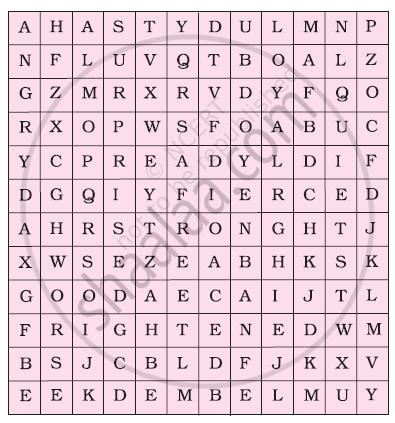
Multiple Choice Question:
Why does the flier have to run?
Read the newspaper report to find the following facts about Columbia’s ill-fated voyage.
Height at which it lost contact: ____________
What activities are dear to little children? Who does the child envy and why in the poem Vocation?
Why did the author order so many pairs of boots? Did he really need them?
In the poem, We are the Music Makers, what are the 'sea-breakers'?
When do you have flashes of sympathy and admiration for Lady Macbeth in the course of the play? Explain by citing examples from the Acts studied. Write your answer in about 200-250 words.
