Advertisements
Advertisements
Question
If the displacement of an object is proportional to the square of time, then the object is moving with :
Options
uniform velocity
uniform acceleration
increasing acceleration
decreasing acceleration
Advertisements
Solution
uniform acceleration
We are given with the relationship that,
x = kt2
Differentiating it twice we get,
v = 2kt
a = 2k
Where,
v - velocity
a - acceleration
So, the answer is
(b) Uniform acceleration
RELATED QUESTIONS
State whether distance is a scalar or a vector quantity.
Under what conditions can a body travel a certain distance and yet its resultant displacement be zero ?
Fill in the following blank with suitable word :
Displacement is a…………………… quantity whereas distance is a………………………….
Draw a velocity-time graph for a body moving with an initial velocity u and uniform acceleration a. Use this graph to find the distance travelled by the body in time t.
Figure given below shows a velocity-time graph for a car starting from rest. The graph has three parts AB, BC and CD.
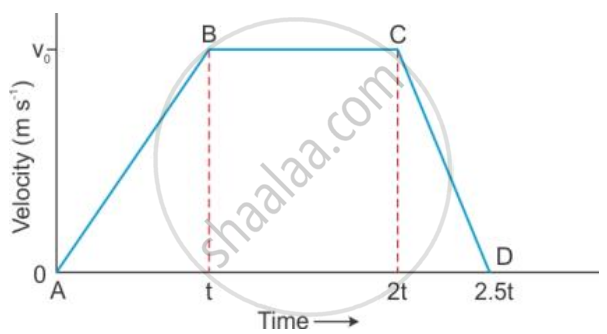
State how is the distance travelled in any part determined from this graph .
Give an example of a body which covers a certain distance, but its displacement is zero.
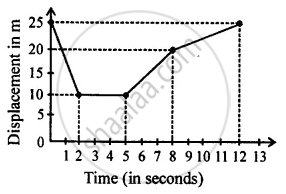
From the displacement – time graph shown given below calculate :
- Velocity between 0 – 2 s.
- Velocity between 8 s – 12 s.
- Average velocity between 5 s – 12 s.
The graph shows how the velocity of a scooter varies with time in 50 s.
Work out: The distance traveled in 10 s, 20 s, and 50 s.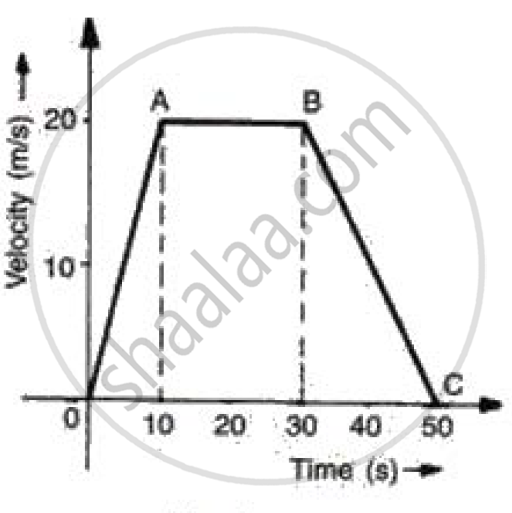
The table below shows the distance travelled by two vehicles A and B during each second:
| Time (s) | 0 | 1 | 2 | 3 | 4 | 5 | 6 | 7 |
| Distance travelled by A (m) | 0 | 20 | 80 | 180 | 240 | 300 | 360 | 420 |
| Distance travelled by B (m) | 0 | 10 | 40 | 90 | 160 | 250 | 360 | 490 |
Which vehicle is moving with uniform velocity?
Assertion: Displacement of a body may be zero when distance travelled by it is not zero.
Reason: The displacement is the shortest distance between initial and final position.
