Advertisements
Advertisements
Question
From the diagram given below. answer the question that follows:
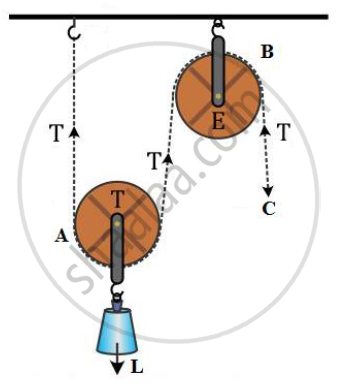
- What kind of pulleys are A and B?
- State the purpose of pulley B.
- What effort has to be applied at C just raise the load L = 20 kgf?
(Neglect the weight of pulley A and friction)
Advertisements
Solution
1) Pulley A is a movable pulley, as it moves upward along with the load. Pulley B is a fixed pulley, as its axle is attached to the support.
2) The purpose of pulley B is to change the direction of the effort, allowing the effort to be applied conveniently downwards at point C.
3) The load is supported by two segments of the string, each exerting tension T:
L = 2T
20 = 2 T
T = 10 kgf
Since:
E = T
E = 10 kgf
Therefore, an effort of 10 kgf downward at C is required to just raise the load.
RELATED QUESTIONS
What is the justification for using the pulley then ?
Differentiate between a single fixed pulley and a single movable pulley.
Give reason for the following:
In case of a block and tackle arrangement, the mechanical advantage increases with the increase in the number of pulleys.
A type of single pulley is very often used as a machine even though it does not give any gain in mechanical advantage. For what purpose is such a pulley used?
Draw the diagram of a single movable pulley and obtain its mechanical advantage, velocity ratio, and efficiency.
A ‘block and tackle’ system used 3 pulleys in the lower block and 4 pulleys in the upper block. What is the ‘velocity ratio’ of this system? If the load is to be lifted by a person capable of applying a maximum effort of 1000 N, what is the maximum load than can be lifted under ideal conditions?
The actual maximum load that gets lifted turns out to be 6300 N. What are the values of the actual M.A. and efficiency of the set-up?
_______ is a machine made up of wheel and rope.
| Meera chose to use a block and tackle system of '9' pulleys instead of a single movable pulley to lift a heavy load. |
Why should she connect more number of pulleys in the upper fixed block?
