From the diagram given below. answer the question that follows: (1) What kind of pulleys are A and B? (2) State the purpose of pulley B.
Advertisements
प्रश्न
From the diagram given below. answer the question that follows:
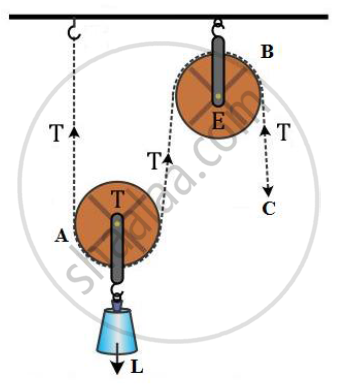
- What kind of pulleys are A and B?
- State the purpose of pulley B.
- What effort has to be applied at C just raise the load L = 20 kgf?
(Neglect the weight of pulley A and friction)
Advertisements
उत्तर
1) Pulley A is a movable pulley, as it moves upward along with the load. Pulley B is a fixed pulley, as its axle is attached to the support.
2) The purpose of pulley B is to change the direction of the effort, allowing the effort to be applied conveniently downwards at point C.
3) The load is supported by two segments of the string, each exerting tension T:
L = 2T
20 = 2 T
T = 10 kgf
Since:
E = T
E = 10 kgf
Therefore, an effort of 10 kgf downward at C is required to just raise the load.
संबंधित प्रश्न
A block and tackle system has V.R. = 5.
Rohan exerts a pull of 150 kgf. What is the maximum load he can raise with this pulley system if its efficiency = 75%?
Draw a neat labelled diagram showing a pulley being used to lift a load. How are load and effort related in an ideal situation?
Answer the following in detail.
How does a pulley make work simpler?
Name a machine to change the direction of force.
In a gear system, the gear ration of the driving wheel A and driven wheel B is 10:1. To rotate the driven wheel B in the direction of driving wheel A, the driving wheel A is engaged with other wheel C. what should be the gear ratio of the wheels A and C?
Name the type of single pulley that can act as a force multiplier. Draw a labelled diagram of the pulley mentioned by you.
A block and tackle pulley system has a velocity ratio 5. Draw a labelled diagram of this system. In your diagram, indicate clearly the points of application and the directions of the load and effort.
A pulley system has a velocity ratio 3. Draw a diagram showing the point of application and direction of load (L), effort (E) and tension (T). It lifts a load of 150 N by an effort of 60 N. Calculate its mechanical advantage. Is the pulley system ideal? Give reason.
Draw a diagram showing a block and tackle system of 4 pulleys.

(i) State, how many strands of tackle support the load?
(ii) Draw arrows to represent tension in each strand.
(iii) Find the mechanical advantage of the system, stating the assumptions made.
(iv) If the load is pulled up by a distance 1m, how much does the effort end move?
Diagram given below shows an arrangement of four pulleys. A load L is attached to the movable lower block and effort E is applied at the free end of the string.
Copy the diagram; and

(i) Draw arrows to indicate tension in each part of the string; and
(ii) Calculate the mechanical advantage of the system.
